Lawmakers share Medicaid CHILD Waiver program concerns
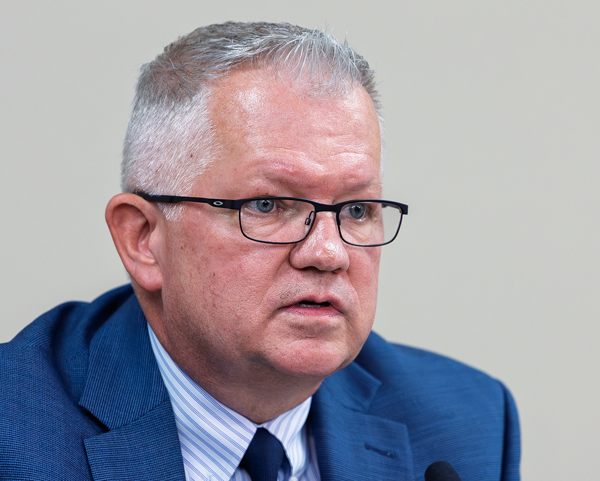
Committee co-chair Sen. Danny Carroll, R-Paducah, shares his concerns with how the Medicaid CHILD Waiver is being applied during Wednesday’s Interim Joint Committee on Families and Children meeting. A high-resolution photo can be found here.
FRANKFORT — Some Kentucky lawmakers say they have concerns about an upcoming Medicaid waiver program originally intended for youth with severe disabilities.
Committee co-chair Sen. Danny Carroll, R-Paducah, told the Interim Joint Committee on Families and Children on Wednesday that he believes the upcoming waiver program will not be implemented correctly.
“Now, there have been a lot of discussions that the waiver that has been formulated and proposed is not what the legislature asked for,” Carroll said.
In the 2024-26 biennial budget, the general assembly appropriated $4.2 million in state funds and $10.5 million in federal funds to develop a new Home and Community Based Services 1915(c) waiver, which is now known as the Community Health for Improved Lives and Development (CHILD) Waiver, Carroll said.
“It was meant to serve children who were basically on the Michelle P. Waiver and to move those kids to the CHILD Waiver to free up waiver slots for adults,” Carroll added.
Carroll told the committee it’s a “hard conversation to have” because the alternate program – proposed by the Cabinet for Health and Family Services – will still be serving a population of children in serious need of specialized care.
Dr. Leslie Hoffman, the deputy commissioner for the state Department of Medicaid Services, said the cabinet is asking the Centers for Medicare and Medicaid to approve a plan to use the CHILD Waiver for children ages 0 to 21 with significant behavioral health or developmental needs.
Officials are focusing on children and youth with the most complex needs, “the very acute of very acute children,” Hoffman said. “We are focusing on children and youth that are stepping out of acute psychiatric inpatient care such as a PRTF or an at-risk out-of-home placement due to requiring intensive behavioral health and residential supports.”
Lesa Dennis, the commissioner for the state Department of Community Based Services, said a growing number of children need this type of service.
In 2023, there were 60 youth who spent more than 90 consecutive days in inpatient psychiatric care. In 2024, that number rose to 379 youth, Dennis said.
“The existing system of care lacks the capacity and range to support children and youth with complex needs, which has resulted in delays in discharge from inpatient psychiatric hospitals…,” Dennis told the committee.
Dennis said these children are known to have a history of trauma and severe mental health diagnoses such as depression and psychosis. Others have substance abuse disorder. Many of these children are also in-and-out of foster care and the juvenile justice system.
Dr. Katie Marks, the commissioner for the state Department for Behavioral Health, Developmental and Intellectual Disabilities, told the committee the CHILD Waiver will use a standardized, needs-based assessment to determine eligibility.
An individualized service plan and care coordination would be created for those who qualify for the estimated 100 available slots.
Carroll asked the cabinet how the decision was made for the CHILD Waiver to be used for this population of children.
“The language in House Bill 6 was fairly clear,” Carroll said. “Again, these are both populations that I and many others advocate for very, very strongly. But it is clear that this waiver was meant to serve a different population.”
Hoffman told Carroll that the cabinet is seeking to serve a high needs population and is attempting to do that with the funding and parameters provided.
Rep. Rachel Roarx, D-Louisville, said the proposed waiver is “undoubtedly” addressing a need, but she is also concerned the waiver is not being applied correctly.
“I share with the chairman that this doesn’t really get to the heart of cutting down our waiver waitlist crisis,” Roarx said. “We have thousands of folks that are on that waitlist, waiting for services who can’t get it, families who can’t go to work because they’re taking care of loved ones in these situations.”
Senate Majority Caucus Chair Robby Mills, R-Henderson, asked the cabinet how the general assembly should word future legislation on the issue.
“Since we’re thinking and heading into another budget cycle, if we were wanting to remove more children from the waiver backlog, what should the wording be in our budget document…?” Mills said.
Marks said the cabinet would be happy to co-create something with the legislature on that issue.
The next Interim Joint Committee on Families and Children meeting is scheduled for 1 p.m. on Aug. 27.