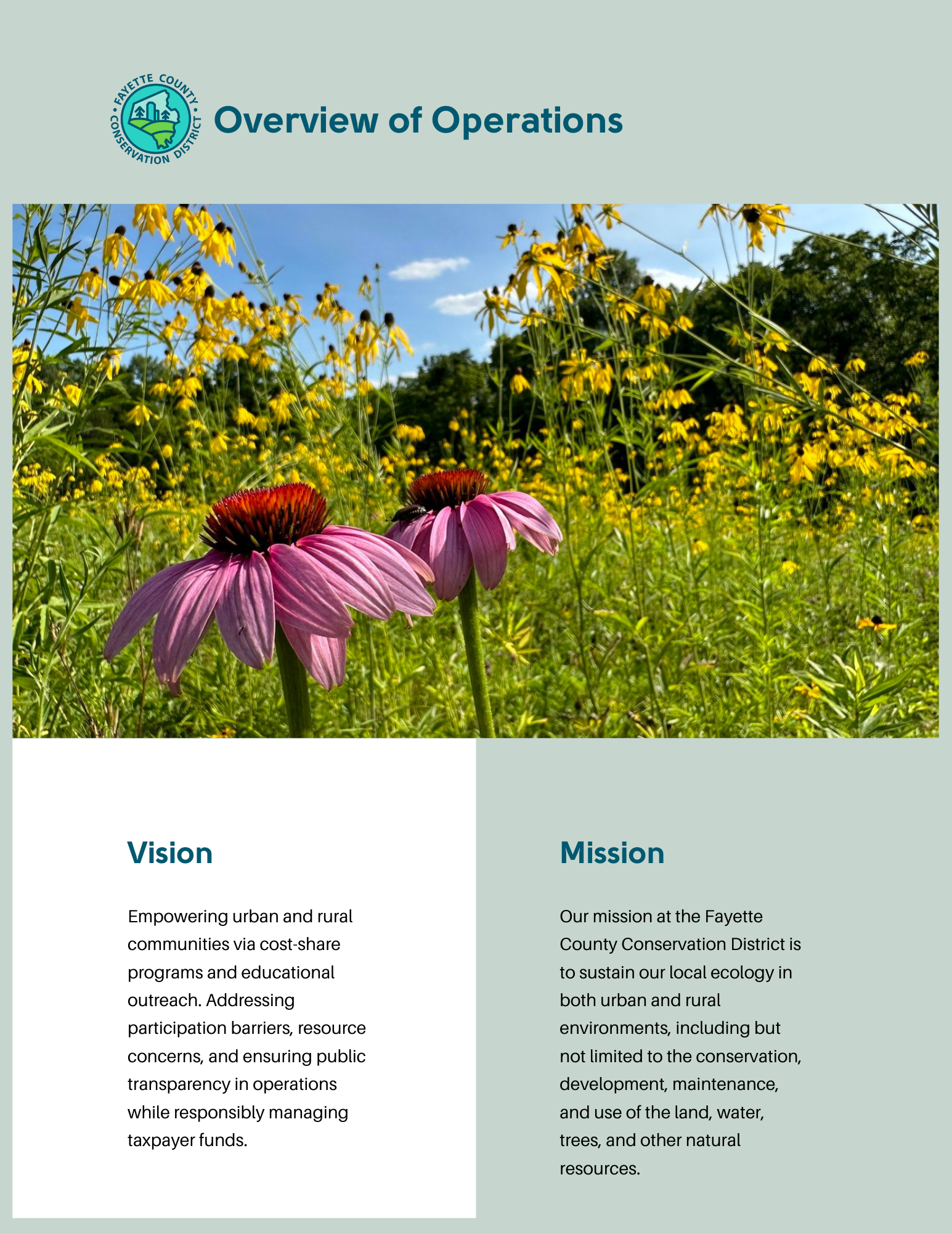
Lexington, Ky. – The Fayette County Conservation District says it delivered a bigger slice of its resources to city residents last year while keeping long-standing support for farmers — a shift that could shape how the district spends tax dollars and tobacco settlement funds going forward. The district’s new annual report cites a $1.2 million total economic impact, record completion rates on cost-share projects, and a sharp rise in urban conservation work, setting the stage for questions about priorities, transparency and future funding.
Director Heather Silvanik writes that FCCD “leaned into the demand for program support and guidance,” adding a fall Backyard Conservation session, a precision agriculture class, and organic-matter testing to soil vouchers. Approved projects “are being completed at the highest rate we’ve seen,” the report notes, a data point likely to bolster arguments for expanding cost-share dollars.
Among the headline numbers: 69% of revenue went straight back to taxpayers through cost-share and education; the average cost-share rate across programs was 33%; and project completion reached 89%. The district counted a $362,682 LFUCG millage allocation — a tiny fraction of the property tax that funds FCCD — plus $237,237 in intergovernmental revenue, primarily from the Kentucky Agricultural Development Board and the state Division of Conservation. Operational spending totaled $195,648, with $345,789 distributed via cost-share and $69,146 for education.
Potential flashpoints
- Urban tilt, rural backbone: More than half of soil samples were analyzed in urban areas, and the Backyard Conservation Program logged 288 participants completing 627 projects — from 178 raised beds and 93 pollinator gardens to 32 rain gardens and 24 compost systems. At the same time, 63 agricultural producers completed 89 diversification projects through CAIP, planting 795 acres of cover crops, building 7,200 square feet of heavy-use areas, and disposing of dead livestock through a district program. Expect debate over whether the urban shift is right-sized — and whether farm support is keeping pace.
- Public dollars, private lands: With cost-share reimbursements rising and more applicants investing beyond required matches, council members and taxpayers may probe how the district verifies outcomes, what’s driving higher completion rates, and whether equity considerations guide awards across Lexington neighborhoods and farm sectors.
- What’s next — agroforestry and federal asks: Looking to FY 2026, FCCD plans to elevate agroforestry, seek federal support, and build a farmer network for best-practice sharing — ambitions that could require new partnerships and recurring operating money. The report also points to stepped-up outreach around Soil & Water Supervisor elections, a perennial transparency issue.
Why it matters
FCCD is a small agency with outsized reach: it helps homeowners cut runoff and boost tree canopy, and it underwrites practices like cover crops that protect water quality and soil on the county’s working lands. The report suggests momentum on both fronts — but also raises policy questions about the right balance of urban vs. rural investments, the sustainability of education grants and scholarships, and whether current millage levels match demand for services.
What to watch for during the meeting
- Budget alignment: Whether board members or city liaisons push for changes in the split among cost-share, education and operations based on the year’s outcomes.
- Program targeting: Discussion of ranking criteria for grants and vouchers, including first-time applicant preferences and geographic distribution.
- Metrics and audits: Requests for more granular reporting on project durability, water-quality benefits, and verification of private-land improvements funded with public dollars.
- Agroforestry roadmap: Timelines, partner roles, and the scale of any federal funding request.
Background highlights from the report
- Revenues: $362,682 from LFUCG millage; $237,237 in intergovernmental funds; $10,749 in equipment-rental income; $5,252 in other revenue.
- Spending: $345,789 cost-share; $195,648 operations; $69,146 education and outreach.
- Education impact: $36,455 awarded to 21 projects via the Conservation & Education Grant; $12,500 in seasonal scholarships to 10 students; $1,000 for Jim Claypool Art & Writing winners and teachers; outreach to 6,000+ people at 80 tabling/education events.
How to participate: Public meetings of the Conservation District and its Board of Supervisors are open under Kentucky’s Open Meetings Act. Members of the public typically may attend in person and may be offered a public comment period, depending on the agenda. Confirm the specifics with FCCD staff before you go.