Legislators hear from tourism officials on jobs, tax revenue
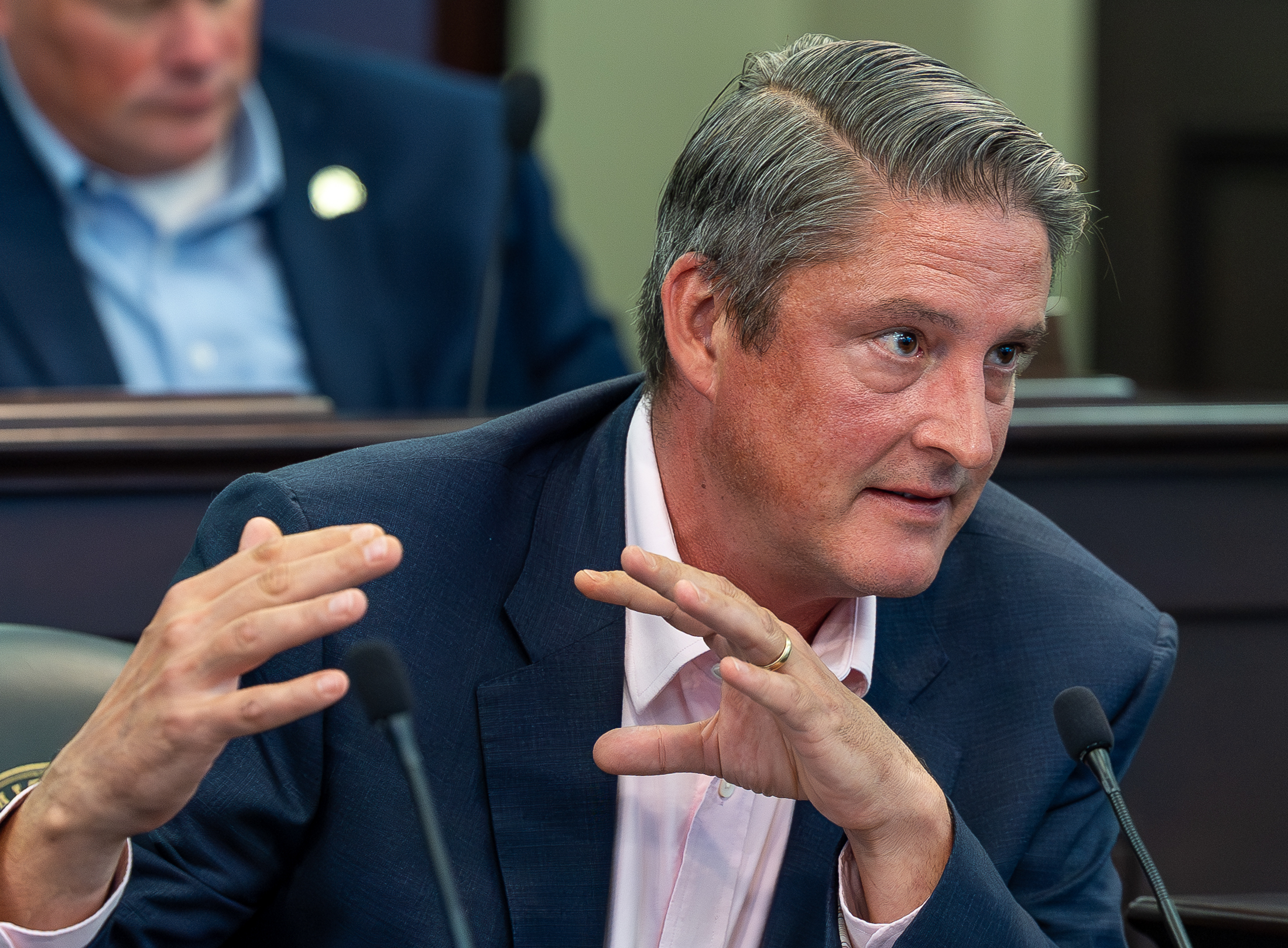
Rep. Matthew Lehman, D-Newport, speaks Thursday during a meeting of the Interim Joint Committee on Tourism, Small Business and Information Technology. A high-resolution photo can be found here.
FRANKFORT — Legislators on the Interim Joint Committee on Tourism, Small Business and Information Technology on Thursday received an overview from stakeholders about the status of Kentucky’s tourism industry.
Hank Phillips, president and chief executive officer of the Frankfort-based Kentucky Travel Industry Association, said the state of tourism in Kentucky is very strong.
“When we talk about the strength of tourism, the way we define that is in terms of the benefits that tourism provides to the people of Kentucky and the communities of Kentucky. Examples of that: over $14 billion in economic impact from tourism, the support of nearly 100,000 jobs by tourism and the contribution of a billion dollars in local and state tax revenue,” he said.
The quality of life is another important facet of tourism. The experiences provided for tourists also benefit Kentuckians, he said.
“That’s a huge consideration by businesses in decisions to relocate to Kentucky and by families considering moving to Kentucky and working here,” he said.
Prakash T. Maggan, an executive with Lexington-based Rainmaker Hospitality, also testified and said the company operates 24 hotels in Kentucky and four in Ohio.
“While our industry came back from COVID much more quickly and much more strongly than anybody would have ever anticipated, we are now seeing a lot of headwinds in our industry,” he said.
Maggan said the state transient tax and ensuing advertising it funds are vital to the tourism industry.
“And we want to make sure that that funding continues to support our local tourism offices. We need to make sure that they have all of the resources necessary to show off the attractions and natural resources in our state,” he said.
Lori Murphy-Tatum, tourism director for the City of Richmond, said the 1% funds are vital for the state’s department of tourism. She added that some people associated with Airbnb short-term rentals are not paying the local transient tax.
“We are funded through transient tax. So, we get that from our hoteliers, from our bed and breakfasts and our short-term rentals,” she said.
Rep. Shane Baker, R-Somerset, asked if people are still coming to Kentucky but not staying in hotels.
Maggan said officials have seen a slowdown this year.
“We just want to make sure that, as the economic climate gets tougher for everybody, we’re continuing as best in our industry and giving us the best possible chance to come out with a recovery on the other end because, as all cycles go, we will have a rising tide again,” he said.
Rep. Adam Moore, D-Lexington, asked about the role artificial intelligence is starting to play in tourism.
“One of the things with AI, as you know, it is combing the internet for every bit of information that it can find. And that’s why it’s so important on the back end, on your local tourism offices and even with the state,” Murphy-Tatum said. “We’re spending a lot more time going into our websites, going into Google and fact checking everything that we can find and make sure that’s correct.”
Sen. Matt Nunn, R-Sadieville, asked if local tourism offices could have more discretion about what type of projects they can fund. He pointed to a volunteer rescue service in Red River Gorge.
“I can’t help but think that the local tourism office might be interested in funding some of those needs because likely a lot of those people that get rescued by that service are tourists there rock climbing,” he said.
Murphy-Tatum said those who serve on commission boards by state law decide how the money is spent, and attracting people to Kentucky is paramount.
Rep. Matthew Lehman, D-Newport, asked how important the bourbon industry in Kentucky is now and does the state need to diversify.
Phillips said that from a tourism perspective, bourbon is huge, but it’s not the only “pillar.” He also listed the outdoors, horses, music, art and food.
“In terms of what’s going on right now with the bourbon industry, I think it’s important for all of us to understand that the good days of bourbon, first they aren’t over, and the main thing I want to point out is they weren’t a fluke. It’s not a fad. The bourbon industry is a signature industry of Kentucky is solid. It’s a solid foundation,” Phillips said.