Judges decided the winner of the 2025 Federal Duck Stamp contest on Friday, September 19th. I watched the livestream, along with about 1,700 other fans. James Hautman’s acrylic painting of three Buffleheads in flight rose above the other 289 entries to capture first place. The image will grace the 2026-2027 Duck Stamp.
Jim and his two brothers, Joe Hautman and Bob Hautman, are legendary in the duck stamp art world. It is Jim’s record-breaking 7th win. Joe has won six times and Bob, three. In 2015, the three notably claimed first, second, and third places in the contest. Between them, they have painted artwork for over 50 state and federal conservation stamps.
The Federal Duck Stamp has a vaunted history. The idea to sell an annual stamp for funding the purchase of wetlands came from Jay N. “Ding” Darling, a famous cartoonist and former chief of the Biological Survey, a precursor of the U.S. Fish & Wildlife Service. Darling drew the first stamp for 1934-1935, a brush and ink drawing of Mallards. The design selection became a contest in 1950-1951, when artist Walter Weber won for his trumpeter swans.
Due to its longevity, its role as the federal government’s only art contest, and the high caliber of artistic entries, winning is a prestigious honor for artists. It’s a career pinnacle achievement for realist wildlife painters, comparable to the Oscars or the Grammy’s. For a niche group, the contest has become a bit of an obsession, captured in the documentary, “The Million Dollar Duck,” and the book, “The Wild Duck Chase.”
The concept of the duck stamp has proven highly effective. Duck hunters over 16 years old are required to purchase the stamp annually, and others choose to buy one to support conservation. Ninety-eight percent of stamp proceeds goes directly to add protected land to the National Wildlife Refuge System. In its 91-year history, the duck stamp has raised $1.2 billion and conserved 6 million acres across the country.
As a creative tool for funding land conservation, duck stamp art preserves the nation’s rural character and honors a pastoral way of life. The contest’s long-time support for realistic wildlife art sustains rural livelihoods and engenders passion for the natural world. It joins a diverse group of people in the common cause of preserving wildlife habitats.

A Duck’s Life
To say artist Adam Grimm’s life revolves around ducks is not overstating the facts. His friends called him Duck even before he became the youngest person ever to win the Federal Duck Stamp contest at 21 years old. That 1999 victory solidified his wildlife art career, and he now supports his family of six with that work. He won last year for the third time; the current 2025-2026 duck stamp features his painting of a pair of King Eiders.
“I like capturing each species in its natural beauty, the way it was created,” he said in an interview. “Painting wildlife accurately and in the best light is what I really like to do.”
The Grimm family’s move to Wallace, South Dakota, was also motivated by ducks. The town of 91 people sits in the Prairie Pothole Region, a prime area for duck hunting and photography. Its distinctive topography creates the ideal nursery, producing nearly half of all North American waterfowl. Wallace is surrounded by small wetlands called Waterfowl Production Areas preserved with duck stamp funds.
“I originally came out to South Dakota on a hunting trip before I got married and was so amazed at this area,” he said. “It’s duck heaven.”
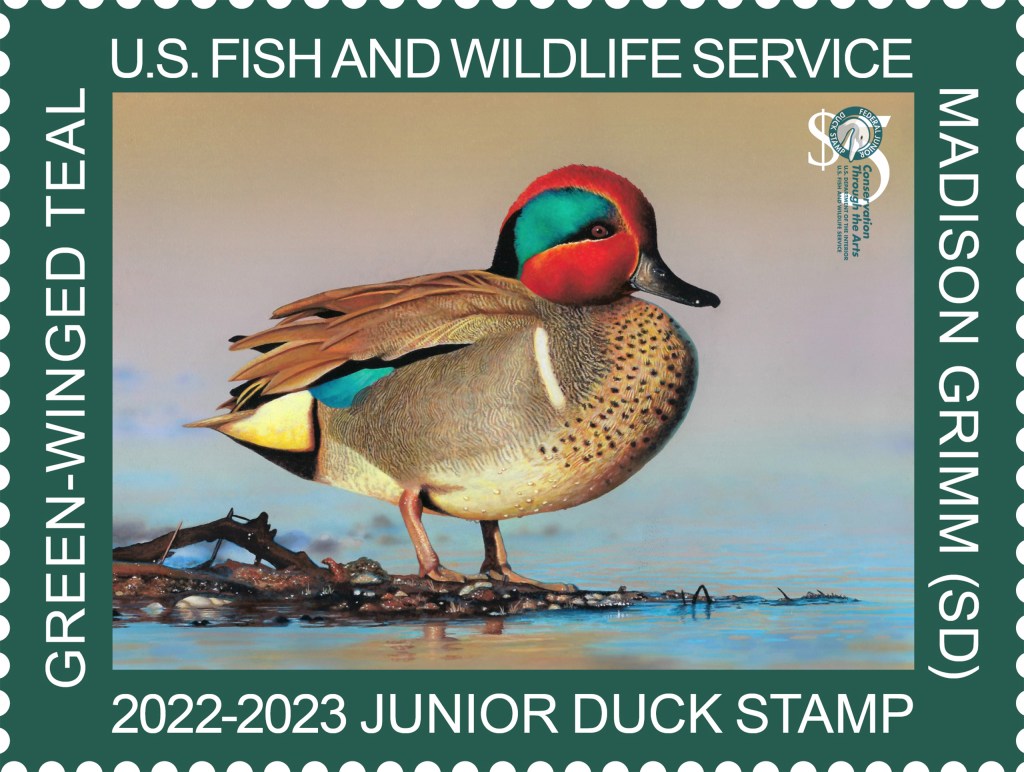
Ducks even define Grimm’s family life. His eldest daughter, Madison, turned 18 this year and entered her first duck stamp contest. She won the junior duck stamp contest three times, the first at age six. And this year, she founded her own duck-centered nonprofit.
Madison Grimm’s aviary features a concrete pond that can hold 100 ducks. After navigating the federal waterfowl rescue permit process, she began fielding calls from local farmers who found intact duck eggs after accidentally damaging nests. Her nonprofit, Second Chance Flight, rescued 200 ducks this year, with the possibility of reaching five times that amount next year.
As with his own family, Grimm sees wildlife art as a way to get people in touch with the land. While at an urban art fair, a woman admired a Wood Duck painting and asked where they live. He shared that they were native to the area and told her about their nearby wetland home. She returned to the fair the next year, excited to tell him about seeing them in person.
“Seeing those ducks may have changed that woman’s life,” he said. “There is pretty amazing stuff around when you go out looking. People can live in a rural environment and still take it for granted. I talk to people from here and they long to be someplace else, but this is my favorite place for living and raising a family.”

Going Viral
Kira Sabin is an artist who has entered the Federal Duck Stamp contest since 2019. They have never won, but the contest has forever changed their life. In 2021, they posted a TikTok video about the program and their entry that year. It reached 2.6 million views. That digital fame launched Sabin’s full-time artistic career. In addition, the video introduced millions of new people – especially young adults – to the stamp and the contest. (This article was inspired by my 21-year-old son, a follower of Sabin).
“I was baffled people didn’t know about it since it is one of the most successful wildlife fundraisers ever,” Sabin said in an interview. “It is so important to support programs already in place that work.”
The artist grew up in rural Hutchinson, Minnesota, with wild lands and lakes to explore. It’s the hometown of famed wildlife artist Les Kouba, whose paintings Sabin remembers in the homes of so many neighbors. Sabin is not a hunter but many of their family members are, including the grandfather that introduced them to the contest.
“I love that the stamp is particularly a bridge between hunters and conservationists,” they said. “My family members are big into hunting and are some of the most knowledgeable people about the land I know. Most hunters are great conservationists.”
Sabin has been key in shifting the culture of the contest in recent years. As a young LGBTQ+ person, they were initially nervous about meeting the experienced wildfowl artists since they don’t match the traditional demographic. They’ve received a warm welcome.
“Politically and culturally, I don’t mesh with the big names,” they said. “But I like to be a bridge. It’s okay if we don’t have the same political views if we are nice to each other and all want to preserve wildlands. There has never been a conflict.”
Only three women have ever won the contest in its 90-year history. Sabin aims to change that, posting year-round about it on their social media accounts to actively recruit other artists. They said that organizers have noticed a spike in entries by women and young people, breathing new life into the program.
For many of the artists who enter, competing in the Federal Duck Stamp contest is about being part of something larger than themselves. Artist Michael Kensinger of central Pennsylvania explained it best in a speech during a break in the judging. After many years of entering, he reached a measure of success last year as creator of the companion species, a black and white drawing printed on the First Day of Issue collector’s envelope alongside the duck stamp.
Kensinger said his long involvement has inspired him to raise awareness and funds for land preservation and duck nesting boxes. Being part of national efforts to conserve wetland habitat has given him purpose and a sense of identity. Even if he remains as one of the many people who enters and never wins, he hopes to be known as the guy who loved it nonetheless.
The post For the Love of Ducks appeared first on The Daily Yonder.