On September 19, 2025, Trump passed an executive order requiring international applicants to pay a $100,000 fee to acquire H-1B visas, a program that allows employers to hire skilled workers in specialized positions. The new fee will affect a wide range of industries, including education, healthcare, technology, and research.
Proponents of Trump’s new policy say that it will incentivize employers to hire American workers, but detractors argue that there aren’t enough skilled American workers available to fill those positions. The H-1B visa program was originally created to address workforce needs that current residents of the United States couldn’t meet, according to experts. While the H-1B program previously operated as a lottery, it will now prioritize higher-skilled and higher-paid workers.
A new dataset from Alex Ip at the Xylom, an Asian American-run nonprofit news outlet, maps H-1B visa holders at research universities in the United States. Because of Trump’s H-1B visa fee, universities would need to spend a larger share of their research budget to keep the same number of visa workers next year. The median financial burden, or share of an institution’s research budget needed to retain visa holders, was 3.1% in fiscal year 2023, according to Ip’s analysis. That comes out to about $3.6 million, but that figure varies widely between institutions.
“It will be significantly more difficult and expensive for America’s top research institutions – which already cannot keep up with industry compensation – to continue to attract skilled workers from across the world,” Ip wrote.
Institutions in red states are expected to be disproportionately affected by this policy change, according to Ip.
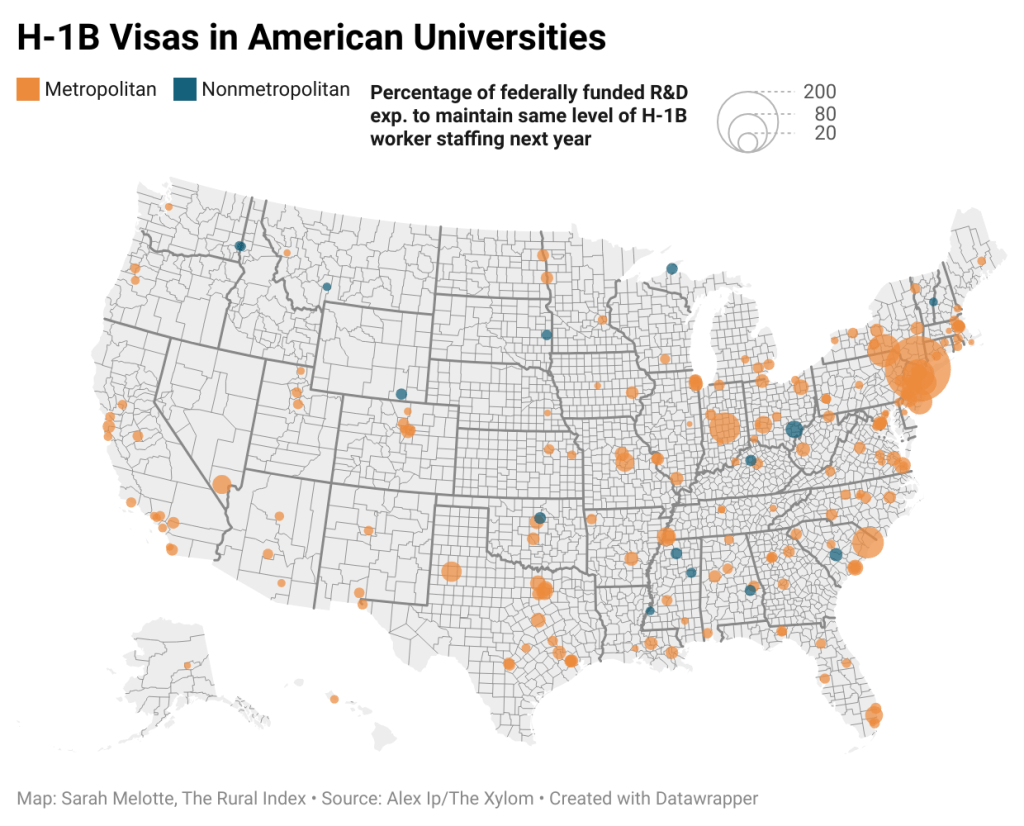
In this edition of the Rural Index, I’ll be exploring the financial burden of Trump’s new policy on rural research institutions in particular. This map shows all of the 211 land-grant, sea-grant, and R1 institutions included in the Xylom analysis from the fiscal year 2023. These are universities with high research and doctorate degree production and are therefore expected to be hurt the most by Trump’s new policy.
Out of the 211 universities in the Xylom dataset, 196 are in metropolitan counties and 15 are in nonmetropolitan, or rural, counties. In metropolitan counties, the median percent of federal research dollars required to maintain the same level of visa workers staffing next year was 3%. In nonmetropolitan counties, that number was 3.7%.
The most financially burdened rural institution was Ohio University, which is expected to have to expend approximately 12% of its federal research budget on retaining H-1B visa workers next year. That represents about $2.7 million.
The table above displays the financial burden of all 15 rural institutions included in the Xylom dataset. Click here to see an interactive version of the table.
Rural institutions spent just over $1 billion federal research dollars in 2023, compared to $50 billion in metropolitan institutions. All but two of the rural research institutions – Dartmouth and Tuskegee – are public universities. Ten of the 15 institutions are land-grant universities. The median federal research funding that rural institutions received was approximately $61.5 million in fiscal year 2023. To retain visa workers, rural institutions spend, on average, about $2.1 million in federal research funding, totaling $32 million across all rural institutions.
Six of the 15 rural institutions are in the American South, four of which are historically black universities and colleges, or HBCUs. The rural HBCUs included in this dataset are Alcorn State University in Mississippi, Kentucky State University, South Carolina State University, and Tuskegee University in Alabama.
The post Trump’s H-1B Visa Policy Will Hurt Research Institutions appeared first on The Daily Yonder.