AI task force advances recommendations for legislative session
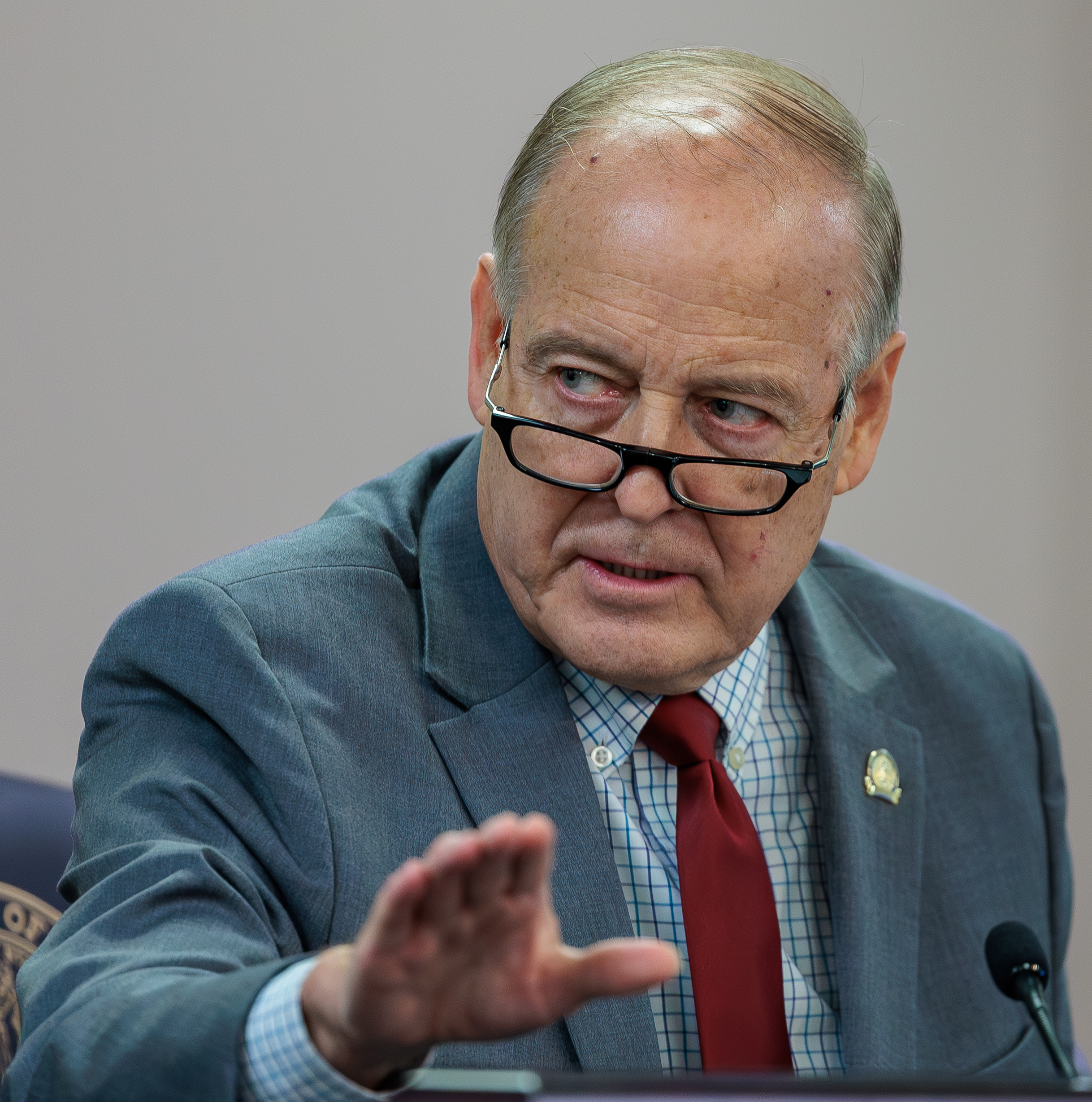
Sen. Gex Williams, R-Verona, speaks Thursday during a meeting of the Artificial Intelligence Task Force 2025. A high-res version can be found here.
FRANKFORT — The Artificial Intelligence Task Force 2025 on Thursday advanced recommendations for the Kentucky General Assembly to consider during the upcoming legislative session – a main goal of the group.
Co-Chairs Rep. Josh Bray, R-Mount Vernon, and Sen. Amanda Mays Bledsoe, R-Lexington, outlined the 10 recommendations during the panel’s last meeting before the session kicks off in January.
“We tried to incorporate everybody’s recommendation. Some of them are federal issues that would be more appropriate there, and so we’ve got a recommendation of that. But thank you to everyone who sent those in,” Bray said.
Among the recommendations, the task force is asking lawmakers to consider changes to state law that would strengthen protections for consumer data as artificial intelligence – known as AI – continues to evolve.
The panel also recommends that lawmakers consider updates to AI policies for state agencies along with stronger policies to protect minors on social media from the potential effects of AI.
Another recommendation seeks acknowledgement that AI may impact careers, and the task force is asking lawmakers to collaborate with professional standards boards regarding the use of AI in certain professions.
A full list of the recommendations is available here.
Senate Minority Caucus Chair Reginald L. Thomas, D-Lexington, said the section on minors is an excellent recommendation because it promotes online safety for children and parents. He said he hopes the legislature will take action during the session on the issue.
“We see every day here in America discussions of sexual exploitation of minors, sexual trafficking of minors. We know it occurs with a great deal of frequency. And AI is out here every day causing harm and danger to our children,” he said.
Thomas added that two other recommendations dealing with data centers are important and data centers should not be built in Kentucky without an environmental impact survey. He cited concerns about how power usage by data centers could impact people and businesses already on the electrical grid.
“I don’t think that that cost should be passed on to the current users of that electrical system,” he said. “I think if there’s an increased cost that comes with data center construction or use, then that data center should pay for that increased cost, not the current consumers or the current business users who were using it before the data center came online.”
The recommendations call on lawmakers to consider polices related to the location of data centers in Kentucky and their use of water and power resources.
Bray said Thomas’s concerns are why those sections were drafted. He recalled past solar legislation that dealt with similar issues.
“If you’ll remember the solar bill that passed a few years ago, it provided minimum requirements on setbacks, on decommissioning bonds, making sure that if a solar farm were to be decommissioned, there was money there to make it right so that local landowners wouldn’t be tasked with that,” he said.
Bray said the Kentucky Public Service Commission completes a grid usage study regarding capacity and availability when a large user seeks approval. He agreed that lawmakers do not want electric bills to increase due to power consumption from a data center.
“We’ve had a lot of conversation with power companies, data centers, the Public Service Commission, so there will be a bill coming to address those exact concerns,” Bray said.
Sen. Gex Williams, R-Verona, pointed to one recommendation that would incorporate AI development and governance into the jurisdiction of legislative committees. He said the jurisdiction should fall under the Natural Resources and Energy Committee.
“There’s a one-to-one relationship between data centers and energy,” he said.
The general assembly created the task force to study the use of AI throughout Kentucky to foster innovation and competitiveness, to promote AI literacy and to ensure AI development and governance in Kentucky, including data centers.
Mays Bledsoe said the task force has been a “wonderful tool” for the last two years, educating legislators and offering a path forward toward a long-term plan.
“It’s been a really good committee, and I’ve been really grateful for our conversations,” she said.