Tonight at 5 p.m., in a too-small council chamber inside a too-old former hotel, Lexington’s leaders will decide whether to move City Hall into a gleaming bank building on Vine Street.
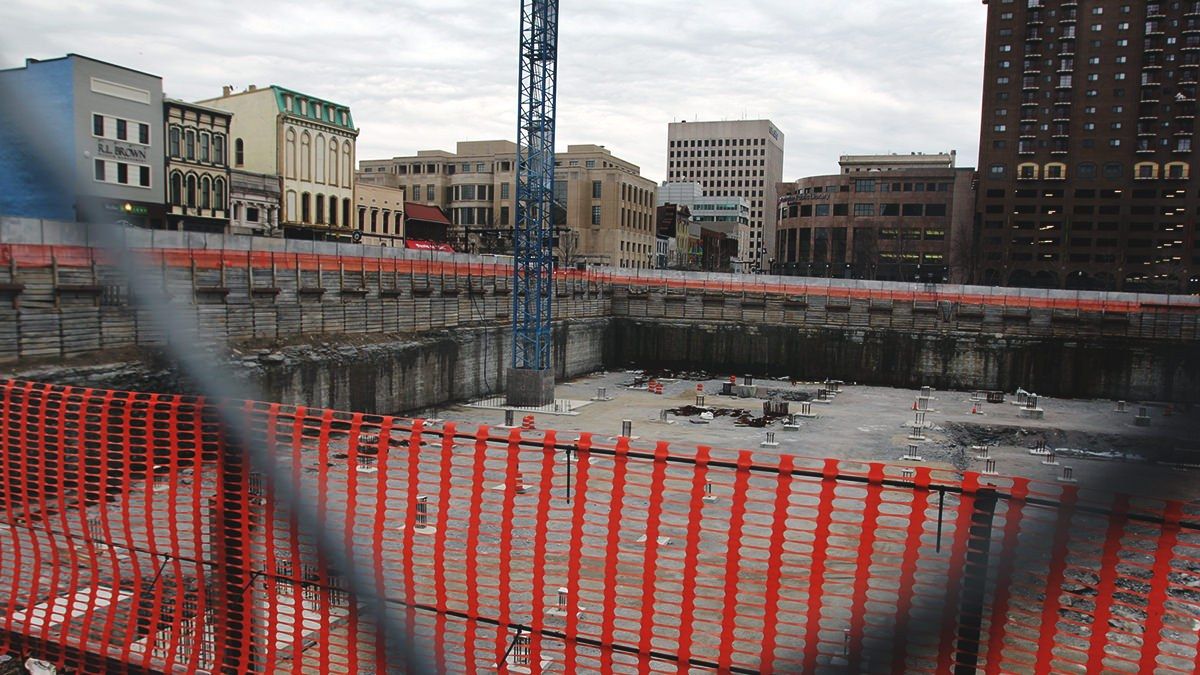
If they vote yes, we’ll get a renovated “Government Center” at 200 West Vine — and a whole new generation will finally get to understand what older Lexingtonians mean when they say CentrePit.
The kids who only know “the balls” as downtown’s biggest meme might be about to see what a true Lexington moment looks like.
Here’s the basic deal:
- The city wants to turn the Truist/BB&T/PNC building at 200 W. Vine into a new Government Center, plus a new public lobby and modern council chamber.
- It’s a public-private partnership with the Lexington Opportunity Fund, a joint venture of Greer Companies and The Webb Companies — yes, those Webbs, of Big Blue Building and City Center/CentrePointe fame.
- Total project cost is pegged at $86.6 million. The city puts in $30 million up front from its capital reserve, then pays up to $3.5 million a year for 35 years in lease payments, after which the building becomes city-owned.
Do the math and you’re looking at a long-term commitment north of $150 million for a building the public doesn’t fully own until most of today’s college freshmen are worrying about their own kids’ FCPS assignments.
City officials pitch this as a practical necessity: the current Government Center is a 1920 hotel that was supposed to be a temporary City Hall when the city bought it in 1982. Four decades of “temporary” later, staff are crammed in, the building is riddled with accessibility issues, and there’s an estimated $55 million in deferred maintenance hanging over it like a busted HVAC unit.
On paper, you can see the logic. On Vine, you can see the gold glass.
The politics, though, are where it starts to feel very… Lexington.
Council has already delayed the vote once, after residents showed up to say: hey, maybe we should talk about this before we empty a big chunk of the city’s savings account into an eight-story bank box. The first real financial breakdown hit the public only days before council initially tried to move the ordinance.
District 5 Councilmember Liz Sheehan said the quiet part out loud: “This is the first time the public is seeing the financial information,” and maybe ramming a first reading through right before Thanksgiving, with second reading on December 2, wasn’t exactly the gold standard of transparency.
District 4’s Emma Curtis pointed out the other elephant in the room: the $30 million down payment comes from a capital reserve built up in better years — while the federal funding landscape for homelessness and other safety-net services has gotten a lot shakier. Maybe, she suggested, using that money should at least be in conversation with whether Lexington can afford a permanent homeless shelter and other basics.
At public comment, one resident summed it up in a single line:
“We’re told there’s no money for things that actually improve people’s lives, but somehow there is money for a brand new city hall.”
No design rendering can soften that contrast.
And then there’s the cast of characters behind the curtain.
The Webb Companies and Greer Companies aren’t new names in this town. The Webbs are behind the Big Blue Building — the Lexington Financial Center — a skyline-defining tower that also leaned on public support back in the 1980s.
They also gave us CentrePointe, which gave us CentrePit, which gave us a decade-long civics lesson in what happens when you demolish a city block on a promise and end up with a giant, muddy hole in the ground. That saga eventually reincarnated as City Center, the shiny mixed-use stack that now overlooks Triangle Park.
Now those same developer families — through the Lexington Opportunity Fund — are back with a deal that asks Lexington to:
- Buy their bank building at a premium,
- Lease it back to them so they can redevelop it,
- Then lease it from them for three and a half decades.
You don’t need a PhD in public finance to spot the pattern. When Lexington wants to underwrite risk for wealthy landowners in the urban core, we discover whole new definitions of “opportunity.”
Meanwhile, the official city FAQ talks about “efficiency,” “accessibility,” and “welcoming public space.”
All good goals! Nobody’s arguing for more asbestos and jammed elevators. But when you combine those warm words with a 35-year lease to some of the richest families in town, it stops sounding like civic improvement and starts sounding like a legacy project with a financing plan wrapped around it.
Hard questions. Uncomfortable answers.
There’s also the generational thing.
Older Lexingtonians remember watching a block of functioning downtown buildings — music venues, bars, small businesses — flattened for CentrePointe. They remember the “world-class” renderings, the big talk, and then year after year of fenced-off dirt. Some of them have kids who grew up thinking of that block as simply “the hole by the park.”
Younger folks, especially the ones who moved here in the last decade, mostly know the Big Blue Building, City Center, and yes, the balls — those shiny public art orbs that instantly became a local meme and a shorthand for “Lexington’s priorities are… interesting.”
Tonight’s vote gives that younger crowd a chance at the full Lexington experience: not just laughing at the sculpture, but living through the part where city government ties itself to a high-gloss private project for a generation and hopes the public forgets the price tag.
In that sense, this Government Center deal could make “the balls” look downright restrained — a thoughtfully pensive selection, even. At least the orbs didn’t come with a 35-year ground lease.
Let’s be fair: there is a real problem to solve.
The current Government Center is outdated, cramped, and hostile to anyone who doesn’t like stairs, fluorescent lights, or struggling to find a chair at a controversial meeting. It’s embarrassing that Lexington — a city that never misses a chance to call itself “world-class” — still runs its government out of a patched-up hotel we swore was temporary before the UK students of today were born.
But solving that problem with this deal, right now, with these partners, is a choice.
It’s a choice to sign away predictable, long-term public dollars to a developer class that has already defined our skyline, while the city still struggles to define a coherent approach to housing, homelessness, and basic public space.
It’s a choice to spend months fine-tuning pro formas and renderings and only let the public into the numbers in the final couple of weeks, then act surprised when people feel rushed and suspicious.
And it’s a choice to call this an “opportunity” partnership without answering the simplest question: opportunity for whom?
Whatever council does tonight, this will be a defining moment.
If they pass it, we’ll spend the next few years watching the Truist building get a spa day while we argue over whether we can “afford” a permanent shelter or stronger tenant protections.
If they kill it, we’ll go back to the same crumbling chambers, but with a clear message: stop bringing us half-baked, developer-first “solutions” and calling them inevitable.
Either way, Lexington’s image as a city that loves shiny things more than boring equity work is on the line.
We’ve already had a big hole. We’ve already had the balls.
The question tonight is whether council wants to give the next generation a Government Center they can be proud of — or a 35-year reminder of who really runs downtown.