This Week at the State Capitol
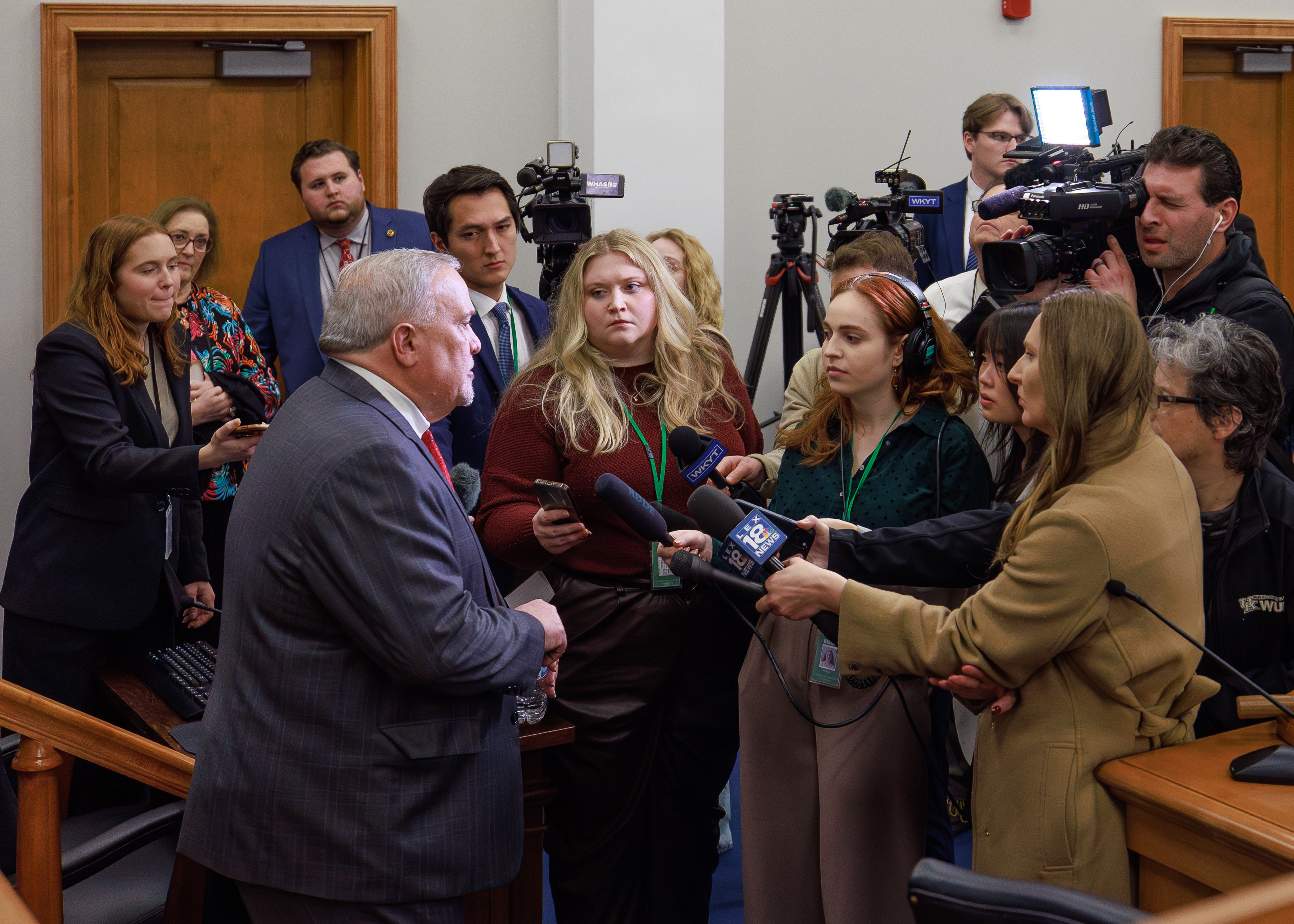
Senate President Robert Stivers, R-Manchester, answers questions from the press on the Senate floor during the first week of the 2026 legislative session. A high-res version can be found here.
FRANKFORT — From the moment lawmakers gaveled into the 2026 legislative session on Tuesday, the Kentucky General Assembly was already notching a new mark on the history of state government.
No committees have held hearings. No bills have received a vote yet. But for the first time since 1910, lawmakers are convening a regular session of the general assembly outside the hallowed chambers of the Kentucky State Capitol.
A 26,000-square foot temporary building next to the Capitol Annex will play host to the general assembly over the next few years as the state Capitol undergoes extensive restoration work to preserve the landmark for future generations.
Some may have missed the marble columns and soaring rotunda of the Capitol this week when proceedings kicked-off in the chambers. But otherwise, business was moving forward in typical fashion for a 60-day budget session.
Legislators filed more than 250 bills and more than 50 resolutions on the House and Senate floors, and the proposals seek to address a full spectrum of issues – education, taxes, health care, jobs, religion, firearms, crime and privacy, among others.
Lawmakers also updated the House and Senate rules to reflect the temporary setting and remove some of the procedures adopted during the COVID pandemic.
The Senate punctuated the week by welcoming a new member to the ranks; Sen. Gary Clemons, D-Louisville, received the oath of office on Tuesday, filling a vacancy left by former senator, David Yates, who was appointed to serve as Jefferson County Clerk in October.
In other action, Sen. Cassie Chambers Armstrong, D-Louisville, has been named as minority whip in that chamber.
In the House, Rep. Lindsey Burke, D-Lexington, was named as minority caucus chair, and Rep. Joshua Watkins, D-Louisville, was named as the new minority whip.
Other leadership positions remain unchanged from last year.
The general assembly meets in 60-day sessions during even-numbered years and in 30-day sessions during odd-numbered years.
Hundreds of bills are introduced each session, and the state’s biennial budget is one of the most anticipated measures that lawmakers are tasked with adopting during a “long” 60-day session.
The next spending plan will guide state appropriations through the end of fiscal year 2028 and is expected to generate as much debate as any measure this session.
Lawmakers have been crunching numbers and hearing testimony about the state’s budget needs for months, and the House Majority Caucus is expected to introduce its plan within the next several weeks.
Members of the House Minority Caucus filed legislation Friday that reflects budget proposals the governor unveiled earlier this week.
The general assembly will reconvene on Monday for day five of the session.
Legislators have until March 2 to file new bills in the Senate and until March 4 to file new bills in the House. The general assembly is set to adjourn sine die on April 15.
Kentuckians can track the action through the Legislative Record Webpage, which allows users to read bills and follow their progression through the chambers.
Citizens can also share their views on issues with lawmakers by calling the general assembly’s toll-free message line at 1-800-372-7181.