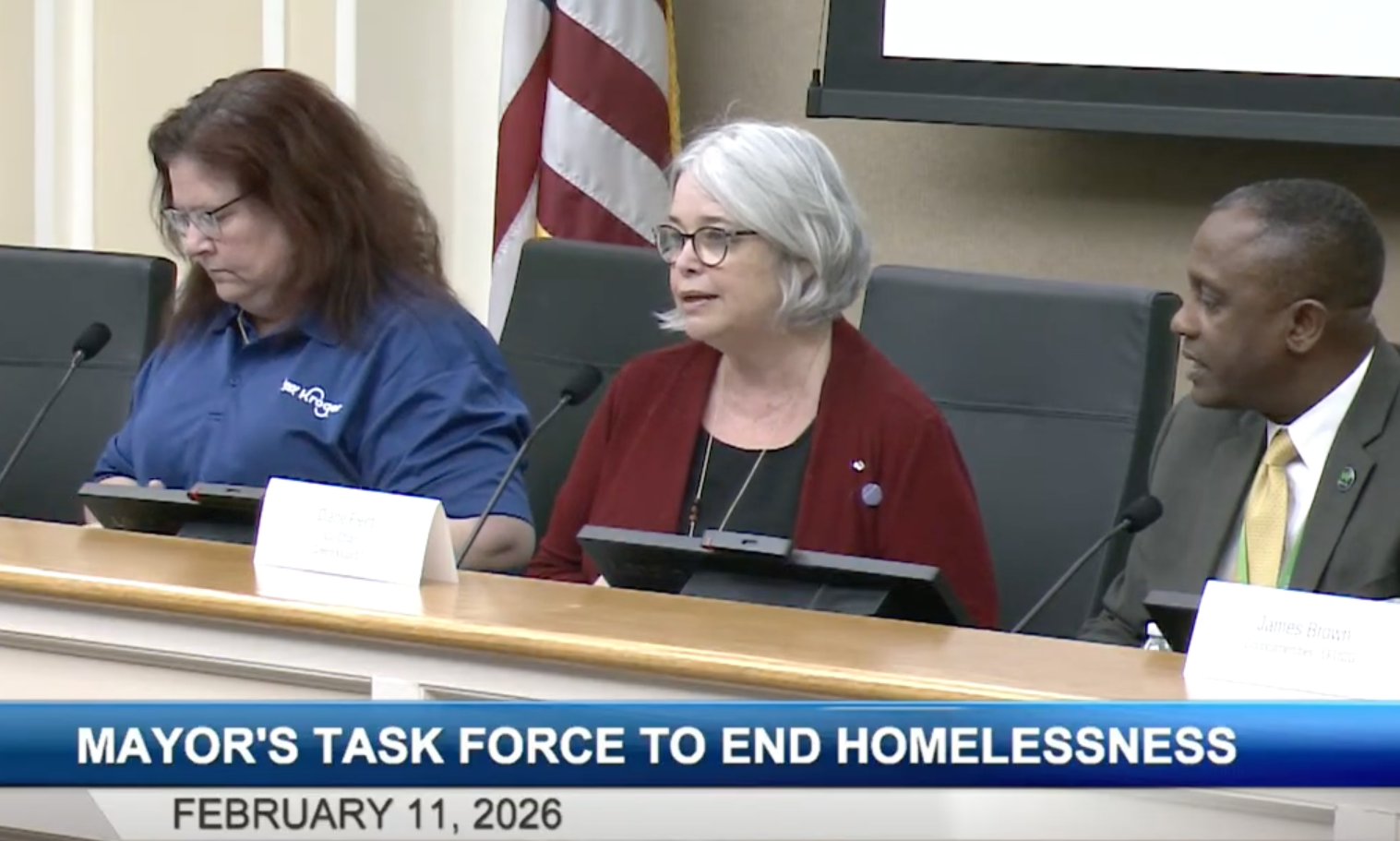
LEXINGTON, Ky. — Members of the Mayor’s Task Force to End Homelessness on Wednesday heard a presentation from a Nashville organization that shelters 800 people a night on a $15 million privately funded budget, and grappled with how to design solutions that serve not just the chronically homeless but also families, the elderly and those teetering on the edge of losing housing.
The wide-ranging meeting, held two weeks after a brutal cold snap that pushed Lexington’s shelters well past capacity, touched on case management shortfalls, the cost of inaction and the launch of a series of community listening sessions that begins Thursday.
Nashville model draws interest — and sticker shock
A subcommittee studying peer cities and shelter models reported on a virtual presentation from the Nashville Rescue Mission, a faith-based organization that operates two campuses — one for men, one for women and children — and serves as the sole emergency shelter for Middle Tennessee. The mission employs 130 to 138 staff, offers 24/7 wraparound services including mental health and medical care, and runs a life recovery program that has helped some participants save enough money to buy homes upon completion.
The entire operation runs on private donations with no government funding, a detail that impressed task force members but also raised questions about replicability. Council Member Tyler Morton, who co-chairs the subcommittee, said the group was particularly drawn to the wraparound services model and on-site employment pipeline.
Task force members pressed for details on capital costs, which were not available during the presentation. Jenny, who leads the Hope Center, noted that while the Nashville figure sounds daunting, Lexington’s faith community has demonstrated its own capacity — pointing out that $135,000 materialized in two weeks during the recent cold emergency. But she cautioned that kind of mobilization is not sustainable on a recurring basis.
Lexington’s 2025 point-in-time count identified 925 people experiencing homelessness, the majority in emergency shelters or transitional housing. The city has roughly 500 year-round shelter beds, with the remainder coming from seasonal or overflow capacity. During the recent extreme cold, some facilities sheltered far more than their official count — the Hope Center, for example, housed as many as 230 people despite an official capacity closer to 150.
Case management emerges as central gap
The supportive services and prevention subcommittee reported on a community roundtable that brought together representatives from Bluegrass New Beginnings, Community Action, Arbor Youth, St. James Place, the Hope Center street outreach team, the Davis Workforce Center and Fayette County Public Schools’ McKinney-Vento program, among others.
The dominant theme across every agency, co-chair David reported, was the need for more intensive, end-to-end case management rather than simple referrals. Caseloads at some agencies reach 70 clients per worker, a ratio that effectively reduces case managers to phone-number dispensers rather than advocates who can accompany clients to appointments, help with applications and provide accountability.
St. James Place reported that hiring a dedicated social worker led to a measurable drop in evictions among its residents — evidence, committee members said, that case management pays dividends not just during the shelter phase but after people are housed.
The subcommittee also identified a need for a centralized services hub that would spare homeless individuals from traveling across town to access different programs.
Three categories, one plan
Commissioner Lanter, the task force co-chair, framed the challenge around three broadly recognized categories of homelessness: situational (triggered by job loss, a medical emergency or a relationship breakdown), episodic (recurring instability often tied to fixed incomes or systemic barriers) and chronic (individuals unlikely to achieve self-sufficiency without long-term support, often due to severe mental illness, disability or age).
Jeff, who oversees city homelessness programs, underscored the cost calculus of failing to intervene early. Paying a month’s rent to keep a family housed — roughly $1,000 — is far cheaper than the cascade of emergency services, shelter stays and economic losses that follow once someone enters the system, he said, though he acknowledged the full cost of chronic homelessness is difficult to quantify.
Jenny, the Hope Center director, made a pointed appeal for the task force not to lose sight of the population that no employment program can reach. “What are we going to do with our 85-year-olds that are out there living in their cars?” she asked. “Our disabled and elderly and severely mentally ill are never going to be in the workforce.”
Listening sessions launch Thursday
The community engagement subcommittee, co-chaired by Council Member Chuck Ellinger and Jenny, announced a schedule of public listening sessions designed to gather input before the task force finalizes its recommendations.
The first session, with the Street Voice Council — a group representing people with lived experience of homelessness — was set for noon Thursday at the Lyric Theater. Subsequent sessions will target business leaders the week of Feb. 23, the faith community in early March, neighborhood associations and service providers in late March, and public safety officials in April. A final general-public session will follow.
The sessions are framed as listening opportunities, not presentations, co-chairs emphasized. Summaries will be distributed to all task force members after each one. A wrap-up session will bring findings back to participants before recommendations are finalized.
Stable Recovery pitches faith-based employment model
The meeting opened with a presentation from Stable Recovery, a faith-based residential recovery program that combines addiction treatment with employment training. The program reported an 83% completion rate among participants, with graduates remaining employed after leaving the program. It operates a waitlist, with roughly half of those waiting coming from Fayette County.
Task force members noted the program’s value as one piece of a broader continuum but observed it is designed for individuals, not families, and requires a level of readiness that not all homeless people can meet.
Funding picture still taking shape
The funding and partnerships subcommittee, chaired by Zach, reported it is still in information-gathering mode, working to map the current landscape of local and federal homelessness funding. The group plans to invite Rick McQuadey to a future meeting to discuss how the city’s affordable housing program could be used to incentivize permanent supportive housing.
Zach said the committee is waiting for the other subcommittees and the full task force to coalesce around specific recommendations before making funding proposals.
What’s next
The task force announced a poverty simulation exercise called “Which Way to Go?” scheduled for March 4 from 2 to 4 p.m. at the Consolidated Andrews Center. The event, which allows participants to experience the navigation challenges of poverty firsthand, is open to task force members and their staff, with registration requested by Feb. 20. The Volunteers of America from Louisville will present to the peer cities subcommittee on March 4 as well.
Co-chair Lanter closed by urging members to keep the full spectrum of homelessness in view. “Homelessness has a lot of different faces,” he said, adding that the task force’s charge is to deliver a holistic, comprehensive plan to Mayor Linda Gorton — not one focused on a single segment of the population.