Legislation advances on DNA collection for felony arrests
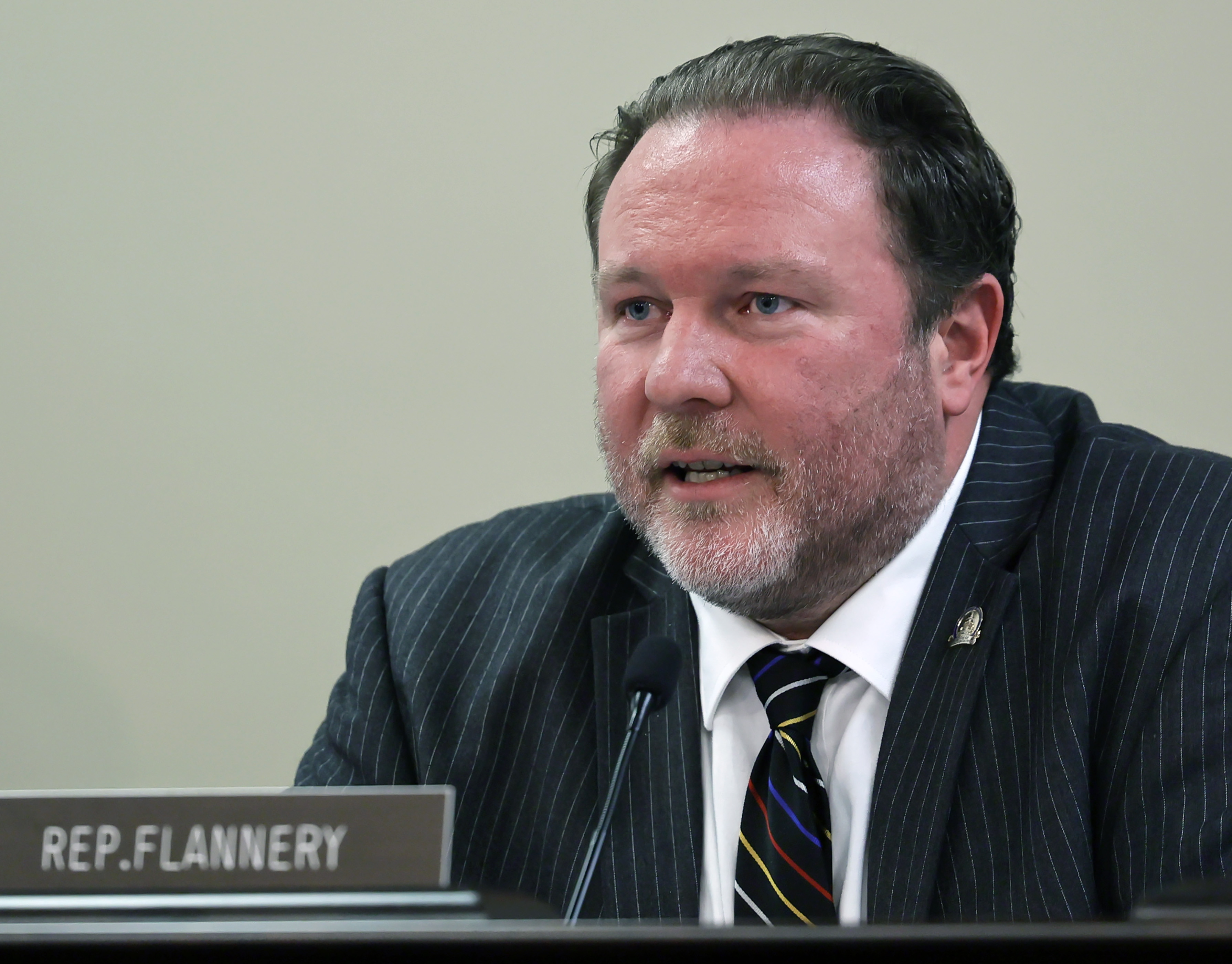
Rep. Patrick Flannery, R-Olive Hill, is the primary sponsor of House Bill 414, which would require DNA collection upon a felony arrest in Kentucky. He spoke on the bill during Tuesday’s House Local Government Committee meeting. A high-res version can be found here.
FRANKFORT — Individuals facing felony charges in Kentucky may soon have to provide more than just their fingerprints upon arrest.
House Bill 414 would require jails to collect a DNA sample when a person is booked into jail on a felony charge. Rep. Patrick Flannery, R-Olive Hill, is the primary sponsor of the legislation and the chair of the House Local Government Committee.
Sen. Julie Raque Adams, R-Louisville, testified alongside Flannery and two advocates on the legislation during the committee’s Tuesday meeting.
Flannery told the committee that 31 other states have already enacted similar legislation, which has aided law enforcement in solving cold cases.
“This is very helpful for different reasons,” Flannery said. “One is hopefully we can solve crimes that have been remaining out there. Hopefully for folks that are innocent, this can be used to exonerate them.”
U.S. Supreme Court case Maryland v. King opened the door for states to pass legislation like HB 414, Flannery said. Adams told the committee she first filed similar legislation years ago.
Then, Kentucky would’ve been a pioneer, she said. Today, Kentucky is considered an outlier compared to its surrounding states.
“I’ve always been deeply committed to this, and I’ve always thought it was the right direction,” Adams added.
Under HB 414, collected DNA would be sent to the Kentucky State Police’s forensic laboratory. The DNA samples could only be used for criminal justice purposes.
The legislation limits DNA collection upon felony arrest to adults. The bill would require the samples and the DNA profile to be expunged upon an acquittal, a dismissal or a conviction for a nonfelony offense.
Individuals who successfully complete a pretrial diversion program could also qualify for expungement.
Rep. Michael Meredith, R-Oakland, asked Flannery why collecting a $5 fee for the collection of the DNA samples was removed from a new draft of the legislation.
Flannery said the state does not collect a fee for fingerprinting or other aspects of the booking process, so the change would make the DNA collection no different. He also said HB 414 would have a “minimal, if any” fiscal impact.
Advocate Michelle Kuiper shared her story as a real-life example of how HB 414 can help Kentuckians. She is a survivor of a serial rapist. It took 17 years for a DNA sample to identify the perpetrator who kidnapped and attacked her in Louisville in 1994.
Kuiper said the man responsible for her assault and the assault of at least two other women had been in and out of jail for other crimes, but no DNA had been collected in those instances. A DNA sample upon a trafficking cocaine conviction in 2012 finally revealed his identity.
Kuiper said she believes HB 414 would help catch more serial rapists and prevent crime.
“It’s a proactive approach that accelerates investigations, potentially prevents future violent crimes, and exonerates the innocents and provides reliable, long-lasting forensic evidence so someone does not have to wait two decades to find their predator,” Kuiper said.
Ashley Spence, founder of the DNA Justice Project, testified alongside Kuiper. She said she saw her rapist identified and brought to justice thanks to legislation like HB 414 in California.
She told the committee when Texas enacted similar legislation, they saw 1,005 cold cases closed in one year.
“Not only is this, in my opinion, smart public policy, it is one of the most fiscally responsible public safety investments that we can make,” Spence said.
Rep. Rebecca Raymer, R-Morgantown, thanked Kuiper and Spence for their testimony. She told the women she has been working to expand access to sexual assault nurse examiners in Kentucky.
“This is a very wonderful piece of legislation that will complement that, and I’m going to be a very proud ‘yes’ today,” she said.
The House Local Government Committee unanimously voted to send HB 414 to the House floor.