Tourism bureau now requesting 60 business days to produce credit card records, pushing disclosure past public hearings on proposed hotel assessment
LEXINGTON, Ky. — VisitLex, the publicly funded tourism bureau for the Bluegrass region, is asking for 60 business days to hand over two years of credit card statements and expense reports — a timeline that would keep the records out of public view until after the Lexington-Fayette Urban County Council is expected to vote on a proposal to give the bureau access to an estimated $2.1 million in new annual tax revenue.
A newly obtained response letter, dated February 19, 2026, reveals that VisitLex is requesting an additional 30 business days on top of the 30 it originally claimed in January, citing the volume of approximately 5,200 potentially responsive records. The extension request came one day after the original deadline expired and one day after the Lexington Times filed a formal appeal with the Kentucky Attorney General over VisitLex’s failure to produce the records on time.
The delay takes on new significance in light of documents obtained by the Lexington Times showing that VisitLex is simultaneously pursuing the creation of a Tourism Improvement District — a new 2% assessment on hotel room revenue in Fayette County that would be collected alongside existing taxes and controlled by a new board. The proposal’s own timeline calls for public hearings before the Urban County Council as early as March, with a vote anticipated by spring.
If VisitLex’s 60-business-day timeline holds, the public would not see the bureau’s credit card spending records until late April at the earliest — potentially after the Council has already decided whether to approve the new taxing district.
The timeline
On December 30, 2025, the Lexington Times submitted an open records request to VisitLex for all credit card statements, invoices, and expense reports for calendar years 2024 and 2025. VisitLex responded on January 7, 2026, acknowledging that approximately 5,200 records were potentially responsive and requesting 30 business days to produce them. That deadline fell on approximately February 18–19.
No records were produced by that date. On February 18, the Lexington Times filed an appeal with the Attorney General’s Open Records Division, arguing that VisitLex had violated the Act by missing its own self-imposed deadline and by pre-emptively citing legal exemptions — including personal privacy and commercial advantage provisions — without applying them to any specific record.
The following day, February 19, VisitLex’s Vice President of Finance and Operations, Patricia J. Knight, sent a letter requesting an additional 30 business days. The letter stated that VisitLex had begun reviewing the records for potential exemptions under KRS 61.878(1)(a) and KRS 61.878(1)(c)(1), and that the review was “ongoing.” It did not explain why no records — even partially reviewed batches — had been produced during the first 30-day window.
A new tax on the table
According to a presentation deck prepared by the consulting firm Civitas and dated February 18, 2026, VisitLex is backing the formation of a Lexington-Fayette County Lodging Management District under Kentucky’s Tourism Improvement District statute. The proposal would impose an additional 2% assessment on gross room revenue from hotels, motels, and short-term rental properties in the county.
The projected revenue is approximately $2.1 million per year. Funds would be directed toward sales and marketing efforts, convention attraction, and destination development — activities that overlap significantly with VisitLex’s existing mission. The district would be governed by a new Board of Directors and would operate for an initial five-year term.
The Civitas deck outlines a timeline that includes a petition drive among lodging operators in January and February 2026, presentation to the Council’s Budget, Finance, and Economic Development Committee in February, and public hearings and a Council vote in March or April.
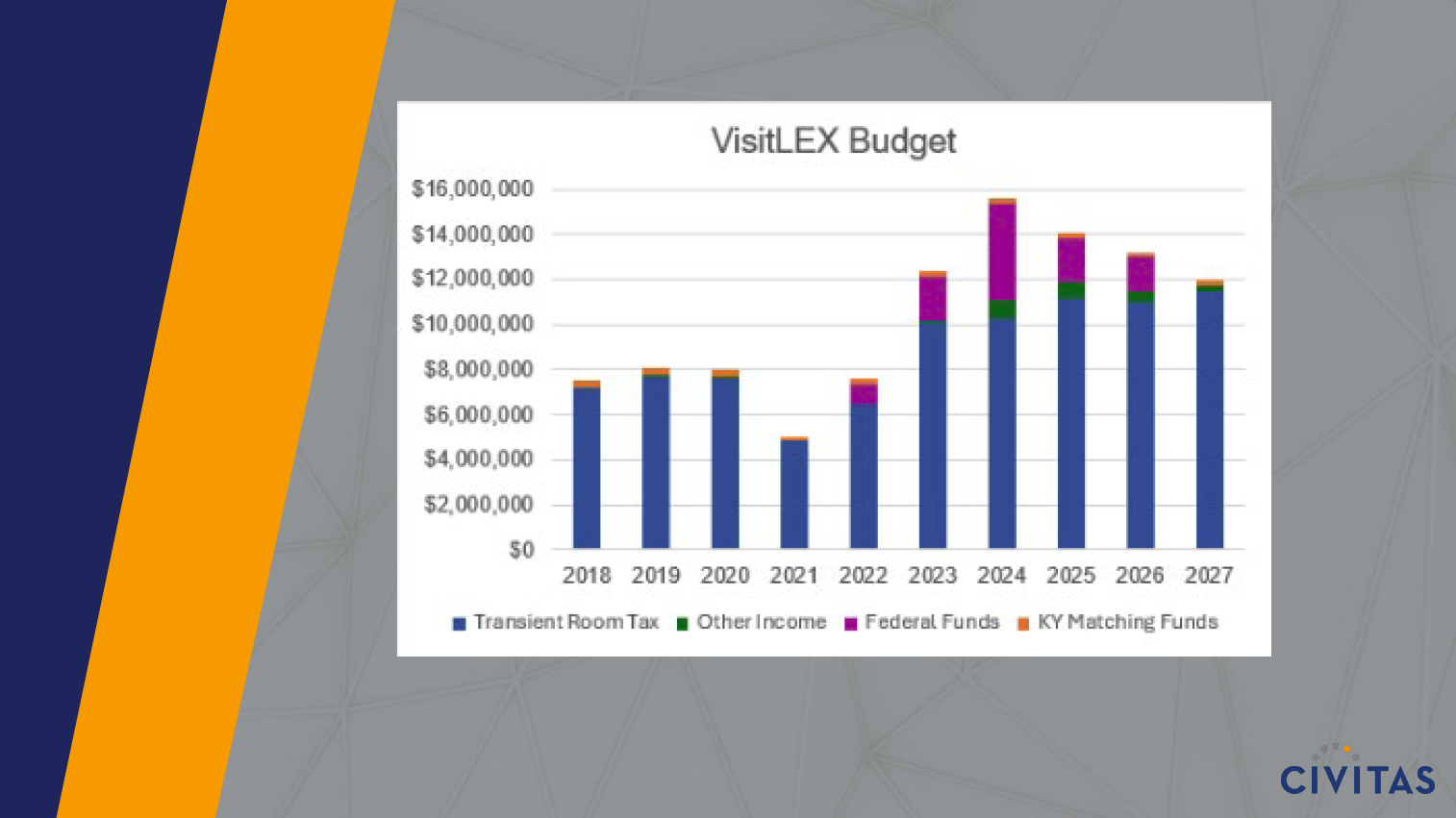
The proposed district would exist alongside VisitLex’s current funding stream: the 9.5% transient room tax that already supports an annual budget of approximately $16 million. In effect, the tourism bureau is asking the public and its elected officials to authorize a significant new revenue source at the same time it is withholding detailed records of how it spends its existing funds.
What the spending records could show
The credit card statements at issue cover a two-year period, 2024 and 2025, and encompass 5,200 individual transactions. These records would provide a detailed, line-item picture of how VisitLex employees use public funds for travel, meals, entertainment, conferences, and other expenses.
The Lexington Times previously obtained credit card records from an earlier period — July 2022 through March 2024 — which showed $427,201.15 in total charges, with significant spending at restaurants, bars, and entertainment venues. Those records were released only after the newspaper filed a prior open records appeal with the Attorney General.
VisitLex’s executive compensation has also drawn scrutiny. The Lexington Times reported in 2024 that four VisitLex employees earn more than Lexington’s mayor, with President Mary Quinn Ramer earning $282,536 in base salary. The bureau distributed $284,745.05 in bonuses during fiscal year 2024, funded through hotel tax revenue, raising questions under the Kentucky Constitution’s prohibition on additional compensation for public employees beyond that set by ordinance.
A pattern across multiple requests
The credit card delay is not an isolated case. On the same day the original request was submitted, the Lexington Times also filed requests for records related to VisitLex’s lobbying activities, governance, vendor contracts, and internal oversight. Across those requests, VisitLex demanded resubmissions, declined to search for records, unilaterally narrowed timeframes, and pre-cited sweeping legal exemptions without applying them to specific documents.
Three formal appeals were filed with the Attorney General on February 18, challenging VisitLex’s handling of the requests. One of those appeals revealed that VisitLex maintains a $60,000-per-year retainer with the law firm McBrayer PLLC for government relations services and has seven registered lobbyists through MML&K Government Solutions — while simultaneously claiming that no contracts, internal communications, or briefing documents related to lobbying exist.
The question before the Council
The convergence of these two tracks — VisitLex’s pursuit of new taxing authority and its resistance to disclosing how it spends existing public funds — puts the Urban County Council in a difficult position. Members will be asked to approve a new revenue mechanism for a public entity whose spending practices remain largely opaque, not because the records do not exist, but because the agency has not released them.
Under the Kentucky Open Records Act, a public agency’s failure to produce records within a self-imposed deadline constitutes a violation of the statute. The Attorney General’s Open Records Division will review the pending appeals and issue decisions that are binding unless challenged in circuit court.