In 2018, the city created one coordinator to fight an epidemic that was killing 200 people a year. By 2024, fatal overdoses had dropped 43 percent. The $7 million in settlement money still hasn’t been spent.
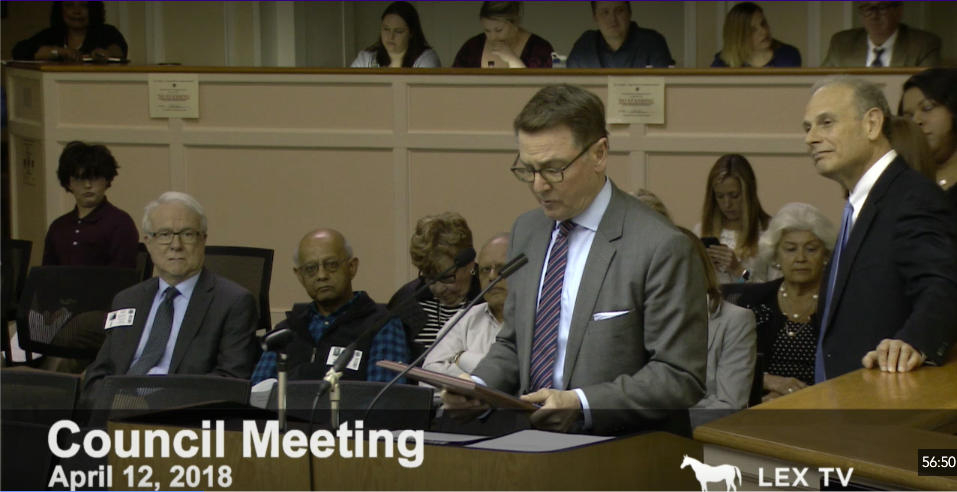
On April 12, 2018, Dr. Svetla Slavova walked to the podium at a Lexington-Fayette Urban County Council meeting to accept the Dr. Rice Leach Health Hero Award. Mayor Jim Gray introduced him. The health department director commended his dedication.
Slavova thanked the council and then did what researchers do — he turned the moment into an argument. He spoke about the importance of making naloxone more readily available to address opioid overdoses. He thanked coworkers at the Department of Health for their partnership.
A few minutes later, the council recognized Rob and Diane Perez, founders of DV8 Kitchen — a restaurant designed to offer second-chance employment to people recovering from substance abuse.
Two recognitions at one meeting. One for the science of keeping people alive. One for the work of helping them live. Between them, the outline of a city’s response to an epidemic that was, at that point, still accelerating.
One Position
Eight months after Slavova’s testimony, on December 4, 2018, the council passed Ordinance 1206-18. It created one unclassified position: Overdose Prevention Project Coordinator, Grade 519N, housed in the Office of the Commissioner of Social Services. The position carried a four-year term ending September 30, 2022.
On March 7, 2019, the council approved the appointment of Maria Slone as the city’s first OPC, at $25.51 per hour, assigned to the Division of Fire and Emergency Services.
That same year, the Community Paramedicine Program launched with two people and a $252,201 federal Bureau of Justice grant, plus a $25,221 city match. The program’s mandate: reach people after an overdose, before the next one.
The Peak
In 2020, Fayette County surpassed 200 overdose fatalities for the first time. The city launched the Recovery Supportive Living Assistance program, a pilot that provided one-time financial help to individuals entering recovery residences — addressing the reality that for many, the barrier to treatment wasn’t willingness but rent.
The council authorized a Comprehensive Addiction and Recovery Act grant to expand naloxone access. The Fire Department received additional grant funding. An agreement with Healing Communities Study, Inc. broadened naloxone distribution.
In 2022, the crisis peaked. Fayette County recorded 210 fatal overdoses and 1,810 non-fatal overdoses in a single year.
The Infrastructure
The city’s response grew in layers. The Expanded First Responders and Community Partners Overdose Prevention Project — EFRCPO — set three goals: distribute naloxone through the health department’s Syringe Service Program and community outreach; train first responders and community partners; and identify “non-traditional locations” for naloxone distribution.
That last goal produced one of the program’s most distinctive features. The OPC began distributing naloxone at gas stations, barbershops, and coffee shops — places where people who would never attend a formal training event might pick up a kit that could save a life.
In January 2024, the council expanded the program, creating two OPC positions and adding a Peer Support Specialist — someone with lived experience in recovery — to the Division of Fire and Emergency Services. The Community Paramedicine Program grew from its original two-person team to 13 staff members, with more than $1.1 million in annual funding.
By 2024, the program’s data showed its reach: the team had followed up with 735 unique individuals in the previous year, 321 of whom had sustained an overdose. The Quick Response Team distributed 230 Narcan kits. Firefighters reversed 356 overdoses. Police officers administered naloxone more than 180 times over two years. One community canvasser, Scott Luallen, distributed more than 5,000 naloxone kits.
The Decline
The numbers turned.
In 2023, fatal overdoses dropped to 177. In 2024, they fell to 120 — a 43 percent decline from the 2022 peak. Non-fatal overdoses dropped from 1,810 to 1,421.
Kentucky’s statewide decline was 30 percent, outpacing the national average of 20 percent. Fentanyl was still present in 62 percent of overdose deaths. Methamphetamine was in 51 percent. The drugs hadn’t changed. Something in the response had.
Mayor Linda Gorton framed it simply: “Every life lost to addiction is one too many.”
Carmen Combs Marks, the city’s Substance Use Disorder Intervention Program Coordinator, offered a more clinical assessment. Prevention, treatment, and harm reduction were working together, she said, “to save lives.”
The Barrier
But Marks also named the obstacle that no program could fully solve.
At an August 2025 council work session, she told the council that the most significant barrier to accessing naloxone was not cost, not availability, not geography. It was stigma. Community members pushed back against being associated with the issue. The fear of being seen — picking up a kit, attending a training, admitting that someone in your life might need the drug that reverses an overdose — was keeping the medication out of the hands that needed it.
It was the reason the OPC had gone to barbershops and gas stations in the first place. If people wouldn’t come to the program, the program would go where the people already were.
The Money
On November 9, 2017, LFUCG had filed suit against opioid manufacturers, distributors, and pharmacies. The case was consolidated into a national multi-district litigation in the Northern District of Ohio.
The settlements came. Over 16 years, Lexington is expected to receive $14.3 million. By mid-2025, approximately $5.9 million had arrived.
In June 2023, the council created the Opioid Abatement Commission to recommend how to spend it. The commission began meeting monthly — every second Friday at 10 a.m. in Council Chambers, open to the public.
As of the June 2025 Social Services and Public Safety Committee presentation, the commission had not yet made formal spending recommendations. The money — millions of dollars extracted from the companies that fueled the epidemic — sat in a city account while the programs built to fight that epidemic ran on federal grants, some of which were now threatened by funding cuts.
What Remains
The RSLA program, which started as a pilot in 2020, now distributes $300,000 per year in recovery housing assistance at $500 per person. The EmPATH center — Emergency Psychiatric Assessment Treatment Healing — opened at Eastern State Hospital to provide an alternative to emergency room visits for behavioral health crises. The Mayor’s Substance Use Disorder Advisory Council meets to guide outreach and advise on treatment and recovery issues.
Fayette County is still ranked 12th among Kentucky’s 120 counties in its opioid crisis burden. An estimated 5,400 to 5,500 people in the county had a known opioid use disorder as of 2019 — a number that preceded the fentanyl wave.
The position that started this — one coordinator, Grade 519N, $25.51 an hour — has multiplied into a 13-person paramedicine team, multiple OPCs, a peer support specialist, a SUDI coordinator, and an advisory council. The $155 the council allocated for Overdose Awareness Day in 2018 has grown into more than a million dollars in annual programming.
The 210 deaths recorded in 2022 have fallen to 120. The $7 million in settlement funds has not been spent.
This investigation was conducted using the LFUCG Meeting Archive, a searchable database of Lexington-Fayette Urban County Government meeting transcripts, summaries, and minutes spanning August 2007 to present.
Sources:
- LFUCG Meeting Archive — Urban County Council, April 12, 2018 (Clip 4496) — Dr. Slavova award, DV8 Kitchen, naloxone testimony
- LFUCG Meeting Archive — Social Services & Public Safety Committee, June 3, 2025 (Clip 6445) — Full SUDI/opioid abatement data, overdose statistics, EFRCPO, litigation timeline
- LFUCG Meeting Archive — Council Work Session, August 26, 2025 (Clip 6528) — Stigma as barrier, paramedicine update
- City of Lexington — Fatal overdose deaths decline in Fayette
- City of Lexington — Community Paramedicine Program
- City of Lexington — Opioid Abatement Commission
- CivicLex — Substance Abuse Intervention Programming Update
- Gov. Beshear: Kentucky Overdose Deaths Decline by 30.2% in 2024
- EMS1: Federal funding cuts threaten Kentucky community paramedicine programs