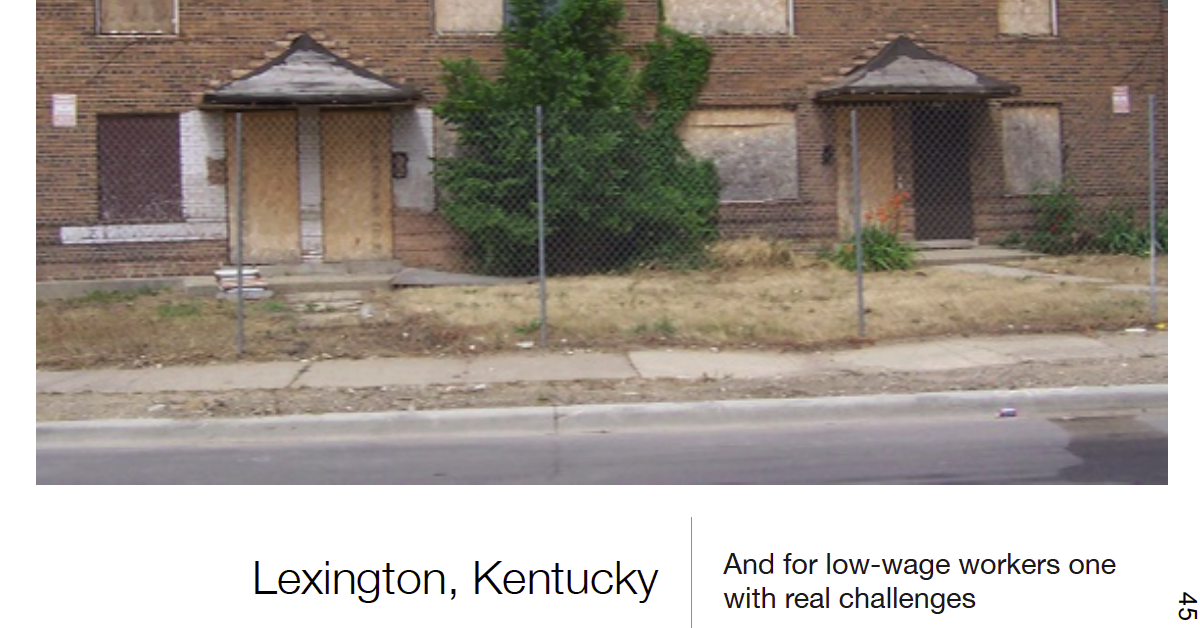
An investigation into nearly 20 years of city meeting transcripts reveals a pattern of study, debate, and deferral — while the affordable housing gap grew from 6,000 units to 30,000.
On a Tuesday afternoon in February 2014, a consultant named Charles Buki stood before the Lexington-Fayette Urban County Council and laid out the math.
Lexington had a shortage of 6,000 affordable rental units. Filling that gap would require roughly $36 million a year — a hole, he told the council, that was “growing by $2.4 million a year annually.”
“Not 6, not 60, and not 600, but 6,000,” Buki emphasized, as if the number itself needed to sink in.
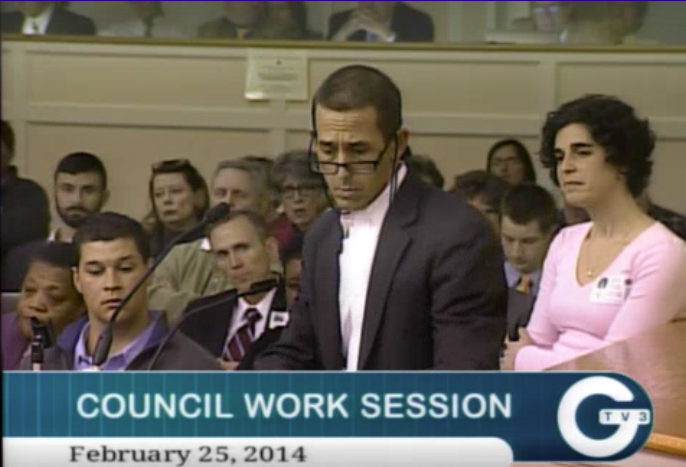
What happened next would set the template for the decade that followed. A council member proposed a funding mechanism — dedicating one percentage point of the city’s existing 5% insurance premium tax to an Affordable Housing Trust Fund. It wouldn’t require a tax increase. The money was already being collected.
The motion to table that proposal passed on Mayor Jim Gray’s tie-breaking vote.
“It was not a good day for the leadership of this council,” Council Member Ford said afterward, “and for low to moderate income people in Lexington.”
That was 12 years ago. Today, according to the city’s own 2024 Affordable Housing Needs Analysis, the shortage has ballooned to 22,000 units — and is projected to reach 30,000 by 2030.
A Crisis in the Archives
The story of Lexington’s affordable housing crisis is preserved, almost line by line, in the publicly available LFUCG Meeting Archive — a database of more than 2,600 city government meeting videos, agendas, and minutes stretching back to August 2007. The Lexington Times used digital tools to distill these meetings into a searchable model, which will eventually be released to the public. Search the full transcripts for “affordable housing” and you’ll find it appears in at least 100 meetings across nearly two decades of council sessions, committee hearings, planning commission debates, and public comment periods.
What those records reveal is not a city that ignored the problem. It’s a city that studied it exhaustively — commissioned analyses, invited experts, held round tables, created offices and boards — while the fundamental gap between need and action continued to widen.
Before the Trust Fund: The Early Warnings
The archive’s earliest affordable housing flashpoints come from 2007, when two debates foreshadowed tensions that would persist for years.
In November 2007, the Planning Committee took up a proposal to regulate student housing density near the University of Kentucky. Property owners pushed back hard, raising concerns about discrimination and housing supply — an early skirmish in what would become a recurring battle between neighborhood character and the need for more housing.
That same month, the Urban County Council Work Session heard from residents of a mobile home park facing rezoning. Their concern was simple: displacement, and nowhere affordable to go. It was one of the first times the archive captures the voice of people for whom the housing crisis wasn’t abstract — it was an eviction notice.
The Tabling: February 25, 2014
The February 2014 Council Work Session remains the archive’s most dramatic affordable housing moment. The meeting lasted over three hours and produced nearly 29,000 words of transcript.
Before Buki and his colleague Karen Beck-Pooley from CZB, LLC even began their presentation, three citizens testified.
David Christensen, a resident of Brennan Drive, was blunt: the housing shortage was “much greater than a problem,” he said. “I would use the terminology crisis.” He pointed to what economists call the paradox of success — Lexington’s growth as a desirable city had driven up rents, while wages at the lower end hadn’t kept pace.
Teddy Smith-Robillard spoke about her experience with mental illness and homelessness. Ike Lawrence called for a homeless commissioner with real authority, someone who could be a “tough love advocate to shrink homelessness, not to grow it.”
Then came the data. CZB’s presentation laid out the scope: 6,000 units short, $36 million a year to close the gap, and the problem compounding annually.
Council Member Kay offered a solution: redirect one of the five percentage points of insurance premium tax the city already collected. No new tax. A dedicated revenue stream for affordable housing.
The motion was tabled. The mayor broke the tie.
Council Member Kay, despite the defeat, struck an optimistic note: “I remain optimistic… I believe what I heard from them was a genuine interest in addressing this issue even if we don’t see the ways to address it in exactly the same way.”
What Eventually Happened
The Trust Fund didn’t die on that February afternoon — it was deferred. Seven months later, in September 2014, the council voted unanimously, 12-0, to create the Affordable Housing Fund and an oversight board. But the dedicated insurance premium tax revenue Kay had proposed was not included. Instead, the council approved an allocation of $2 million per year for four years.
Since then, the city has allocated $38.5 million to the fund — including $25.4 million from the General Fund and $13.1 million from federal American Rescue Plan Act dollars. That money has financed the creation or preservation of more than 3,100 housing units. Today, 1% of Lexington’s General Fund revenue is reserved for affordable housing, which amounted to roughly $4.8 million in Fiscal Year 2025.
Those aren’t trivial numbers. But set against a 22,000-unit shortage — with the city currently building only about 600 new homes per year — they illustrate the gap between incremental policy and the scale of the need.
The Numbers Keep Getting Worse
The trajectory is stark:
- 2014: 6,000-unit affordable rental shortage (CZB analysis)
- 2024: 22,000-unit shortage across all incomes (city-commissioned Needs Analysis)
- 2030 projection: 30,000-unit shortage if current trends continue
Meanwhile, the human cost has intensified. Median rent in Lexington increased 47% from 2019 to 2024, reaching roughly $1,104. More than 54% of renters are now cost-burdened, spending 30% or more of their income on housing. Twenty-eight percent are extremely cost-burdened — half their income going to keep a roof overhead.
Homelessness in Lexington rose 12% in a single year, with the 2025 count finding 925 people without stable housing, up from 825 the year before.
The Missing Tool
One thread running through the meeting archive is especially striking for what it reveals about policy failure beyond Lexington’s borders.
At a September 2025 Planning Commission Work Session — an Affordable Housing Round Table with housing experts from across the region — a participant stated a fact that drew audible frustration: “We are the only state that borders us that does not have a state housing tax credit.”
Every neighboring state — Ohio, Indiana, West Virginia, Virginia, Tennessee, Missouri, Illinois — has a state-level housing tax credit that supplements the federal Low-Income Housing Tax Credit. Kentucky does not. The speaker estimated that adopting one could increase production of affordable housing by 30%.
In November 2025, a Kentucky legislative task force recommended creating exactly such a credit, along with strengthening affordable housing trust funds and establishing a loan fund for residential infrastructure. Whether the 2026 legislature will act remains to be seen.
The Cost of Inaction at Every Level
The September 2025 round table also exposed how the system’s costs compound at the local level. Housing below 80% of Area Median Income “requires subsidy in just about every case,” one participant noted. Even with favorable bank terms and coordination with the mayor’s REACH fund, one project still needed a $100,000 subsidy per unit — “and it’s still going to be tight.”
Infrastructure costs pile on further. Water quality fees, sewer fees, exaction fees — each one individually reasonable, collectively prohibitive for affordable development. Other cities have used density bonuses, fee waivers, and streamlined permitting to offset these costs. The meeting transcripts show Lexington’s housing community is well aware of these tools. Implementation has been slower.
Homelessness: Managing a Crisis
In 2014 — the same year the Trust Fund motion was tabled — Lexington established the Office of Homelessness Prevention and Intervention. Today led by Jeff Herron, the office coordinates services, conducts strategic planning, and manages encampment responses.
In 2025, the office conducted 22 encampment cleanups at 19 locations across the city, at a cost of approximately $65,500. An encampment coordinator was hired to manage responses more systematically.
But the office operates under severe constraints. Local funds make up 69% of its budget, with minimal state support. And now, a major federal shift threatens to make things worse: changes to HUD Continuum of Care funding announced in late 2025 cut what states can spend on permanent supportive housing to about 30%, redirecting the majority toward short-term transitional programs. An analysis by the Corporation for Supportive Housing found the changes could put more than 2,000 Kentucky households at risk of returning to homelessness.
The winter shelter location debate in September 2025 — where the council heard significant public concern about where to put a cold-weather refuge — underscored the NIMBY dynamics that make even emergency responses contentious.
At a Continuum of Care board meeting, attendees discussed a troubling cultural shift: a “general post-pandemic change in how homelessness is viewed and the increasing negative perception towards people who are homeless, particularly downtown.”
The Paradox of Success, Revisited
In his 2014 testimony, David Christensen named the dynamic that continues to define Lexington’s housing challenge. The city’s success — as a university town, a health care hub, a place that attracts talent and investment — drives up the cost of living. Growth creates the very crisis that growth could, theoretically, fund solutions for.
Twelve years later, that paradox hasn’t resolved. Lexington has grown more prosperous and more unaffordable simultaneously. The meeting archive captures this tension in meeting after meeting: planning commissioners debating density bonuses, council members weighing trust fund allocations, housing advocates asking for fee waivers, and neighbors opposing the building next door.
In February 2026, a Lexington nonprofit launched a campaign called “30,000 by 2030,” pushing for the construction of 30,000 new housing units by the end of the decade. At the current rate of 600 homes a year, that would require nearly an eightfold increase in production.
The 2014 consultant’s warning echoes: the hole is still growing.
This investigation was conducted using our LFUCG meeting archives and minutes spanning August 2007 to present. Supplementary reporting drew on current news coverage and public data.