Kentucky General Assembly sends biennial budget to governor’s desk
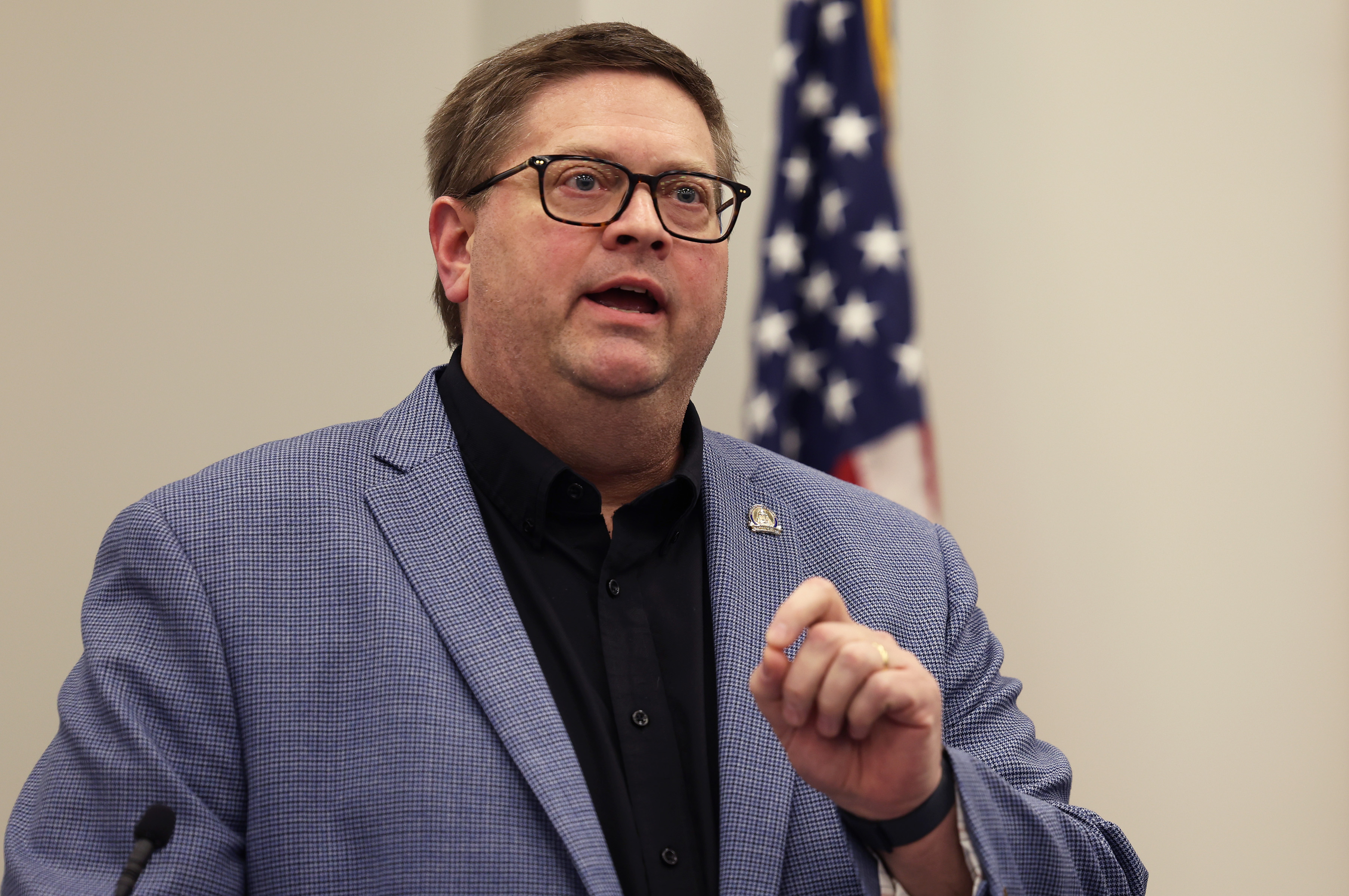
Rep. Jason Petrie, R-Elkton, speaks on House Bill 500 on the House floor on Wednesday. The legislation lays out the state’s executive branch spending plan for the next two fiscal years. A high-resolution photo can be found here.
FRANKFORT — After months of deliberation, the Kentucky General Assembly gave final passage to the state’s spending plan for the next two fiscal years on Wednesday.
Rep. Jason Petrie, R-Elkton, and Sen. Christian McDaniel, R-Ryland Heights, serve as the House and Senate Appropriation and Revenue Committee chairs, respectively, and presented the final numbers on the chamber floors.
Petrie told House members that House Bill 500 – the proposed executive branch budget – is tailored toward “disciplined fiscal management.”
“After much discussion, I’m happy to report that we still have a shared commitment across both chambers of the general assembly to a disciplined fiscal management, prioritizing needs over wants, making sure we live within our revenue means and focusing on core public needs,” Petrie said.
HB 500 makes investments in public education, health care, infrastructure and public safety, according to Petrie.
The legislation also makes a commitment to implementing spending reductions across most state agencies to improve efficiencies and curb any excess, Petrie said. He said this directive shows a strong commitment to ensuring the budget reserve trust fund remains well-funded.
Additionally, HB 500 proposes,
- Investing $6.2 billion in the general fund over the biennium toward Medicaid with an additional $290 million allocation reserved for future use if necessary.
- Increasing public pension and retirement system contributions and reducing long-term liabilities.
- 2% salary raises for state employees in both the 2026-27 and 2027-28 fiscal years.
- Funding the Dolly Parton Imagination Library with a focus on prioritizing children in foster care.
- Increasing the funding formula for schools, also known as SEEK, to $4,626 per pupil in the 2026-27 fiscal year and to $4,792 per pupil in the 2027-28 fiscal year.
On the Senate floor, McDaniel spoke on the long, sometimes stressful, budget drafting process.
“If there’s one reason … that this task can get done, it is because of the phenomenal work of the staff here affiliated with it,” he said.
In the House, several members spent more than an hour asking questions and expressing concern about funding pertaining to health care, mental health care, juvenile justice, foster care and more.
Rep. Lisa Willner, D-Louisville, said she was grateful to see funding for student mental health in the legislation, but noted the appropriation had not seen an increase since 2020.
Willner also spoke on her desire to have seen funding for a juvenile justice facility for high acuity youth in a mental crisis.
“Many of these kids are essentially in solitary confinement in a juvenile justice facility,” she said. “No hospital can take them because they’re too aggressive, too violent. And I really felt that having this facility in place was going to be very, very important for addressing some of the other challenges within juvenile justice. So it’s disappointing we keep kicking that can down the road. Those costs are only going to continue to rise.”
House Minority Floor Leader Pamela Stevenson, D-Louisville, said HB 500 does not adequately fund Medicaid, despite the state having the proper funds to do so.
“We are marching towards getting rid of Medicaid,” she said. “This budget has a known gap of $400 million. We know it’s a gap. We know people are going to go without … This is not a situation where we don’t have the money.”
House Speaker Pro-Tempore David Meade, R-Stanford, disagreed.
“The money is adequate for this program, plus the backstop that is put in,” he said.
The Senate voted 38-0 on HB 500, and the House voted 73-21. Petrie reiterated the legislation funds priorities in the commonwealth.
“Restraining the growth in spending is not a cut,” he said.
The Kentucky General Assembly also passed House Bill 501, the proposed transportation cabinet budget; House Bill 503, the proposed legislative branch budget; and House Bill 504, the proposed judicial branch budget on Wednesday.
All four bills are now on the governor’s desk for his consideration.