🌎 Resumen en español · traducción automática
Lexington inauguró su primer marcador histórico del Proyecto de Remembranza Comunitaria de la Iniciativa por la Justicia Equitativa para conmemorar a Robert Charles O'Hara Benjamin, un activista de derechos civiles asesinado en 1900 mientras ayudaba a hombres negros a registrarse para votar. El evento, celebrado durante Soulfest en Gatton Park, incluyó el descubrimiento del marcador y la recolección de tierra del sitio donde Benjamin fue asesinado, con muestras que se preservarán en el Museo de Historia de Lexington y en la sede de la organización en Montgomery, Alabama. Con esto, Lexington se une a otras comunidades de Kentucky como Shelbyville, Frankfort, Mount Sterling y Owensboro en el reconocimiento de la violencia racial que ocurrió después de la Guerra Civil.
Traducción y resumen generados por IA a partir del artículo en inglés. Puede contener errores; consulte el texto original.
One of Lexington’s biggest Juneteenth events now takes place at Gatton Park; on Saturday, Soulfest filled the amphitheater with the smells of BBQ while music wafted from the stage as friends hugged and visited.
And a little way off from the party, a man wept.
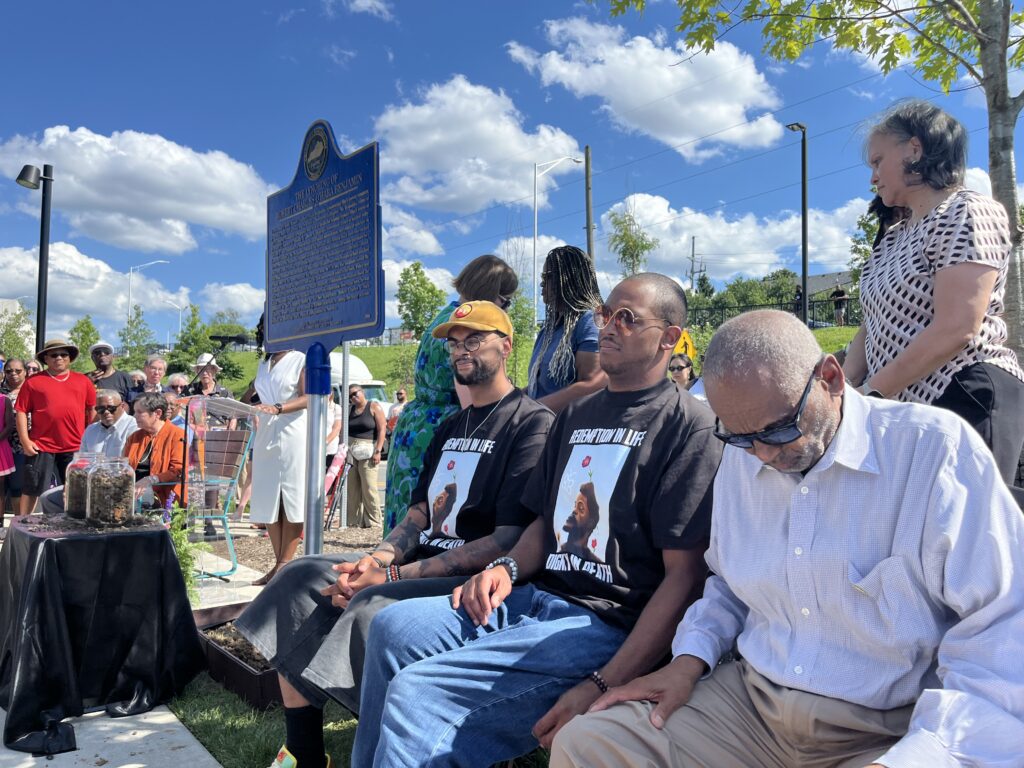
DeBraun Thomas had waited and worked for this moment for the past 10 years. Amidst all the celebrations, a historical marker had just been unveiled to commemorate the death of Robert Charles O’Hara Benjamin, who was shot in the back by a white man as he tried to register Black voters on Oct. 2, 1900.
Thomas had visited Benjamin’s grave site in African Cemetery #2 earlier that morning.
“He’s been an unsung hero for so long,” Thomas said, as he stood alongside his friend and colleague Russell Allen, who started with him in this work in 2016. “This has been so much work and I’m so grateful.”
“This” is Lexington’s first Equal Justice Initiative’s Community Remembrance Project, joining similar markers in Shelbyville, Frankfort, Mount Sterling, and Owensboro among others that commemorate Kentucky’s horrific history of racial violence after the Civil War.
EJI is the brainchild of Bryan Stevenson of “Just Mercy” fame. The civil rights lawyer created two sites in Montgomery, Ala., the Legacy Museum, which documents the 400 years of U.S. history, linking slavery to modern mass incarceration, and the National Memorial for Peace and Justice, a haunting and beautiful tribute to the more than 4,400 lynchings in this country.
At Saturday’s event, Benjamin’s marker was unveiled, and participants filled two large jars with soil from where Benjamin was killed near what’s now the downtown Hyatt. The Community Soil Collection at the Legacy Museum will hold one of them; the Lexington History Museum the other.

“We are reconciling with history that must be told,” Thomas said. “We still have a whole lot of other people who should be recognized.”
A Renaissance man
Still, R.C.O. Benjamin is an extraordinary figure to start with, a Renaissance man who was killed at just 45 years old. He was a teacher, poet, journalist, minister and activist who started his life on the Caribbean island of St. Kitts, and, according to former Herald-Leader columnist Tom Eblen, set precedents wherever he went, including the first Black lawyer in Virginia and Alabama, the first Black lawyer to practice law in California courts and the first Black editor of numerous newspapers around the country.

He was the editor of the Lexington Standard and a minister at Pleasant Green Missionary Baptist Church.
On Oct. 2, 1900, Benjamin got into an argument with a white precinct worker named Mike Moynahan, who was challenging Black residents who were trying to register to vote. Later that day, Moynahan shot him in the back, at the corner of Spring and Water Streets. An inquest ruled it justifiable homicide.
Historian George Wright started documenting Kentucky’s murderous history with his 1996 book “Racial Violence In Kentucky 1865-1940: Lynchings, Mob Rule, and “‘Legal Lynchings.’” He got interested in Benjamin then, and later this year, the University Press of Kentucky will publish his 400-page biography of the man.
Early in his career in California, Benjamin published a pamphlet titled “Southern Outrageous,” about lynchings, which Wright tracked down to the University of California at Berkeley. “That pamphlet really predicted the kind of violence he would be a victim of,” Wright said after the ceremony.
As a society, we have always moved forward and backward on race, making incremental progress as we go. We are now in the midst of a political backlash trying to undo progress by denying this history, purging the military of Black people and women, tearing down literal and figurative historical markers that lay out the proof of wrongdoing.
As a border state that didn’t actually join the Confederacy during the Civil War, Kentucky has a complicated relationship to its history of enslavement. That’s where Allen and Thomas started: trying to make the case that Lexington should not showcase Confederate statues in what was once one of the largest slave markets in the country, also known as Cheapside. They succeeded in that quest, and finally succeeded in this one as well.

Lexington and communities all over the state are now putting out a clearer vision of who we are and what we did. Last week, for example, Gov. Andy Beshear pardoned 43 people who’d been imprisoned in Kentucky for helping enslaved people escape on the Underground Railroad, as well as declaring Juneteenth an executive branch holiday.
Wright and his wife, Valerie, worked on the marker, and helped fill the jars of dirt on Saturday.
“The concept of remembrance is an important step to reconciliation,” he said. “You’ve got to remember the horrors. It’s not about making people feel bad but it’s an acknowledgement.”