On the November ballot in eight central Kentucky counties — Bourbon, Clark, Fayette, Franklin, Jessamine, Madison, Scott and Woodford — there is a line most voters will skip. It asks them to choose a judge for the Kentucky Court of Appeals, the court one step below the Supreme Court that decides the appeals which never make headlines: a custody ruling, an insurance fight, the size of a jury’s damage award, whether a conviction holds. The candidates run with no party label. Most people will leave the line blank.
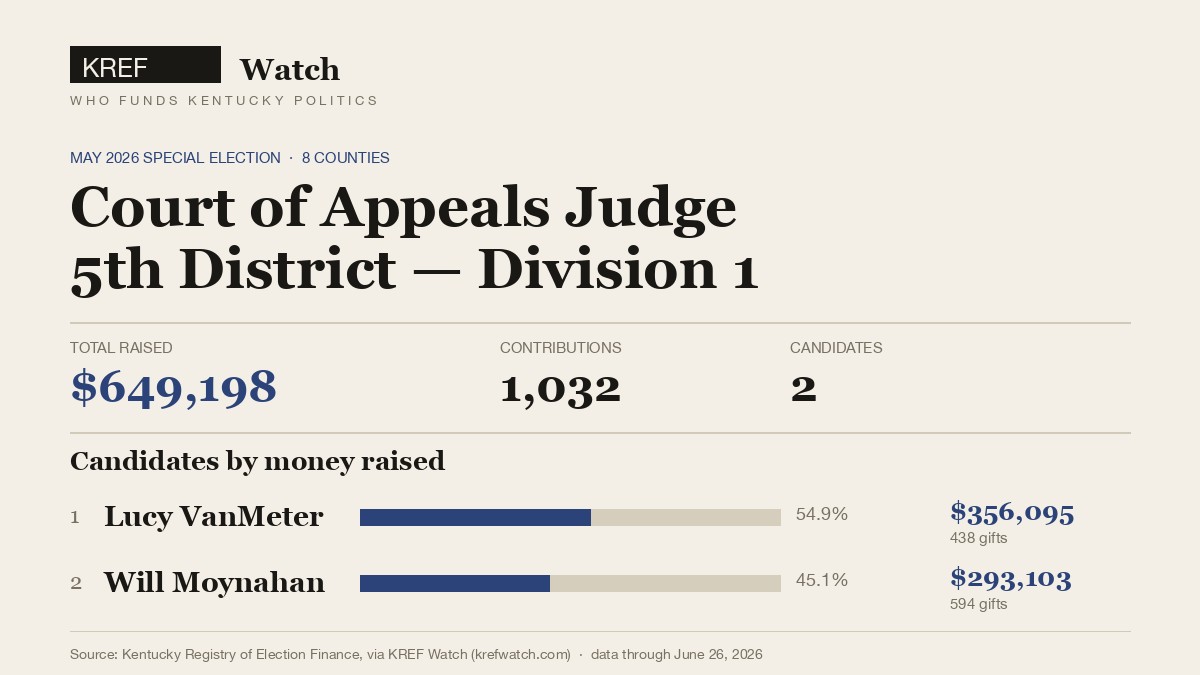
Behind that blank line is about $649,000.
That is what the two candidates for a single appellate seat — Court of Appeals, 5th District, Division 1 — have raised between them, according to filings with the Kentucky Registry of Election Finance. It is real money for a race with no party, no national stakes and almost no coverage. And a striking share of it arrives in $2,200 checks, the most an individual can legally give. Read the donor list and those checks stop looking random. They sort, almost perfectly, into two networks — two versions of who runs Kentucky — facing each other across a ballot line built to look apolitical.
The seat, and the wall of identical checks
The seat came open in January 2025, when Justice Pamela Goodwine was elevated to the Kentucky Supreme Court. Governor Andy Beshear appointed Will Moynahan — an assistant U.S. attorney in the Eastern District of Kentucky — to hold it. Now Moynahan, the appointed incumbent, faces Lucy Ferguson VanMeter, a Fayette Circuit Court judge since 2018 and, before the bench, a 17-year equity partner at the Lexington firm Stoll Keenon Ogden. Only the two of them filed, so the May primary was canceled. They meet on November 3.
Start with the thing that makes a judicial race look strange: the column of identical $2,200 checks. It is not a conspiracy. Kentucky caps an individual contribution at $2,200 per election. An appellate campaign across eight counties needs real money for mail and television and name recognition in a contest where most voters know nothing about either candidate — and under a low cap, the only way to reach a few hundred thousand dollars is to stack a few hundred people who each give the legal maximum. A long list of max-out donors is simply what a serious judicial campaign looks like. The interesting question is never why they maxed out. It is who they are.
One side: the trial bar, labor, and the Beshear circle
Moynahan raised about $293,000. More than a third of it came from donors who listed their occupation as lawyer — against roughly a fifth on the other side — and the names read like a roster of Kentucky’s plaintiff’s bar: Hans Poppe, Ann Oldfather and Gregory Bubalo of Louisville, the Golden Law Office of Lexington, the managing partner of Morgan & Morgan’s Kentucky offices. These are the firms that sue hospitals and insurers and corporations — the lawyers whose verdicts are upheld or undone, on appeal, by the court Moynahan now sits on.
Around that core sits organized labor — the Ironworkers, and the Teamsters’ powerful Louisville Local 89 — and the teacher-aligned Better Schools Kentucky PAC. In fact every dollar of political-action-committee money in the entire race went to Moynahan; VanMeter took none. And threaded through his individual donors is the Democratic establishment that produced his appointment: former Governor Steve Beshear, the current governor’s father; Jamie Eads, the Beshear-appointed head of the state’s horse racing and gaming regulator; and Frank Shoop, among the Beshears’ largest career donors. Past the state line, a scattering of out-of-state money — the Democratic mega-donor Ian Simmons of the Blue Haven Initiative among the names — tracks Moynahan’s Harvard, Navy and Justice Department past more than any Kentucky interest.
The other side: the horse farms, the old firms, and the family
VanMeter raised about $356,000 — somewhat more than the appointed incumbent. She did it with far fewer lawyers by share, no PAC money at all, tens of thousands of dollars of her own, and a donor list that reads like a directory of the Bluegrass establishment.
The horse country is all there: Helen Alexander, the Thoroughbred breeder and a granddaughter of King Ranch’s Robert Kleberg; John Phillips of the historic Darby Dan Farm; the family behind W.T. Young LLC — Overbrook Farm, the fortune built on what became Jif peanut butter, the namesake of the University of Kentucky’s main library; Walter Gross III of the G&J Pepsi bottling family. Add the sitting Senate President Pro Tempore, Republican David Givens, and a partner from her old firm, and you have business-and-bench Kentucky writing checks for one of its own.
And then there is the part that is impossible to look past. Two of the donors to Judge VanMeter’s campaign are Laurance B. VanMeter — who, until about a year and a half ago, was the Chief Justice of Kentucky — and his son, a Sullivan & Cromwell lawyer in California. The former Chief Justice gave $2,150; his son gave the $2,200 maximum. Laurance VanMeter is Lucy Ferguson VanMeter’s husband — and before he led the state’s court system, he sat on the very Court of Appeals his wife is now running to join. The recently retired head of Kentucky’s judiciary is a near-maximum donor to her campaign for that bench.
None of this is a scandal. That is the point.
It needs saying plainly: nothing described here is illegal, and almost none of it is even unusual. A spouse may give to a spouse’s campaign, and a husband supporting his wife’s candidacy is the most ordinary thing in the world. Lawyers fund judges in every state that elects them; family money and old friends fund first-time candidates everywhere. There is no allegation here, against anyone, of anything.
What the donor list does is make visible the thing the “nonpartisan” label is designed to hide: that a judgeship is a prize two organized networks want, and that the people most invested in who wins are the people whose interests come before that court. On one side, the plaintiff’s bar, labor and a Democratic governor’s circle. On the other, the defense-side establishment, the horse-farm gentry, a Republican legislative leader and a judicial family. The ballot line says these candidates have no politics. The money says otherwise — not cleanly Democrat versus Republican (the establishment candidate’s backers include a Republican Senate leader, while the incumbent’s include a Democratic governor’s circle) so much as one Kentucky versus another.
This is why judicial money is not like other money. When a state senator takes a maxed-out check, the worst case is a vote. When a judge takes one from a lawyer who will later stand at her bench, the question becomes whether the person who loses in that courtroom got a fair hearing. The U.S. Supreme Court said as much in 2009 in Caperton v. Massey, an Appalachian coal case in which a West Virginia justice refused to step aside from a lawsuit involving the man who had spent some $3 million to help put him on the bench; the Court held that the Constitution required recusal. No one in this race is a Caperton. But the principle — that campaign cash and a courtroom can collide — is precisely why the people of eight Kentucky counties deserve to see who is paying for their next judge.
They can. Every check described here is a public record, filed with the Registry of Election Finance and searchable in an afternoon. The trouble is that almost no one looks, because judicial races are the part of the ballot the press covers least and voters skip most. On November 3, central Kentucky will choose an appellate judge — or, more likely, most ballots will leave the line blank and let the few who did their homework decide. Either way the money is already raised, and the networks behind it are already plain. Somebody should be watching.
This commentary was researched and drafted with AI assistance by The Lexington Times newsroom agent team (Claude Opus 4.8) and finalized for publication by The Lexington Times. Every dollar figure was computed directly from the candidates’ own filings with the Kentucky Registry of Election Finance for the Court of Appeals, 5th District-1st Division race, and was checked to exclude contributions to an unrelated 2026 Lexington City Council candidate who shares the VanMeter surname. Donor identities and affiliations were verified against the employers and occupations stated in the filings and corroborating public records and news reports; where a contributor’s tie is characterized, it rests on those sources.
Republishing: This is original Lexington Times reporting, licensed under Creative Commons CC BY-ND 4.0. You may republish this article, in full and unaltered, for free — including commercially — with credit to The Lexington Times and a link to the original.