🌎 Resumen en español · traducción automática
Agentes federales en Lexington acusaron a tres hombres de tráfico de drogas en un lapso de aproximadamente 48 horas esta semana, en casos separados que en conjunto representan más de 50 libras de metanfetamina, aproximadamente tres libras de cocaína, fentanilo, crack, al menos cinco armas de fuego y una prensa hidráulica utilizada para comprimir polvo en ladrillos de tamaño de kilo. Los tres fueron acusados por querella criminal el 22 y 23 de julio y comparecieron por primera vez ante el Juez de Magistrado Federal Matthew A. Stinnett en el Distrito Oriental de Kentucky en Lexington, con los casos construidos por la Oficina Residente de la DEA en Lexington e Investigaciones de Seguridad Nacional en colaboración con el Departamento de Policía de Lexington.
Traducción y resumen generados por IA a partir del artículo en inglés. Puede contener errores; consulte el texto original.
Federal agents in Lexington charged three men with drug trafficking in the span of about 48 hours this week, in separate cases that together account for more than 50 pounds of methamphetamine, roughly three pounds of cocaine, fentanyl, crack, at least five guns and a hydraulic press of the kind used to compress powder into kilo-sized bricks.
All three were charged by criminal complaint on July 22 and 23 and made their first appearances before U.S. Magistrate Judge Matthew A. Stinnett in the Eastern District of Kentucky at Lexington. The cases were built by the DEA’s Lexington Resident Office and Homeland Security Investigations, working with the Lexington Police Department. None of the three has been indicted, and the allegations described below are drawn from sworn affidavits filed by the investigating agents — probable-cause accusations, not proof. Each defendant is presumed innocent.
51 pounds of meth, a rifle and a kilo press
The largest of the three cases is against Tararey Jamelle Taylor, whom the DEA describes as a significant methamphetamine trafficker.
According to an affidavit by DEA Task Force Officer Travis Steward, agents had been watching Taylor and, on July 22, obtained a state search warrant for a residence on Mousas Way and two vehicles. That afternoon they stopped Taylor at the drive-up window of a liquor store on Richmond Road. As they took him into custody, the affidavit says, methamphetamine was scattered across the driver’s seat and floorboard, and a loaded Beretta .40-caliber handgun sat within reach on the passenger seat. Agents say they found a freezer bag holding about 184 grams of suspected meth in the car; a database check showed Taylor is a convicted felon, barred from having a gun.
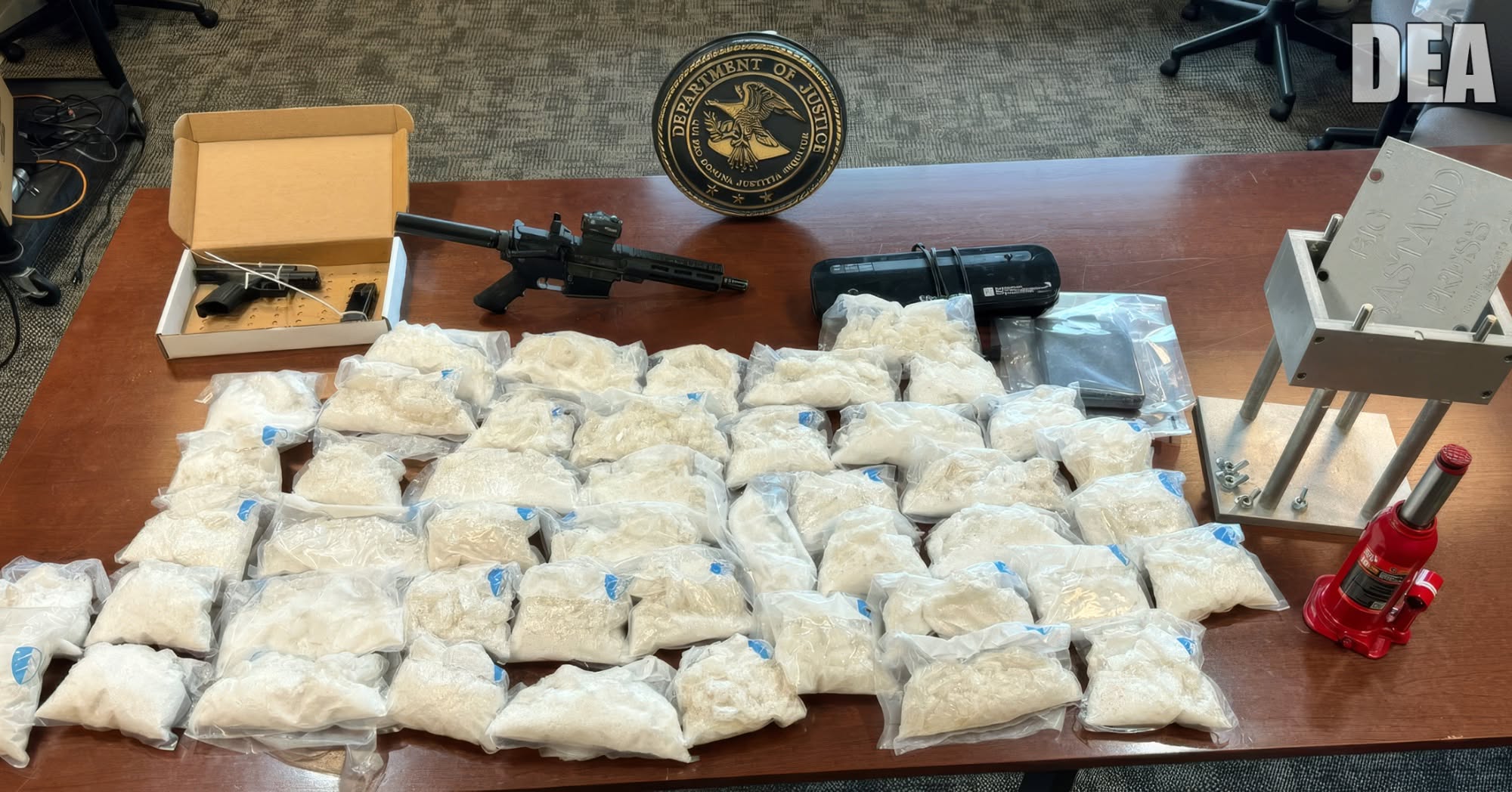
Agents then searched the Mousas Way home. In a trash can behind the house, the affidavit says, they found about 51 pounds — roughly 23,000 grams — of suspected methamphetamine in individually vacuum-sealed bags, stuffed inside a distinctive backpack that a surveilling officer reported seeing Taylor carry the night before. A second trash can held tubs of MSM, a common cutting agent, and empty vacuum-seal bags. Inside the house, agents reported finding suspected fentanyl, suspected crack cocaine, a loaded AR-style rifle lying in a pile of laundry, and a large hydraulic kilo press. After the search, the affidavit says, Taylor denied the 50-plus pounds but admitted he “only had a pound on him” in the car.
Lexington police said the Wednesday warrant — carried out with the DEA, the ATF and Kentucky State Police — yielded more than 50 pounds of meth, firearms and a small amount of fentanyl. The DEA’s Louisville Division publicized the haul on Facebook the next day, posting a photo of dozens of bagged bricks of suspected meth arrayed on a table alongside two guns and the red hydraulic press. Taylor is charged with possession of methamphetamine with intent to distribute. He is represented by court-appointed counsel; Assistant U.S. Attorney Aubrey Girouard is prosecuting.
Asleep at the wheel at New Circle Road
The second case began with a 911 call about a dark SUV blocking traffic. Just after 2:30 a.m. on July 14, according to an affidavit by DEA Task Force Officer Thomas Clements, Lexington officers found Teyo J. Waite asleep behind the wheel of an SUV stopped on the ramp from New Circle Road to Georgetown Road, the vehicle still in gear with his foot on the brake. Officers who couldn’t rouse him — even by rocking the vehicle — broke a window out of concern he was having a medical emergency, the affidavit says.
After Waite was woken and asked to step out, officers reported seeing a loaded handgun with an extended magazine between the seat and console. A search of the SUV, the affidavit says, turned up a bag containing about 209 grams of suspected methamphetamine and about 128 grams of suspected fentanyl powder, a digital scale, roughly $4,485 in cash and packaging materials. Waite is charged with possessing methamphetamine and fentanyl with intent to distribute. Assistant U.S. Attorney Amanda Morgan is prosecuting.
Cocaine in a Lego box, shipped from the border
The third case, worked by Homeland Security Investigations, centers on Erik Maldonado-Hernandez. On July 1, according to an affidavit by HSI Special Agent Blake Leathers — a former LPD narcotics detective — Lexington detectives executed a state search warrant at a Loudon Avenue apartment, finding a small amount of cocaine, digital scales with residue and a card for a nearby self-storage facility.
A drug-detection dog alerted at one unit at the storage facility on Newtown Pike, the affidavit says, and a follow-up warrant turned up about 1,268 grams — nearly three pounds — of cocaine hidden inside a Lego box within a shipping box. The shipping label, according to the affidavit, showed the parcel had been sent from Penitas, Texas, a town on the southern border, and addressed to Maldonado-Hernandez. Agents also reported seizing a handgun, a rifle and a vacuum sealer. He is charged with possession of cocaine with intent to distribute.
What happens next
A criminal complaint is only the first step in a federal case. To move forward, prosecutors must persuade a grand jury to return an indictment — typically within about 30 days — or the defendant may waive that step. Detention questions, guilty pleas or trials all come later. Until then, the sworn affidavits represent one side’s account, and each man is entitled to the presumption of innocence.
This report is based on the criminal complaints and supporting affidavits in United States v. Taylor (No. 5:26-mj-05190), United States v. Waite (No. 5:26-mj-05188) and United States v. Hernandez (No. 5:26-mj-05189), all filed in the U.S. District Court for the Eastern District of Kentucky and available on CourtListener (Waite, Hernandez), and on the Lexington Police Department’s and DEA Louisville Division’s public statements about the Taylor seizure.
Sources
- Criminal complaint & affidavit, United States v. Tararey Jamelle Taylor, No. 5:26-mj-05190-MAS (E.D. Ky. filed July 23, 2026)
- Criminal complaint & affidavit, United States v. Teyo Waite, No. 5:26-mj-05188-MAS (E.D. Ky. filed July 22, 2026)
- Criminal complaint & affidavit, United States v. Erik Maldonado-Hernandez, No. 5:26-mj-05189-MAS (E.D. Ky. filed July 22, 2026)
- “Lexington police help DEA execute drug trafficking warrant, seize meth and fentanyl,” WKYT (July 23, 2026)
This report was drafted with AI assistance (Claude Opus 4.8) and finalized for publication by The Lexington Times. It is based on the criminal complaints and supporting affidavits filed by federal agents in three Eastern District of Kentucky cases (5:26-mj-05188, -05189 and -05190), on the docket records available via CourtListener, and on the Lexington Police Department’s and DEA Louisville Division’s public statements. The affidavits contain probable-cause allegations, not findings of guilt; each defendant is presumed innocent. The cover photograph is a work of the U.S. Drug Enforcement Administration.
Republishing: This is original Lexington Times reporting, licensed under Creative Commons CC BY-ND 4.0. You may republish this article, in full and unaltered, for free — including commercially — with credit to The Lexington Times and a link to the original.