🌎 Resumen en español · traducción automática
Kentucky enfrenta el riesgo de perder ingresos fiscales locales significativos si los centros de datos logran asegurar exenciones tributarias mediante argumentos legales aún no resueltos sobre si califican como instalaciones de manufactura o procesamiento industrial. Si los tribunales reconocen esta clasificación, los centros de datos podrían obtener exenciones del impuesto sobre ventas en costos de energía y del impuesto sobre ingresos brutos de servicios públicos para distritos escolares, además de exenciones completas del impuesto a la propiedad local en equipos. Estas reducciones fiscales se sumarían a las ya generosas exenciones estatales de impuestos sobre ventas, dejando a gobiernos locales y escuelas con mucho menos ingreso del que prometen los defensores de estos proyectos.
Traducción y resumen generados por IA a partir del artículo en inglés. Puede contener errores; consulte el texto original.
As Kentucky’s local governments weigh whether to welcome hyperscale data centers, supporters point to a tempting promise: a surge in local tax revenue from property taxes and school district utility gross receipts taxes.1 For cash-strapped counties and schools struggling after decades of state disinvestment, that’s a real draw.
But that promised revenue may be much smaller than advertised if data centers and their lawyers successfully secure significant tax breaks that have not yet been part of the public conversation. These local-level tax breaks would be in addition to the potential billions of dollars that the state could lose from its own generous sales tax exemptions, and would come with lower state taxes as well.
Are data centers manufacturing or industrial processing facilities? If so, they may qualify for massive additional tax breaks
A major, but quietly unanswered question is whether data centers count as “manufacturing” or “industrial processing” facilities. On its face, this notion seems like a stretch — data centers don’t make cars, appliances, or any other type of physical product. But a prominent Kentucky law firm that has represented data centers has argued they should qualify anyway. The question is unsettled and will likely be decided in court.
The stakes of that classification are huge. If data centers qualify as manufacturers or industrial processors, they could receive:
- An exemption from sales tax on energy costs above 3% of production costs, with the same exemption applying to the utility gross receipts tax for schools. This break results in especially significant savings for facilities that use enormous amounts of power, like data centers, and a significant loss of revenues for the state and school districts. In addition, data centers that generate their own power would owe none of these taxes at all since they would not be purchasing energy from a third party.
- A full exemption from local property tax on equipment used in manufacturing or industrial processing operations, which would include all the equipment purchased under the industry-specific sales tax exemption, and a reduced state rate of $0.15 per $100 of depreciated value (only 1/3 of what they would otherwise pay). If data centers secure this classification, school districts and local governments could lose most of the revenue that made hosting a data center attractive in the first place and that developers are promoting as they try to sell communities on accepting data centers.
Industrial revenue bonds issued by local governments can provide data centers with a property tax exemption for up to 40 years
In some cases, the issuance of an industrial revenue bond (IRB) by the state or a local government provides needed financing for a project, but their most common use is to help a company avoid paying local property taxes for up to 40 years.2 Until recently, it was unclear if data centers would quality for IRBs. But an August 2025 opinion from the Kentucky Attorney General provided data center developers a clear path to ask local governments to include an IRB in their benefits package on top of everything else.
Here’s how an IRB works – the local government, most typically a county, “buys” the company’s buildings and equipment, then leases it back to the company. Since property owned by the government is constitutionally exempt from the property tax, the arrangement erases the tax bill. The benefited companies do have to pay property tax at a much-reduced rate on the value of the leasehold interest, and they sometimes enter into voluntary payment in lieu of taxes or PILOT agreements with local governmental entities that would otherwise receive tax revenues, most commonly school districts.
Data center tax contributions will be far lower than advertised if these additional tax breaks are given
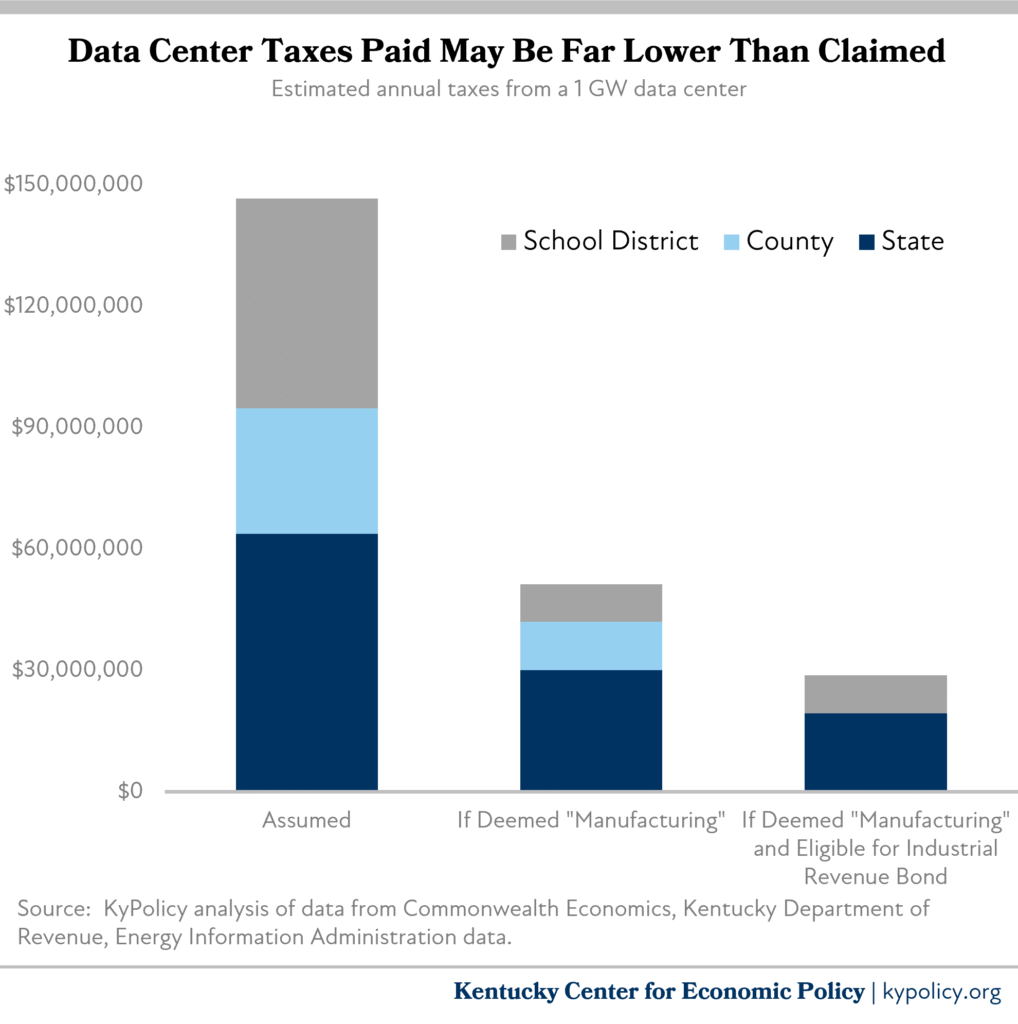
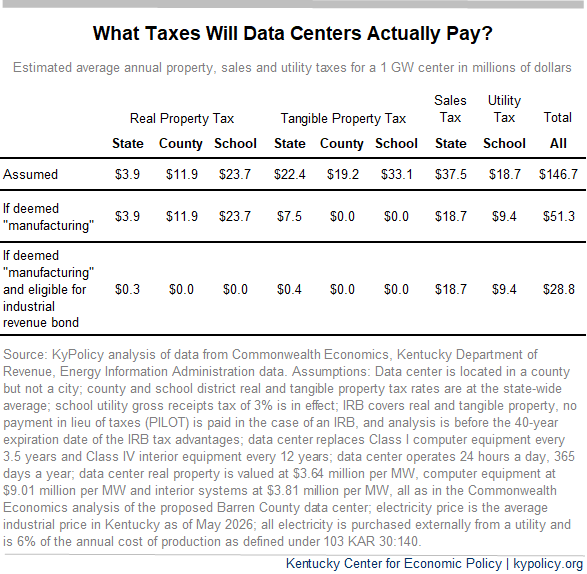
The graph below shows the potential impact in the case of a hypothetical 1 GW data center. Such a center would pay a fraction of the state and local taxes that have been promised by developers if they are successful in winning designation as a manufacturing facility and gaining access to local IRBs (see Appendix for more detail).
Kentucky doesn’t need to give this much away
A recent report prepared for the Kentucky General Assembly by the Energy Planning Inventory Commission notes: “The state offers among the nation’s lowest industrial electricity rates, available land, abundant water resources, a growing fiber infrastructure, and a regulatory environment with a demonstrated record of supporting large economic development projects.” These benefits were also noted by FBT Gibbons in its series on data centers, as well as Blueprint for Kentucky in its piece on data centers.
In other words, Kentucky is already a strong contender for these types of investments without stacking on added tax breaks. Data center developers are touting the amount of local tax revenue for schools and localities their facilities would generate even while at least one prominent law firm that represents data centers is promoting a legal theory that could make much of those revenues go away.
Many policy makers are asking more questions about the purpose and place of data centers in Kentucky. To the extent data centers are allowed, state lawmakers should revisit whether the data-center-specific tax exemption is necessary and take active steps to close off the IRB and manufacturing exemption possibilities for data centers before they significantly undermine the local revenue data centers are supposed to provide.
Appendix
The post How Data Centers Could Avoid Paying Local Taxes appeared first on Kentucky Center for Economic Policy.