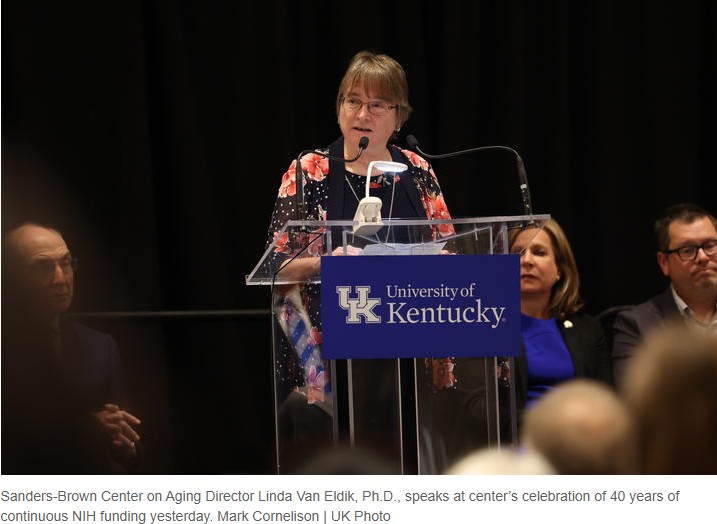
The University of Kentucky Sanders-Brown Center on Aging celebrated its 40th year of continuous funding from the National Institutes of Health for its work in the field of Alzheimer’s and dementia at an Oct. 15 ceremony.
“For four decades, the Sanders-Brown Center on Aging has ensured that discoveries reach the people who need them most. The center shows us what it means to connect knowledge to humanity, and it reminds us that compassion is as essential to discovery as curiosity,” UK President Eli Capilouto said in a news release. “As we look ahead, the work here will continue to shape what’s possible — through new technologies, deeper collaboration and a commitment to prevention as well as care.”
As a National Institute on Aging-designated Alzheimer’s Disease Research Center (ADRC) — one of just 37 in the country — Sanders-Brown has played a crucial role in advancing scientific knowledge, improving patient care and fostering hope for millions of families affected by dementia, according to the release.
“The $28 million investment in their groundbreaking research represents so much more than bricks and mortar. This is an investment in hope for the more than 81,000 Kentuckians aged 65 and older living with Alzheimer’s disease,” Sen. Amanda Mays Bledsoe, R-Lexington, said in the release. “The work being done here also brings comfort and support to the countless families, friends and caregivers who walk alongside their loved ones every day in this fight,”
To earn this NIH designation, centers must demonstrate excellence in multiple areas of dementia research and care. Each institution is competitively renewed every five years based on scientific performance and impact, which the release says underscores the remarkable achievement of Sanders-Brown in maintaining continuous NIH funding for 40 years, making it one of only nine centers to do so.
A legacy of discovery
“Sanders-Brown has truly been a national leader,” Linda Van Eldik, director of the Sanders-Brown Center on Aging and its ADRC, said. “From debunking early myths about what causes dementia to identifying new diseases that mimic Alzheimer’s, our scientists and clinicians have changed what the world knows about the aging brain.”
Sanders-Brown first earned its ADRC designation in 1985 — one of the first 10 centers in the country to do so.
Sanders-Brown’s founding director, Dr. William Markesbery, laid the groundwork for the center, which bridges basic science, clinical research and community outreach.
“Dr. Markesbery realized that to understand Alzheimer’s disease, we also had to understand normal brain aging,” Van Eldik said. “His vision led to one of the first longitudinal brain aging studies in the world — and 40 years later, those same volunteers and their families continue to fuel our most impactful discoveries.”
Dr. Greg Jicha, director of the ADRC Clinical Core, said the center’s success is rooted in its integration of research and care.
“The groundbreaking work starts in the lab, but it can’t stay there,” Jicha said. “At Sanders-Brown, discoveries are translated directly into better care for Kentuckians — new medicines, new diagnostic tools and new hope. And in turn, our patients’ experiences drive new lines of scientific inquiry. It’s truly a full circle of innovation.”
Jicha remembers that when the center first earned NIH funding in 1985, Alzheimer’s disease was virtually undiagnosable.
“We didn’t have diagnostic criteria, let alone treatments,” he said. “Now we have drugs that can actually remove Alzheimer’s plaques from the brain — and UK played a major role in the research that made that possible.”
Researchers at Sanders-Brown remain hopeful about the future.
“I think that when a cure or treatment for Alzheimer’s disease is developed, Sanders-Brown is going to be playing a role,” Jicha said.
For Van Eldik, one goal remains clear: “I want every Kentuckian to know that we have a world-class Alzheimer’s research center right here in Lexington. Our discoveries are changing what’s possible in brain health — and they’re being made for the people of this commonwealth.”