Senate committee green lights updates to school communications law
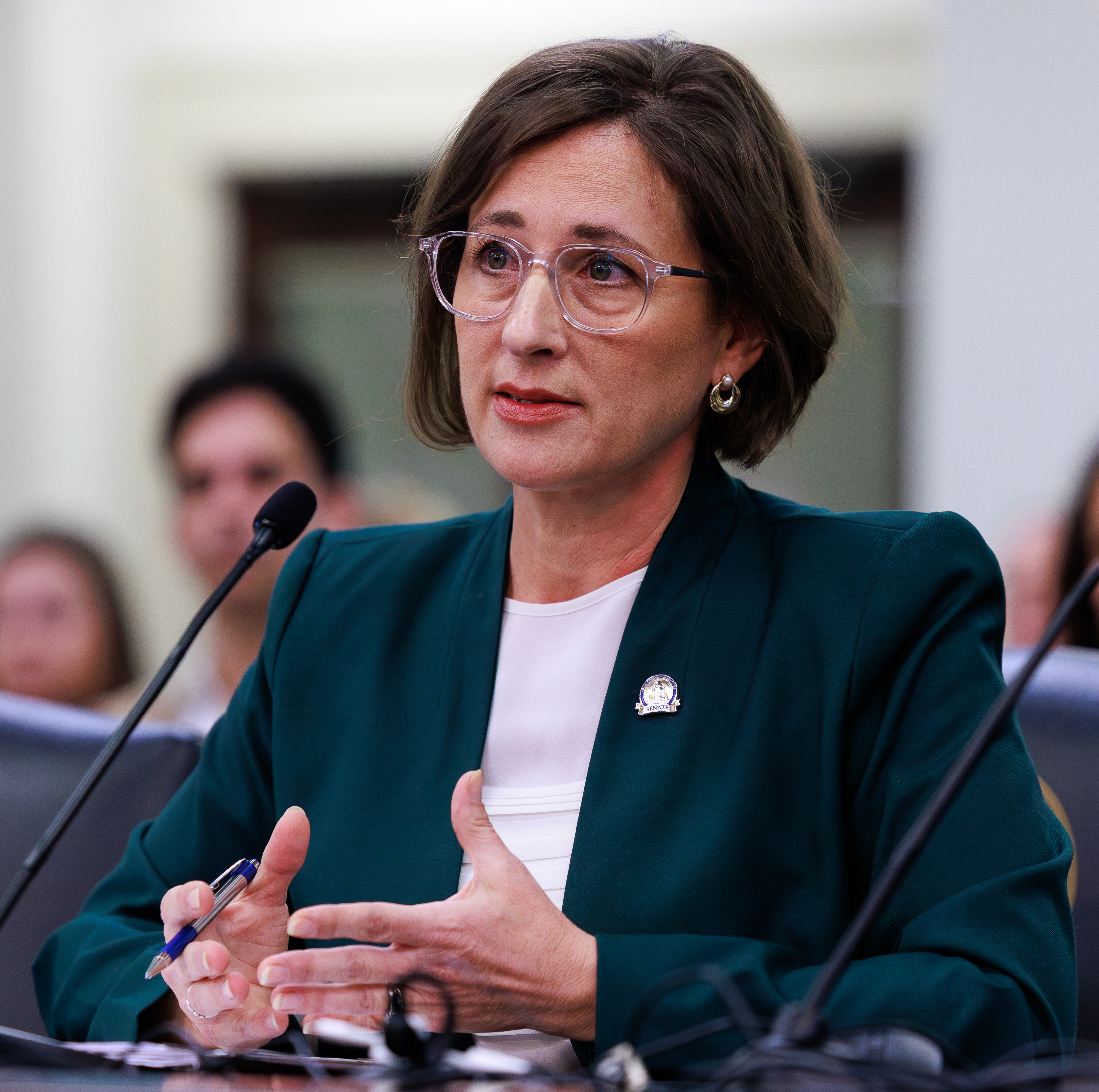
Sen. Lindsey Tichenor, R-Smithfield, speaks Thursday on Senate Bill 181 during a Senate Education Committee meeting. A high-res version can be found here.
FRANKFORT — The Senate Education Committee on Thursday unanimously green lighted a bill that seeks to clarify and improve an existing law designed to prevent unauthorized communication between students and those in authority at schools.
The bill’s sponsor, Sen. Lindsey Tichenor, R-Smithfield, said multiple stakeholders – teachers, principals, superintendents, parents, family members and collective education groups – have offered suggestions and comments on the law that was adopted during the last legislative session.
Tichenor said the law creates a system on traceable communications within school districts to prevent those in a position of authority from having private communications with students. That puts necessary boundaries into place to close off the most easily accessible access points to children, she said.
“Although the grooming of children can happen outside of electronic communications, recent data shows that nearly 90% cases of sexual misconduct and grooming happen through this method,” she said.
Tichenor said she has heard nothing but support for the intent of last year’s law but has also worked with stakeholders on refining the language.
“We brought together a lot of ideas and were able to come up with some solutions that I think will meet the needs to make this bill effective, but not lose its intent,” she said.
Senate Bill 181 seeks to provide clarity on what types of communication are considered authorized versus unauthorized. It creates exemptions for certain communications, such as virtual school instruction, communications that involve parent participation and phone calls from an official school telephone number, among others.
It also spells out mandatory reporting measures and updates the protocols related to parental consent.
Sen. Aaron Reed, R-Shelbyville, asked Tichenor about coaches and student-athletes’ recruiting profiles.
“I’d like to hear a little bit more – like liking, sharing, commenting to reinforce what athletes have claimed. That’s a big part of their recruiting ability, and I know there is a fine line to walk on that,” he said.
Tichenor said public communication is permitted, and if there’s ever an instance when it can’t be public, the parents can give a consent form for that communication to the coach.
Senate Democratic Floor Leader Gerald A. Neal, D-Louisville, said he’s grateful for stakeholder input.
“First of all, this seems to be a thoughtful revisit to this legislation. I’m glad to see that people are knowledgeable in the area have come together and did a relook and came up with some of options here. I support those options,” he said.
Senate Minority Caucus Chair Reginald L. Thomas, D-Lexington, said boundaries are necessary not only in schools, but also at workplaces and elsewhere.
“In my view, this may not be a simple bill, but to me, it’s a very simple concept. Because to me, this bill is all about boundaries,” he said.
Committee Chair Sen. Stephen West, R-Paris, thanked Tichenor for her work and said it’s important.
“This bill is a reaction to a very serious problem in the state of Kentucky. There’s an epidemic of sexual misconduct in our school systems, and all you have to do is read the paper for the past two to three years to get an inkling of what’s going on,” he said.
SB 181 now heads to the full Senate.