House Judiciary approves Logan’s Law
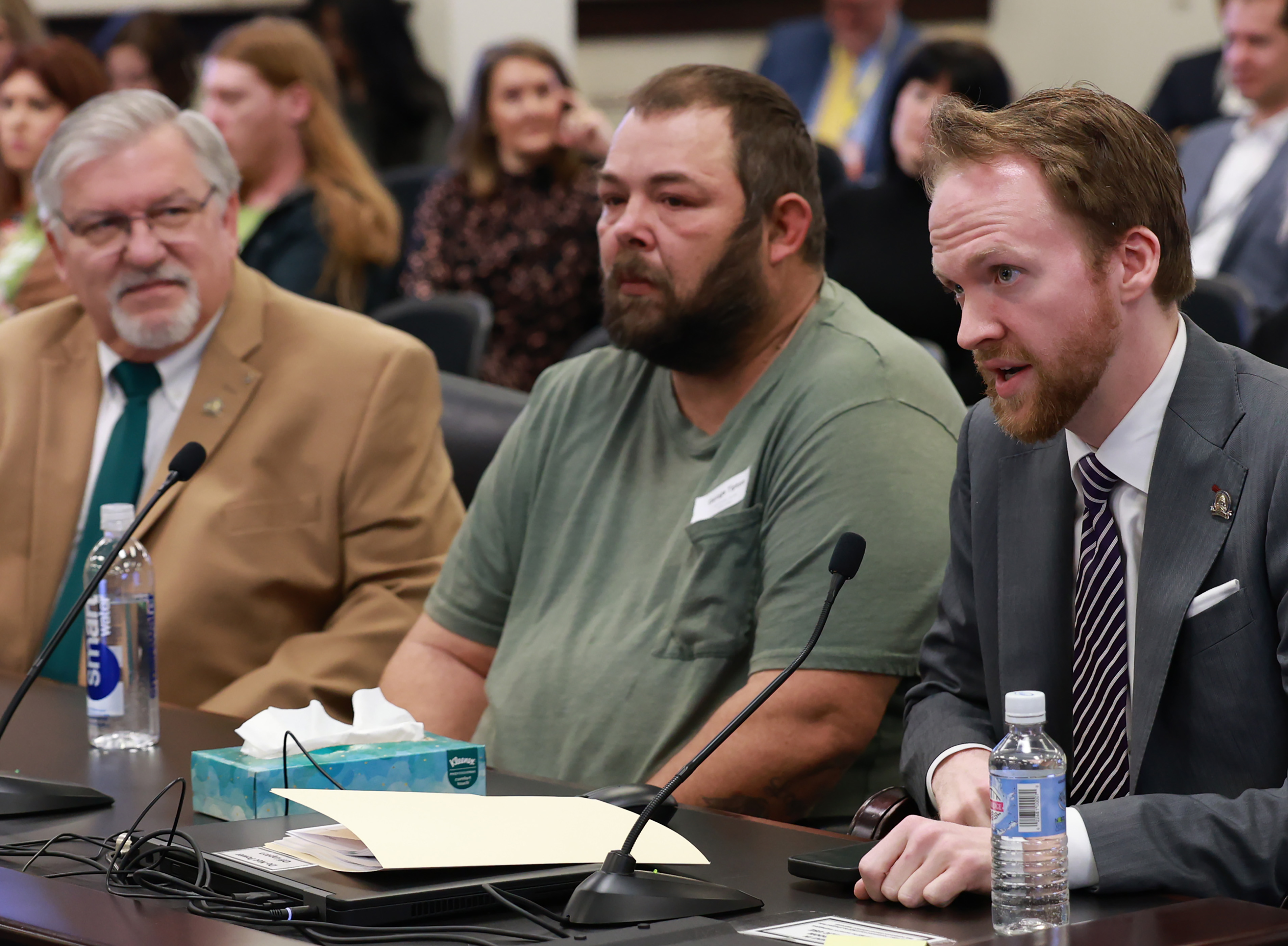
Rep. T.J. Roberts, R-Burlington, (right) speaks on Logan’s Law, or House Bill 422, during Wednesday’s House Judiciary Committee meeting. Dean Tipton (center) joined Roberts and Rep. Daniel Fister, R-Versailles, (left) in advocating for the legislation named for his son Logan. A high-res version can be found here.
FRANKFORT — Logan’s Law took its first step toward becoming law on Wednesday.
The House Judiciary Committee unanimously approved House Bill 422, or Logan’s Law, after hearing directly from Logan Tipton’s father Dean Tipton on the importance of the bill.
Rep. Daniel Fister, R-Versailles, and Rep. T.J. Roberts, R-Burlington, are the primary cosponsors of the bipartisan legislation.
Logan was 6-years-old when Ronald Exantus broke into the Tiptons’s Versailles home and stabbed Logan to death in his bed in 2015, Fister said. A jury later found Exantus not guilty by reason of insanity for Logan’s murder, but did convict Exantus for violently assaulting Tipton and his daughters.
After Kentucky state law permitted Exantus to be released from prison last year – a decade early – Fister, Roberts and more than 60 other House lawmakers decided a change is needed to protect the public and ensure justice for future victims.
Tipton told the committee HB 422 is about accountability and protecting people from suffering the way he and his family have.
“The only thing that I find insane in this whole thing is the fact that in a matter of seconds, he was found innocent by reason of insanity on the murder of my son, but found guilty on the stabbings of my other daughters and myself,” Tipton said. “That is insane. That is not right.”
Fister said HB 422 “brings sanity to the insanity statute.”
An original version of the bill sought to remove the option of an insanity plea from state law, but a new version reforms the statute instead of outlawing it, Roberts said. He described Kentucky’s current definition of insanity as loose and confusing.
“The insanity defense would be amended now to make it to where the individual, as a result of a mental illness or intellectual disability, is not capable of appreciating the nature of their actions,” Roberts added. “In other words, they were so insane, they simply did not know what they were doing.”
Additionally, the bill would create a pathway for severely mentally ill defendants to receive proper inpatient or outpatient treatment, Roberts said.
Roberts also outlined the other main reforms in HB 422 to the committee.
“The first one is mandatory reentry supervision reform,” he said. “This ensures that it’s not just capital offenses and class A felonies that are ineligible, it adds class B felonies.”
HB 422 would also ensure if the parole board unanimously denies parole to someone convicted of a violent felony, that individual would not be eligible for early release.
In Exantus’s case, the parole board unanimously denied him parole, but a loophole allowed him to be released anyway. Roberts said HB 422 would prevent that from happening again.
Another provision focuses on equitable accountability by changing when concurrent sentencing is permitted, Roberts said.
“If they are found guilty on charges for each victim, the sentence is consecutive for each victim,” Roberts said.
Juries would also be allowed to weigh the facts of a case to determine whether a defendant deserves life in prison without the possibility of parole or life in prison with the possibility of parole, Roberts added. The 25-to-life statute would also be amended to 35-to-life.
“And (that section) further requires that for anyone with that sentence, they must serve at least 30 years of their sentence before they can be released,” Roberts said.
Scott West, with the Kentucky Association of Criminal Defense Lawyers, and Bailey Truitt, a staff attorney at the Kentucky Department of Public Advocacy, shared a few concerns they have with the bill.
They both said they worry the legislation will make it harder for attorneys to negotiate plea bargains for their clients, among other concerns. The bill could further bog down an already strained court system, they said.
House Majority Whip Jason Nemes, R-Middletown, said he supports helping mentally ill individuals and low-level offenders, but he believes Kentucky should be keeping violent criminals locked up for longer.
“If you commit murder on one of our people, I don’t want you getting out,” he added.
HB 422 will now go to House floor after receiving a 17-0 vote with two pass votes.
House Minority Caucus Chair Lindsey Burke, D-Lexington, recorded a pass vote due to concerns about the legislation, including how much the bill might cost taxpayers.
“I’m not saying that it’s not worth it, but I need to know how much it is,” she said.
House Minority Floor Leader Pamela Stevenson, D-Louisville, voted “yes” on HB 422. In explaining her vote, Stevenson echoed an earlier call from Roberts for more access to mental health care in addition to passing this bill.
“We’ve got to protect people by doing the whole thing,” she said.