Committee OKs child marriage bill
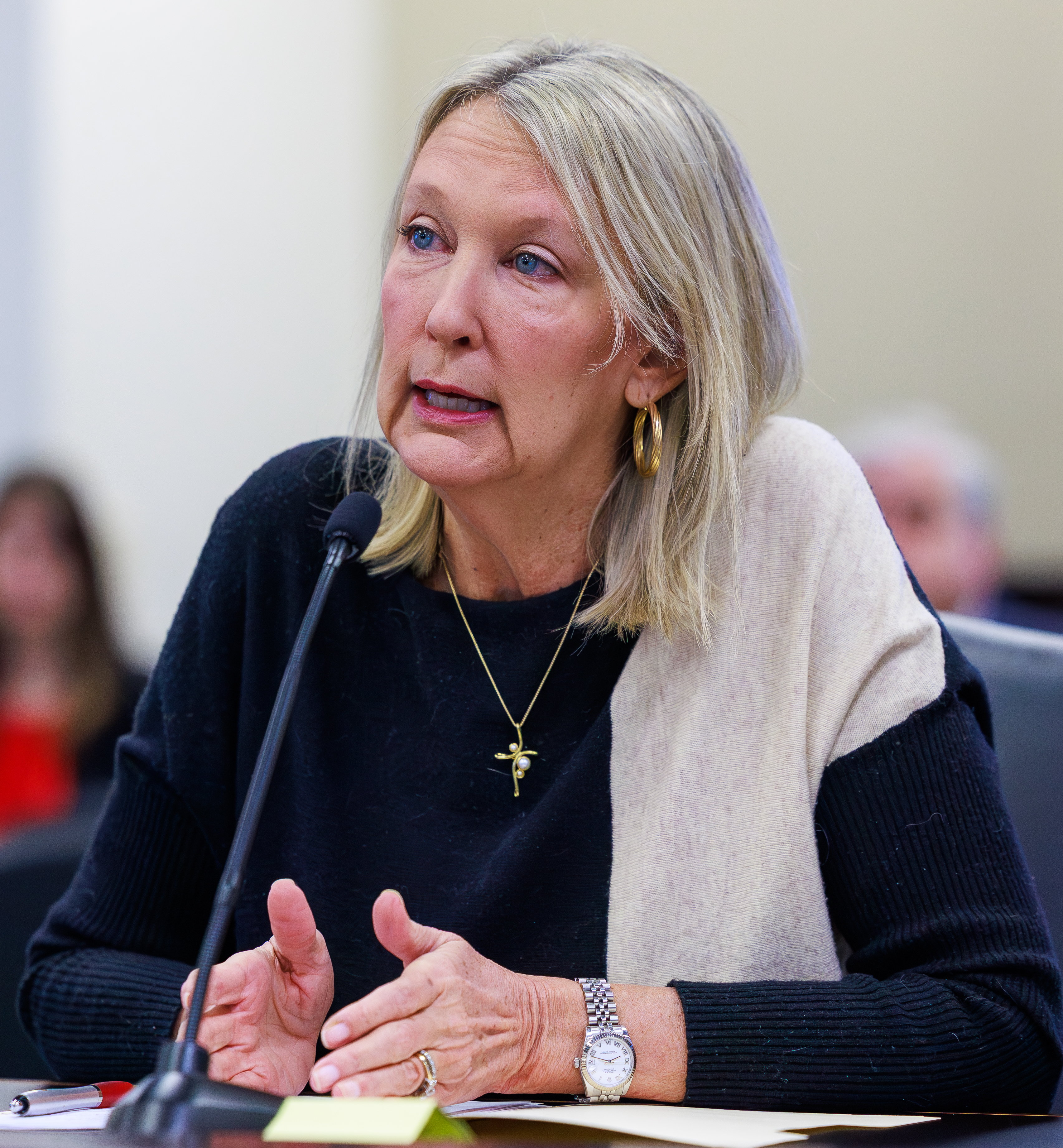
Sen. Julie Raque Adams, R-Louisville, testifies Thursday on Senate Bill 156 to the Senate Veterans, Military Affairs and Public Protection Committee. A high-resolution photo can be found here.
FRANKFORT — A bill crafted to close a marriage age loophole in Kentucky law advanced unanimously Thursday during a Senate Veterans, Military Affairs and Public Protection Committee meeting.
“Basically, this is just legislation designed to end child marriage in Kentucky once and for all by closing the remaining loopholes and ensuring that our laws are clear, enforceable and centered on the safety and dignity of our minors,” said the bill’s sponsor, Sen. Julie Raque Adams, R-Louisville.
The measure – Senate Bill 156 – builds on legislation the Kentucky General Assembly passed in 2018, which essentially identified 18 as the legal age for marriage. However, the law still allowed 17-year-olds to get married if they had approval from the judicial system, Adams said.
“It was kind of a checklist that they would go through. The main one being that that 17-year-olds would be emancipated, so in case anything happened, they would have full legal rights to sign a lease or enter into a domestic violence shelter, those kinds of things,” she said.
The caveat has been exploited and not adhered to, Adams said.
Donna Simmons, founder of the REVIVE Collective and survivor of generational child marriage, testified that she reached out to Adams after years of trauma.
“I approached Senator Adams about filing this bill because this is not theoretical to me. This is my life. My mother was a resident of McCreary County when she was 13 years old and married my father. He was a grown man who had already served in the Korean War and had two young sons,” she said.
Simmons said when she was 14 years old, she was admitted to a behavioral health facility where she was groomed by a 29-year-old staff member.
“When I was released, that relationship continued, and at sixteen, my mother consented to me marrying him. He was 31. I was forced to drop out of high school before completing the tenth grade,” she said. “When I tried to escape his abuse, I was denied housing because I was a minor and I could not enter into a contract.”
Simmons said she was also turned away from a domestic violence shelter because she was under age.
“At sixteen, I miscarried and nearly died from complications. As a married minor, I could not consent to my own medical care. I had to wait for my abuser to decide whether I would receive treatment. I became pregnant again when I was 17. My daughter was born just about a month after I turned 18,” she said
Simmons said when she was choked by her husband, she knew things had to change, and now after surviving violence, exploitation, and systemic failure, she works to protect other girls from becoming trapped.
Simmons testified she had to fight to obtain public records and discovered some officials were violating child marriage laws by authorizing marriages involving 16-year-olds, clerks bypassing required judicial orders and marriages involving age gaps of 10-12 years receiving approval.
“Let us stop interrupting childhood in the name of marriage and give children full lives that they not have to spend decades recovering from,” she said.
Committee Chair Sen. Matthew Deneen, R-Elizabethtown, thanked Simmons for testifying.
“I know many folks may think this is an issue that doesn’t have so many layers, but it does. And we appreciate you sharing your story with us.”
Sen. Gary Boswell, R-Owensboro, said Simmons has a heartbreaking story and said he was sorry she went through it. He voted for the bill, but said he still has some questions.
“My best friend and his wife, they were married when she was 17 and he’s 19. They’ve been married 60 some odd years, and so, I understand the issue when it comes to predators and all that,” he said. “…I’m going to be in favor of the bill, but I do have a few questions and maybe we can talk about later.”
Sen. Brandon Smith, R-Hazard, said Simmons spoke on behalf of other women who might not be able to come forward regarding their situations. He said Kentucky is “only as strong as the least of us” and told Simmons she is part of something historic and is a tenacious fighter after being turned away from institutions she thought would help her.
“But I’m glad you didn’t stop, and I apologize on behalf of all those agencies and institutions that turned you away and let you down,” he said. “But you deserve to hear that apology from somebody in government that says to you that I’m truly sorry they let you down.”