Committee passes bill aimed at reducing college housing costs
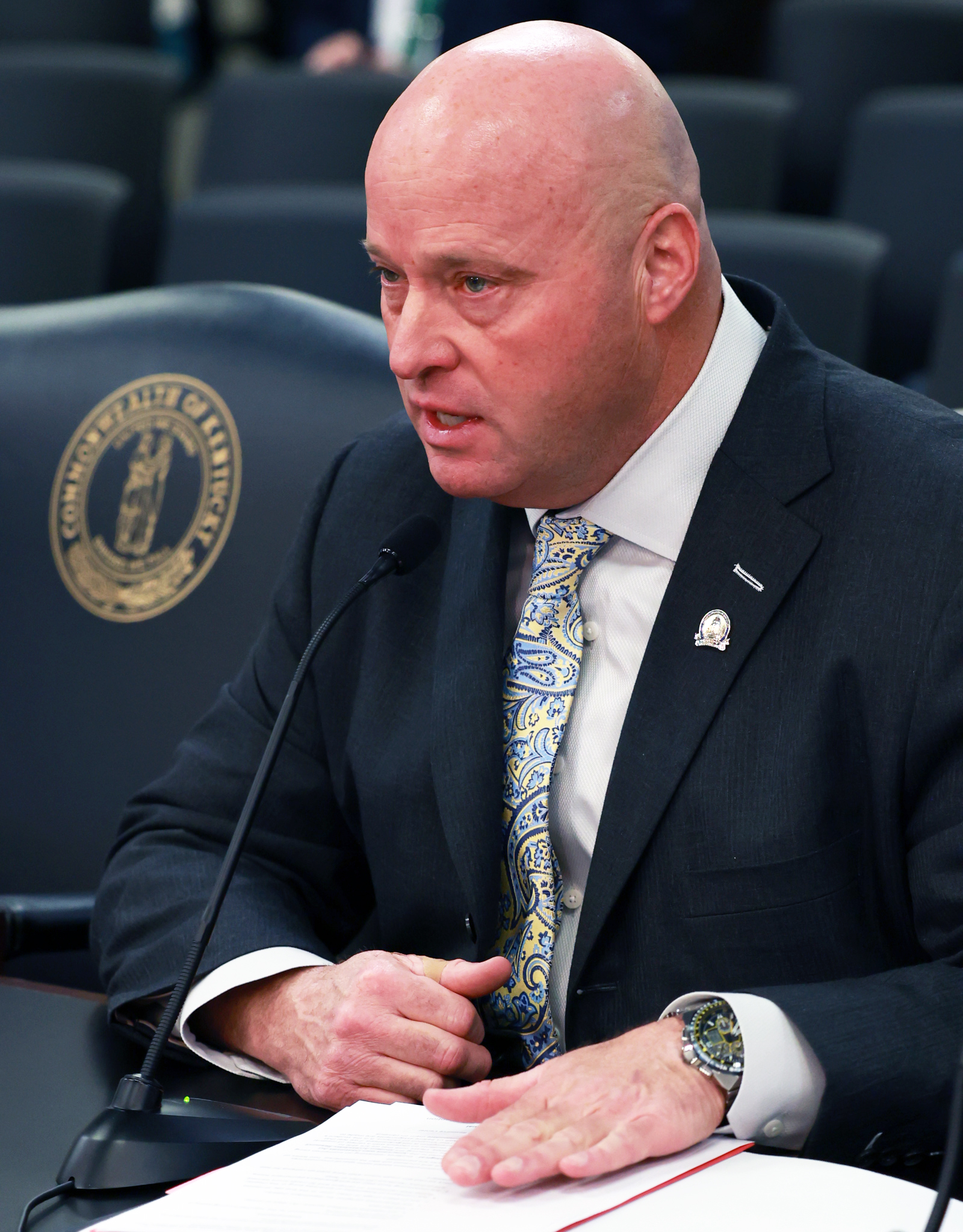
Rep. Steve Bratcher, R-Elizabethtown, speaks on House Bill 766 during Tuesday’s meeting of the House Postsecondary Education Committee. A high-res version is available here.
FRANKFORT — Legislation aimed at lowering college costs by expanding mandatory housing exemptions passed the House Postsecondary Education Committee on Tuesday.
House Bill 766 calls on Kentucky colleges and universities with on-campus living requirements to provide a formal exemption process for qualifying students. The bill seeks to allow more students to opt out of these requirements, potentially reducing overall education costs.
Under the proposal, exemptions would apply to students who live within a specific number of miles from campus, active-duty military members who may be deployed and other qualifying groups.
The measure would also require universities to track how many students request housing exemptions and how many are approved.
Bill sponsor Rep. Steve Bratcher, R-Elizabethtown, said mandatory campus housing can significantly increase the cost of attendance.
“In some cases, the amount you pay for a dorm is more than what you pay for tuition,” Bratcher said. “Then the schools are mandating that students live in these dorms.”
Bratcher also raised concerns about the condition of some campus housing facilities.
“In some areas, these dorms are substandard living conditions,” he said. “They have multiple code violations, and some of them date back 30 to 50 years.”
Some lawmakers questioned whether loosening housing requirements could affect student engagement and retention.
Rep. Kim Banta, R-Fort Mitchell, said universities have historically required on-campus living because it improves retention and involvement rates.
“Universities did this because they found that their retention rate was stronger if a student lived their first year on campus,” Banta said. “It wasn’t pure greed that led to this — it was a data-driven decision.”
Bratcher responded that today’s student populations are made up of more nontraditional students.
“It’s not just the traditional student who graduates high school and goes straight to college anymore,” he said. “We’re seeing a decrease in traditional students attending four-year institutions, and more are entering the workforce first and returning to school later with tuition assistance.”
Rep. Shane Baker, R-Somerset, echoed that sentiment.
“Not all students fit neatly in a box.,” he said. “Anything we can do to come along side students and help them to reach their goal, to attain their education, and to do so affordably and not saddled with a mountain of debt is a win in my opinion.”
Lawmakers also discussed how many institutions already offer exemptions.
Committee chair, Rep. James Tipton, R-Taylorsville, emphasized the importance of mandating the exemption process.
“All of them that have a requirement do have some kind of exemption process in place; however, those processes vary quite a bit,” he said.
Rep. Candy Massaroni, R-Bardstown, said the bill could also reduce costs tied to mandatory meal plans.
“When you are mandated to live in a dorm, you are also mandated to get the meal plan, which is very expensive,” she said. “I think this is going to help a lot of families.”
Bratcher said students should have the autonomy to decide where to live.
“In my opinion, you should not be mandated to live in a college dorm,” he said. “At 18 years old, you can make the decision about where to live while attending college.”
The committee approved the bill unanimously, 14-0. It now heads to the full House for consideration.
“I vote ‘absolutely’ on this bill,” Pollock added.
House Majority Caucus Chair Suzanne Miles, R-Owensboro, said she would love to vote “yes” on HB 425, but there is one provision of the legislation she does not support.
“I am not for the destruction of property, so I will be a ‘no’ today,” she said.
Rep. Deanna Gordon, R-Richmond, and Rep. Chris Fugate, R-Chavies, said they had concerns about how the bill may affect legal, recreational street racing in Eastern Kentucky.
“In the past, we have passed legislation regarding the Backroads of Appalachia and some street racing that they do. Will this affect that in anyway?” Gordon asked.
Fugate said he would vote “no” on HB 425 without a clear answer on how the legislation impacts Backroads of Appalachia.
After some quick research, House Majority Whip Jason Nemes, R-Middletown, who is also a primary cosponsor of the bill, said Backroads of Appalachia would not be impacted.
“It doesn’t affect the program my friends are worried about in Appalachia because they have a permit to engage in what they’re doing,” Nemes said. “This is something that is unlawful and that would not be unlawful.”
HB 425 will now go before the Senate for consideration after a 75-19 vote.