Senate committee advances school bus safety bill
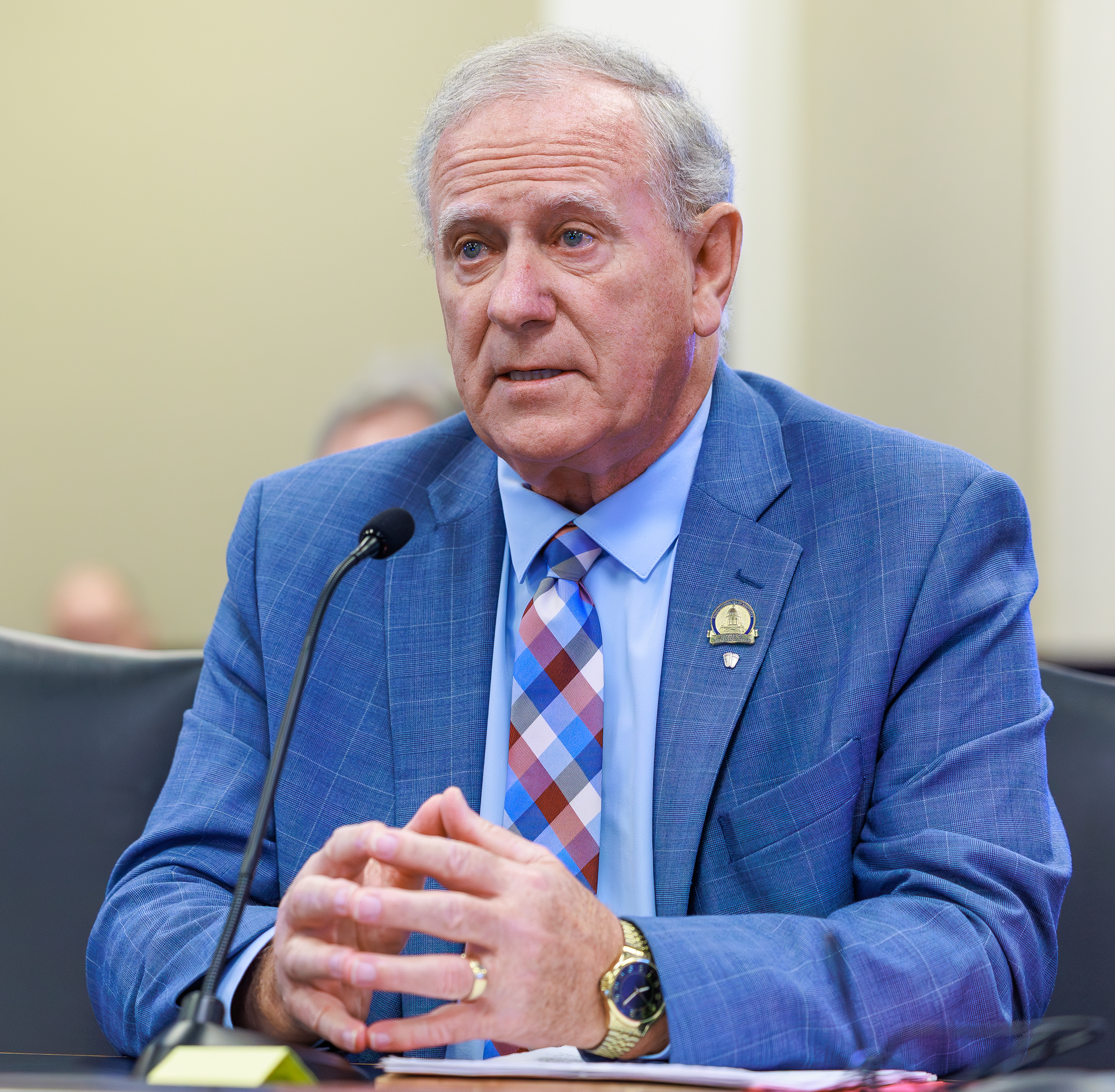
Rep. David Hale, R-Wellington, speaks on House Bill 7 during Thursday’s meeting of the Senate Veterans, Military Affairs and Public Protection Committee. A high-resolution photo can be found here.
FRANKFORT — A Senate committee unanimously advanced a bill Thursday that would allow school districts to install camera systems on school buses to help curtail stop arm traffic violations.
Rep. David Hale, R-Wellington, is sponsoring House Bill 7, and he told the Senate Veterans, Military Affairs and Public Protection Committee that the school bus safety bill could lead to saving lives.
“What this bill does is it sets up an option for these districts to have these manufacturers or vendors install these cameras, which in turn then they would maintain. They would monitor. They would collect the data and the only time there would be a recording would be when the bus would be stopped,” he said.
Hale said when a bus’s stop arm is extended, the camera would record the loading and unloading processes, and once the arm retracts, the recording would stop.
Hale said HB 7 is extremely important to him because it relates to the safety of children and young people, and when he researched school bus-related violations, he became concerned.
“I’ve researched it a lot. I’ve collected a lot of data and I was alarmed. I mean I was actually astounded at the amount of violations that occur every day by people passing a school bus that is stopped, either loading or unloading children,” he said.
Hale said the state Department of Education worked a few years ago with bus drivers who completed a log one day to record how many violations occurred. The participating drivers recorded 1,600 violations that day, he said.
Hale said some districts already have stop arm cameras on their buses, but the cost is “astronomical.”
Hale said under HB 7, if there is a violation and a recorded violation is seen, that data is collected by the camera vendor and sent to local law enforcement officials.
To ensure the safety efforts are successful, Hale said law enforcement groups would have to be involved in the efforts. He said officers, deputies and others would conduct further action using license plate numbers. A letter would be sent to the person associated with the license plate number with the date, location and time of the alleged offense. He said there’s also an appeals process.
“But if not, and they wanted to pay that fine, the fine would be a $300 fine on the first offense and a $500 fine of any offense thereafter in the next three-year period,” Hale said. “That would be collected by the school. That would go to the schools, which in turn would help them pay off what the expense of these cameras would be to install, which is thousands of dollars for each bus.”
The bill stipulates that recorded images related to a violation are considered private and would be accessible only by authorized personnel.
Committee Chair Sen. Matthew Deneen, R-Elizabethtown, said changes adopted by the committee Thursday narrow down the bill to its intent, which is only related to the traffic violation of going around a school bus when the stop sign is extended.
Sen. Gary Boswell, R-Owensboro, thanked Hale for his work on the bill and said it’s long overdue.
“I’ve been watching the testimony over a long period of time. Years ago, when I was in the insurance business, one of the first, most difficult cases I had was a young man walked in front of a school bus to get on the school bus in Daviess County,” he said, noting that the individual was struck and killed.
Sen. Lindsey Tichenor, R-Smithfield, also thanked Hale for the legislation. She said it would be interesting to see the data from participating districts to determine if a fiscal note is needed and ensure more students in Kentucky would be safe.
Sen. Matt Nunn, R-Sadieville, said he had privacy concerns when the bill was first filed, but decided he would support it after looking at Thursday’s changes and hearing testimony.
“We know the severity, the potential severity if something were to occur,” he said. “But the volume in which we’re seeing it, and that’s how you measure risk. You measure severity times volume. That’s how you measure risk. And so, you helped me understand the risk here today.”
The bill now heads to the full Senate.