House committee approves ibogaine research bill
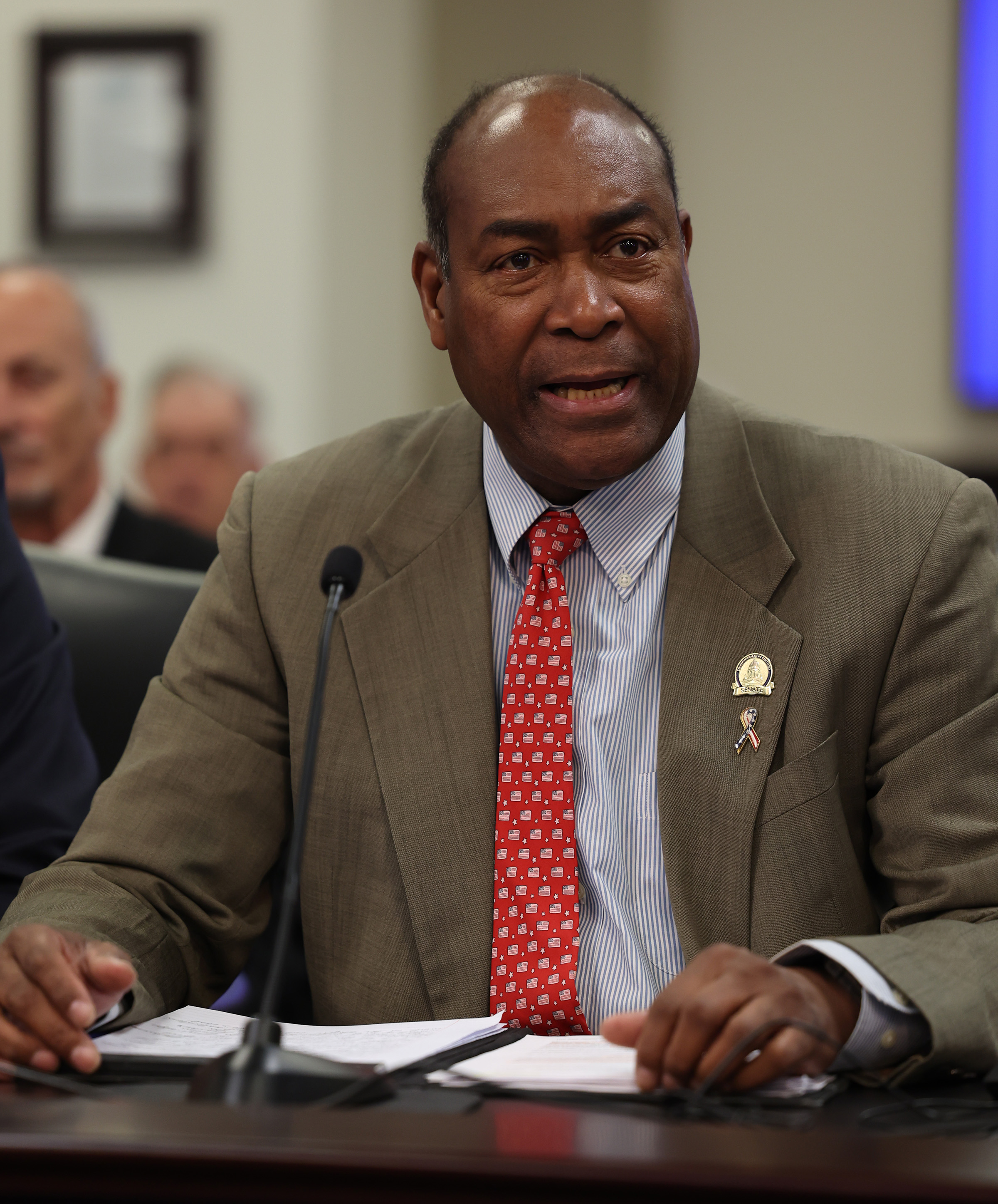
Sen. Donald Douglas, R-Nicholasville, speaks on Senate Bill 77 before the House Veterans, Military Affairs and Public Protection Committee meeting on Tuesday. The legislation would establish a framework for future ibogaine research in Kentucky. A high-resolution photo can be found here.
FRANKFORT — A Senate bill that would establish a framework for future ibogaine research in Kentucky advanced from the House Veterans, Military Affairs and Public Protection Committee on Tuesday.
Sen. Donald Douglas, R-Nicholasville, is the primary sponsor of Senate Bill 77. He told the committee the legislation is the “first step” toward Kentucky having a role in developing a revolutionary treatment for substance use disorder.
“This bill really describes and sets up a foundation and framework for research and for studies, including Federal Drug Administration approval, to assess the clinical and the medical uses of a crystalline substance called ibogaine,” Douglas said. “The research will also explore its medical effectiveness in treating and improving certain neurological conditions as well as chemical addictions.”
Under SB 77, the State Treasury would establish the Ibogaine Research and Intellectual Property Fund to allow Kentucky to establish a public-private partnership with a single drug developer upon FDA approval of clinical drug development trials for ibogaine.
Texas, Mississippi and West Virginia have already passed similar legislation, said Northern Kentucky physician Dr. Jean Loftus, who testified alongside Douglas.
“Once the FDA approves ibogaine, Kentucky will share in the profits, making this revenue generating,” Loftus said. “Funding can be public, private and grant dollars.”
Ibogaine, a crystalline alkaloid psychogenic compound obtained from the Tabernanthe iboga plant, is currently illegal in the U.S.
Loftus told the committee research from other countries shows ibogaine is a successful treatment for opioid use disorder, alcoholism, post-traumatic stress disorder, depression, traumatic brain injury and other substance use disorders.
Loftus said ibogaine is a powerful drug that corrects most of the brain damage caused by these conditions.
“These conditions have much in common,” she said. “They collectively affect nearly a million Kentuckians. It’s estimated that 40% of all combat veterans are afflicted by one or more of these conditions. They cause severe functional impairment, leading to a high rate of death and suicide, with veterans being affected three times more than the general public.”
Ibogaine is being utilized in six other countries, and typical treatment involves administering several ibogaine capsules over a single 8- to 12-hour period under the supervision of a physician, Loftus said.
Ibogaine is more successful than traditional treatments of substance use disorder because it greatly cuts down on withdrawal and craving symptoms, Loftus said.
Citing a Mexican study involving scientists from Stanford University, Loftus said there are also high rates of successful remission when ibogaine is used as a treatment for PTSD and depression.
Douglas said the drug has the potential to have the greatest positive impact on society since antibiotics.
If Kentucky does not pass SB 77, Loftus said the commonwealth would be delayed in offering ibogaine as a treatment to Kentuckians in need.
Rep. Adam Moore, D-Lexington, asked Douglas about a provision in the bill that states the fund “may receive state appropriations.”
“Are you just essentially opening up the opportunity that if we, down the line from now, want to fund it through budget bills, that you’re just putting it in statute there that it could? Is that what it’s there for?” Moore asked.
Douglas said he doesn’t want to prevent any funding source from going toward ibogaine research.
“I don’t want to prevent anyone from wanting to donate or put money toward the betterment of society,” Douglas said while also clarifying SB 77 does not appropriate any money into the fund.
Loftus said FDA approval can cost up to $500 million. Rep. T.J. Roberts, R-Burlington, asked how that compares to the cost of addiction in Kentucky.
“Currently, Kentucky is spending between $1 and $2 billion on treating afflicted Kentuckians,” Loftus said. “And then when you add on to that the other cost to the system, the social services, the judiciary, the police – it’s exponential.”
In explaining why he supports SB 77, Roberts said he believes the legislation is “a small price to pay” compared to the cost of addiction in Kentucky.
“This is a new hope for people who are going through something that is devastating our communities in the commonwealth,” he said.
SB 77 will now go before the full House for consideration after receiving an 18-2 vote in committee.