The legislative chambers have agreed to a new two-year state budget (HB 500) that includes 7% cuts to many state agencies. The agreement falls $691 million short of fully funding the continuing cost of Medicaid benefits while putting $290 million into the Budget Reserve Trust Fund (BRTF) for potential release to Medicaid next year. The budget does not contain a so-called 13th check for state retirees who have not received a cost-of-living adjustment since 2011.
The agreement includes essentially flat funding of K-12 schools and cuts most of higher education, continuing long-term trends of education funding falling behind the rate of inflation. In an accompanying bill (HB 900), the legislature funds over 300 projects and programs totaling $1.76 billion (while adding $320 million in new money to the BRTF), drawing down monies that had been built up due to pandemic-era economic stimulus.
The budget reflects the loss of recurring revenues associated with state income tax cuts but does not appear likely to trigger additional income tax cuts under the legislature’s formula over the next two years.
Cuts of 7% remain with some agencies exempt, judicial branch may be forced to cut specialty courts
The base budgets of most state agencies are cut by 4% in 2027 and 7% in 2028. That reduces General Fund appropriations to those agencies by $275 million over the biennium. The agreement exempts Veterans Affairs, Appropriations Not Otherwise Classified and Judgements, Learning and Results Services, SEEK, the School Facilities Construction Commission, Kentucky Educational Television, County costs, Medicaid Benefits, Family Resource and Youth Service Centers, Juvenile Justice, three universities (Kentucky State, Morehead and Murray), the Postsecondary Performance Fund, Department of Revenue, Secretary of State and Registry of Election Finance, Commonwealth and County Attorneys, Adult Correctional Institutions, Community Services and Local Facilities, Local Jail Support, Pension systems and Proprietary Education.
The Judicial Branch continues to be cut by approximately 7% under the agreement (with a small increase from earlier versions of the budget). In a letter sent before the agreement, the Chief Justice indicated that drug, mental health, veterans treatment and other specialty courts that help address addiction, mental illness and other challenges and divert people from detention could face cuts.
Plan will result in smaller inflation-adjusted SEEK payments to most districts and provides no educator raise or preschool increase
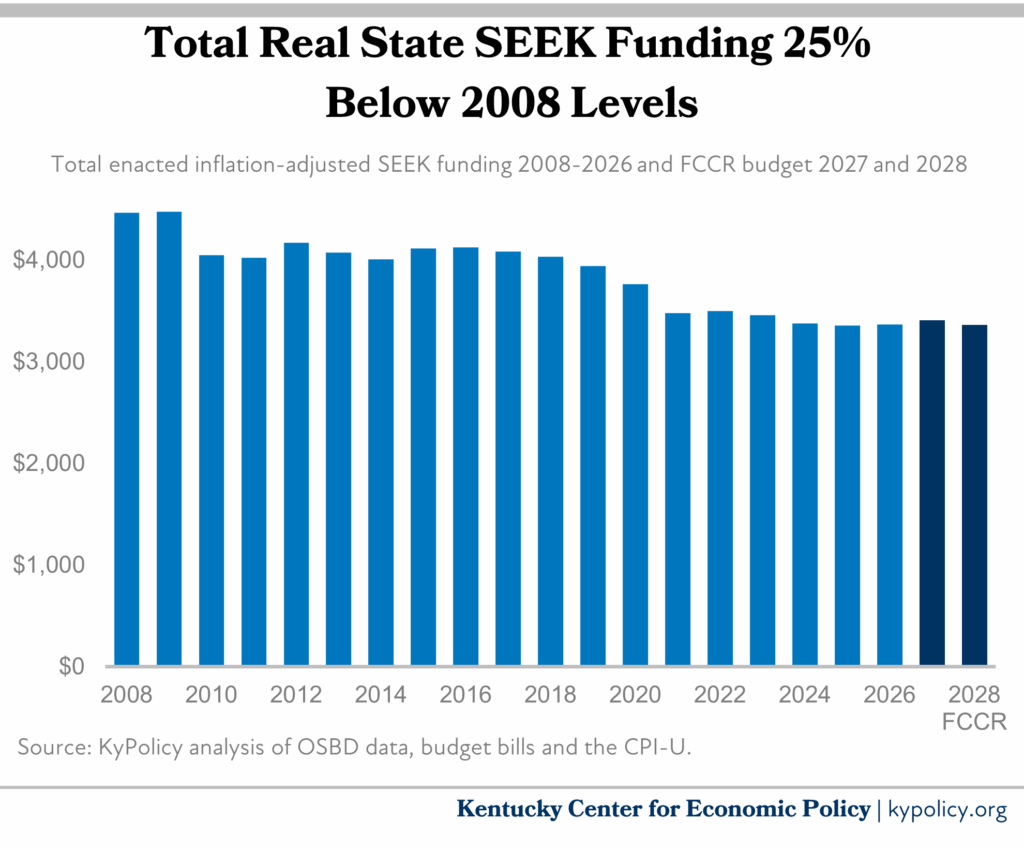
The Senate proposal increases the SEEK base per-pupil guarantee from its 2026 level of $4,586 per-student to $4,626 for 2027, less than 1% increase, and $4,792 for 2028, a 3.6% increase. Like in the House, SEEK transportation contributions are frozen at the 2026 level of $399 million for 2027 and 2028, or $93 million below what the law requires. The Tier 1 level funding under SEEK is matched at the slightly higher 17.5% level used in the last budget. Total SEEK funding will remain flat at 25% below 2008 levels after adjusting for inflation. As a result, an estimated 82% of districts will receive smaller state SEEK payments in two years than they do this year, once adjusted for inflation. Find your district here:
No additional funds are provided for teacher and school employee raises, and the budget does not allow teachers to keep 3.75% of their salary that had been going to pay off the liability in their medical insurance plan.
The budget does not increase funding for preschool and extended school services, which remain at their 2019 level through 2028. Also frozen is funding for Family Resource and Youth Service Centers, the Center for School Safety and school-based mental health service providers. Funding for School Resource Officers is set at $11.5 million each year (with restricted funds now as the source). A total of $14 million in additional funding is provided each year for Career and Technical Education in HB 900 using BRTF monies, as described further below.
Budget cuts higher education institutions by 7% with a few exceptions
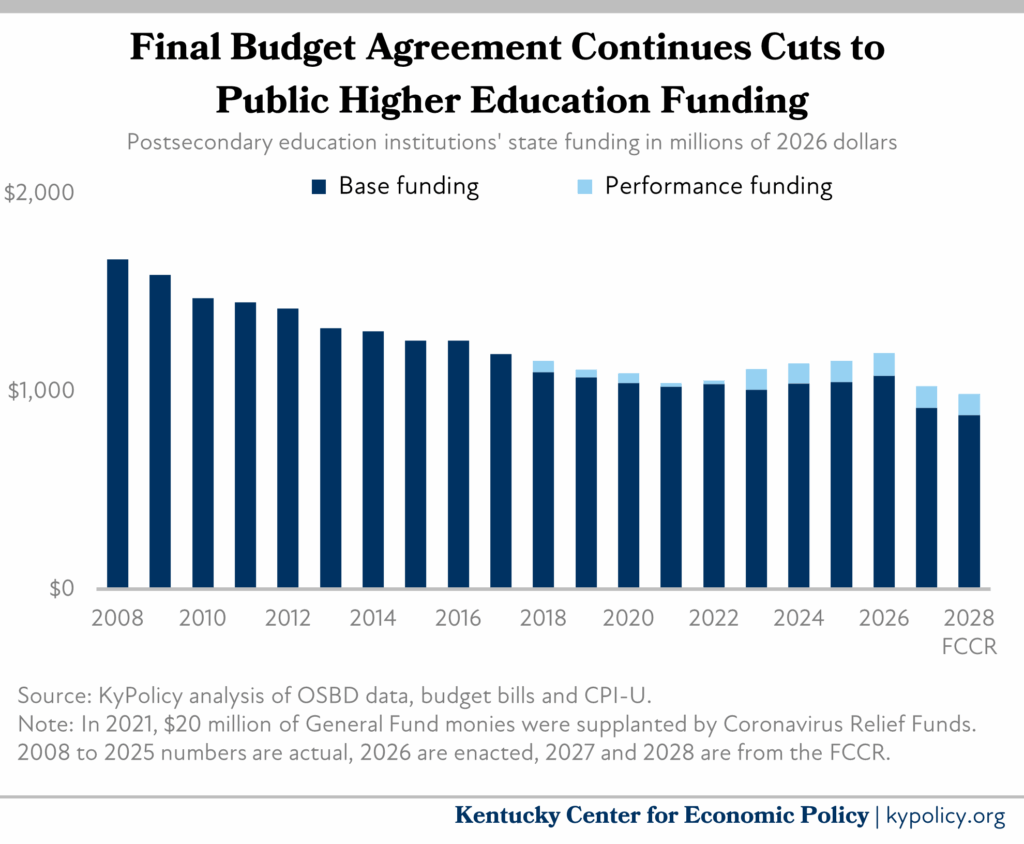
The budget agreement cuts funding over the biennium for universities except for Murray, Morehead and Kentucky State, whose funding is frozen. It also includes $115 million in performance funding for each year of the budget. Total funding for postsecondary institutions is down 12.2% over the biennium compared to 2026 and reduced 41% compared to 2008 levels by 2028 once inflation is taken into account.
Funding for college financial aid programs meets the statutory requirement though falls short of demand. Appropriations to the Kentucky Higher Education Assistance Authority are $20 million less than the governor had recommended in his budget. The governor had noted that his appropriations levels would result in first-come, first-served funding or cuts in grant levels.
Budget agreement continues to underfund Medicaid, holds back $290 million
The budget continues to contain a large Medicaid shortfall. It appropriates $691 million less in General Fund dollars than what was in the agency request for the continuation of Medicaid benefits over the biennium. As a partial potential backstop, the budget transfers $290 million from the Kentucky Insurance Regulatory Trust for a “potential appropriation for Medicaid benefits in the 2027 Regular Session if deemed necessary for claims and payments in fiscal year 2026-2027 or fiscal year 2027-2028.” The budget requires that managed care rates be cut by 2.5% in 2028, with the savings to be used to increase reimbursement for fee for service Medicaid providers.
The budget includes the requested $8.1 million in 2027 and $1.5 million in 2028 for technology changes needed to implement new work reporting requirements mandated by H. R. 1. It includes funding for 405 new slots in Medicaid waiver programs for people with special care needs, slightly less than earlier versions of the budget. And it includes the additional $43.5 million in 2027 and $58 million in 2028 to cover the increased administrative costs of the SNAP food assistance program required by H. R. 1.
The budget continues to make serious cuts to the Department of Community Based Services, reducing funding by $88 million compared to the governor’s proposal. The budget does include earmarks for continued child care benefits for child care workers and to help prevent a benefit cliff for those leaving the Child Care Assistance Program. However, the budget does not indicate the inclusion of funding for the higher reimbursement rates that have been helping keep child care centers open.
The budget includes $6 million each year (of $14.6 million a year to fully fund SB 151) to provide funding for relative and fictive kin caregivers and includes $22 million each year to support existing foster care and kinship care programs for kids with difficulty finding placements. The budget does not mention replacing funds that have been diverted from the Temporary Assistance to Needy Families program this year to address the shortfall in out-of-home care services for youth.
Funding is cut for the Department of Aging and Independent Living by $22 million over the biennium compared to the governor’s budget. It costs approximately $18 million to fully fund the senior meals program with no waitlist.
The budget states an intention to fund the high-acuity juvenile facility but requests information, and includes design money for one of the proposed female juvenile facilities. There is no increase in payments for state inmates housed in local jails that was included in the Senate budget.
Budget does not include cap on health insurance contributions, contains no cost-of-living payment for retirees
The budget does not contain language from the original House version of HB 500 that capped employer contributions for health insurance. The agreement provides for a 2% raise for state employees in 2027 and another 2% in 2028. It makes no mention of $67 million that had been appropriated in 2022 to address pay compression for state employees in recognition of many years without raises, which had been diverted to other purposes in previous versions of the budget.
The budget does not include the $80.3 million that the Senate had included for a 13th-check for state retirees to address the erosion of their pension benefits. The plan makes a payment of $78.5 million from the Permanent Pension Fund to the unfunded liability in the Kentucky Employees Retirement System nonhazardous pension fund, and otherwise fully funds the pension systems.
HB 900 includes $1.76 billion for over 300 earmarks
In a separate bill (HB 900), the legislature earmarks funding from the BRTF of $852 million in 2027 and $908 million in 2028. Over 300 projects and programs are included, and include funds for water and sewer systems, road projects, matching funds for federal infrastructure grants, site development for industry, university research, tourism and recreation, airport improvements, operating funds for programs, and school and fiscal court renovations. It includes $2.5 million each year to the Affordable Housing Trust Fund. The largest projects are as follows:
- $230 million to the Department of Transportation for highway projects
- $100 million for the GRANT program to provide matching funds for federally-funded infrastructure projects
- $90 million for Metro Louisville for downtown revitalization projects
- $90 million for wastewater assistance for troubled or economically restrained districts
- $80 million for “mega-development projects” of at least $10 million
- $50 million for the Kentucky Product Development Initiative
- $50 million for the osteopathic medicine program at EKU
- $37.5 million for an endowed research fund through the Council on Postsecondary Education
- $29.6 million for riverports
- $28 million for career and technical education through the Department of Education
The BRTF has a projected balance of $3.7 billion this year or 24% of General Fund revenues. HB 500 adds $320 million to the BRTF. After subtracting the appropriations in HB 900, the balance will fall to $2.3 billion by the end of the biennium, or 14% of General Fund revenues.
See here for a spreadsheet containing all local projects.
Plan very unlikely to trigger more income tax cuts
The budget is not aimed at triggering more income tax cuts over the biennium, as it appropriates funds approximately equal to the amount of revenue the state will receive. Triggering more income tax cuts would happen only with a significant revenue surplus. And at 14%, the balance of the BRTF falls closer to the 10% threshold below which the other trigger for income tax cuts would also not be met in the future.
The post Budget Agreement Cuts and Freezes Funding for Most Services, Continues to Underfund Medicaid appeared first on Kentucky Center for Economic Policy.