Committee examines potential changes to eminent domain law
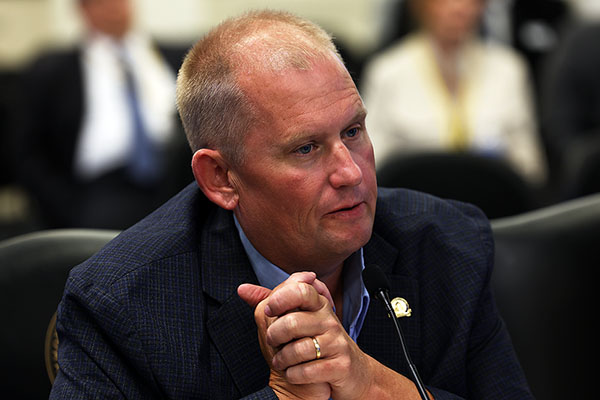
Rep. Ryan Bivens, R-Hodgenville, shares his ideas on changing eminent domain law during Thursday’s Interim Joint Committee on Judiciary meeting. A high-resolution photo can be found here.
FRANKFORT — Two Kentucky lawmakers are looking to reform Kentucky’s eminent domain law.
Rep. Ryan Bivens, R-Hodgenville, and Rep. T.J. Roberts, R-Burlington, were joined by two constituents to talk about eminent domain law on Thursday during the Interim Joint Committee on Judiciary meeting.
Bivens and Roberts both sponsored eminent domain legislation – House Bill 630 and House Bill 353 – earlier this year. Neither of the bills became law.
Under HB 630, Bivens said he sought to better protect land that is subject to an agricultural conservation easement while adding more transparency to the eminent domain process.
“We’ve got to start looking at agriculture, not as an open piece of ground that we can put a black top of concrete over it,” Bivens said. “We’ve got to think about what it does for the economy.”
Rebecca Steele, a farmer from Bourbon County, said eminent domain has caused her family financial trouble, and even the threat of eminent domain can be costly due to the lack of transparency.
Steele said her mother invested more than $400,000 in a dam on their property while also planning to use part of their farm as a wedding venue.
“When we caught wind of the threat of eminent domain, she completely stopped spending because any improvements (made to the property), we were not going to receive the value of that,” Steele said. “… We need more transparency as to what was going on. We needed to know if we were going to be compensated, that it was going to be fair and enough, because you can’t just pick up your farm and move.”
Bivens’ bill also proposed changes to the fair market valuation process while additionally seeking to ensure owners of land used for agricultural or conservation purposes receive 125% of the highest appraised value of the property.
Roberts, who sponsored HB 353, said his ideas for improving the eminent domain process go well with Bivens’ proposals.
Roberts told the committee he believes eminent domain has been “vastly abused” throughout the U.S., especially when it comes to the government seizing property for private use instead of public use.
Roberts said since the U.S. Supreme Court ruled in favor of that practice, states, including Kentucky, have made efforts to add protections for property owners.
“Here in Kentucky our efforts, unfortunately, did not go far enough,” Roberts said. “We still have requirements that allow individuals to have their property taken and be given to other private entities.”
Roberts said his legislation would have banned the use of eminent domain for private use. He also proposed property owners be given proper notice and adequate time to fix a blighted property. HB 353 would have also established a public hearing process for eminent domain.
“What we have to do is ensure that eminent domain is truly a last resort as is intended under our current statutory scheme,” Roberts said.
Rep. Nima Kulkarni, D-Louisville, said she agrees with Roberts’ ideas “conceptually,” but has questions about the details.
“Is this a model bill? Is this something that has been implemented in other states?” Kulkarni asked. “The reason I asked that is because Kentucky is unique. Is there some way to tailor it more to the needs that we have specifically?”
Roberts said his bill was a variation on other legislation from other states.
“I did tailor it a little bit,” he said. “I’m open to amendments to make sure that it’s more of a Kentucky-centric model that adequately protects Kentucky property owners, of course.”
Rep. Wade Williams, R-Earlington, said he is “appalled” the government can take land for economic development. He said, as someone who works in economic development, he approaches property owners and seeks to compensate them appropriately if a deal is made.
In relation to seizing property for public use, like utilities, Williams asked how the proposed legislation would impact critical infrastructure needs.
Bivens said better communication is needed to make the eminent domain process less burdensome for property owners while still meeting the needs of their communities. One example he shared is asking a utility company to wait to install powerlines until after the growing season to avoid harming crops.
“We don’t think about what impacts we leave behind, what those unintended consequences were,” Bivens said.
Lawmakers cannot take action on legislation until the 2026 legislative session begins on Jan. 6.
The next Interim Joint Committee on Judiciary meeting is scheduled to meet on Aug. 29 at 11 a.m.