🌎 Resumen en español · traducción automática
Un oftalmólogo de Georgetown en Kentucky descubrió en una propiedad que compró un edificio de piedra de 200 años que fue parte de la Choctaw Academy, una escuela establecida en el siglo XIX para educar a jóvenes de la Nación Choctaw en estilo europeo, a diferencia de otras escuelas misioneras nativas que eran conocidas por su trato abusivo. Richardson ahora trabaja en restaurar y preservar esta estructura histórica importante, con apoyo del oficial de preservación histórica tribal Ian Thompson, quien considera que es un sitio muy significativo para la Nación Choctaw.
Traducción y resumen generados por IA a partir del artículo en inglés. Puede contener errores; consulte el texto original.
Shopping for a farm in Scott County, Dr. William “Chip” Richardson, a Georgetown ophthalmologist, found one with a feature that grabbed his attention.
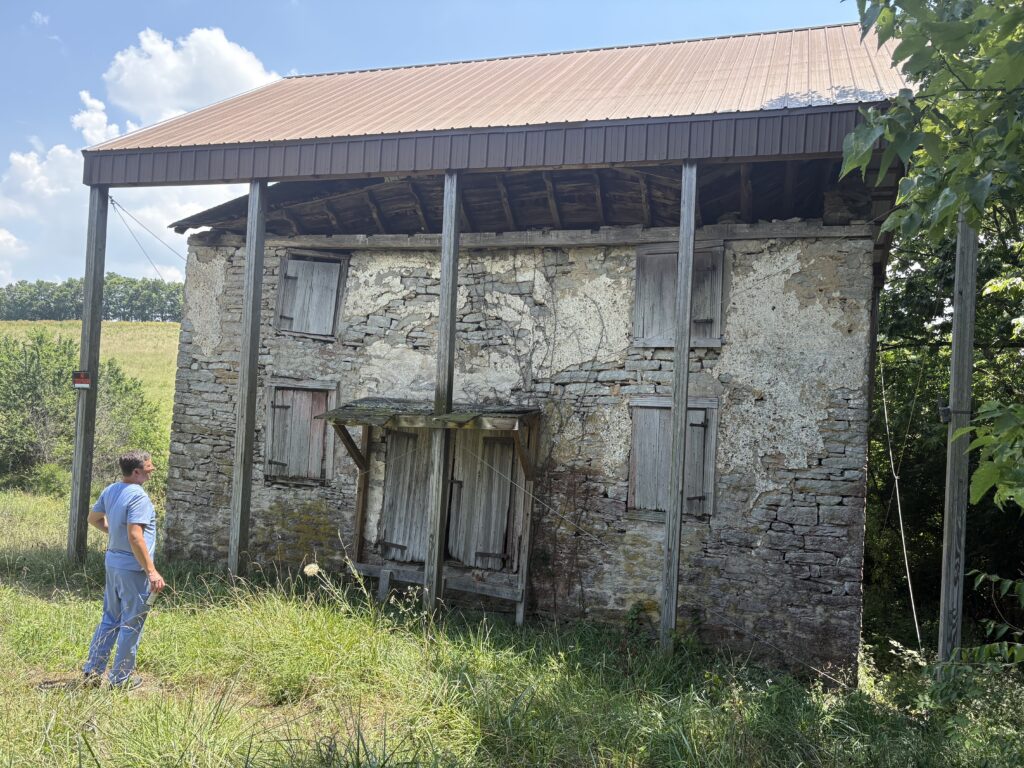
“There was this really old building,” said Richardson, who discovered that the stone structure was all that remained of a Native American school established for members of the Choctaw Nation in Kentucky in the early 1800s.
Now he’s immersed in a years-long effort to restore and preserve it.
“I felt like I was rediscovering a piece of American history that had been forgotten,” Richardson said. “The Choctaws were one of the first tribes to realize education was the key to survival.”
Unlike the infamous, native mission schools — established mostly by religious groups and known for abusive treatment and harsh conditions — the Scott County school was founded with support of the Choctaw Nation to provide young men with European-style education tribal leaders believed they would need to succeed, according to historical accounts.
“It’s a very important historic site for the Choctaw Nation,” said Dr. Ian Thompson, tribal historic preservation officer. “We would like to see it restored.”
Tribal leaders believed education through Choctaw Academy and other efforts essential to establish a new generation of leaders, Thompson said.
“The idea was to train Choctaw leaders who already had Choctaw backgrounds in the way that Western leaders perceived the world so they could act with them more effectively,” Thompson said.
He added:” It’s not necessarily that European training was better but they were trying to learn that way so they could interact with them and understand them.”

“An ambitious experiment in education” is how author and history professor Christina Snyder describes it in her 2017 book “Great Crossings,” which includes extensive information about the Choctaw Academy and the Scott County community named for a bison crossing at Elkhorn Creek.
But all this was news to Richardson, who launched his Georgetown medical practice in 2007, and four years later, with his wife, Candy, bought the farm where the school was located.
Fifteen years later, Richardson continues his sometimes-lonely crusade to restore the sole remaining school building — a former dormitory — and establish the site as a National Historic Landmark.
“It’s been nothing but blood, sweat and tears,” Richardson said of the years-long endeavor. “My dream is to one day restore what’s left of the entire school yard.”
Beyond Daniel Boone
Along the way, Richardson has attracted supporters including Dr. Sean Jacobson, a Kentucky native and assistant professor of history at the University of North Alabama, who said the site has a rich history, worthy of recognition.
It includes the Choctaw Academy, the involvement of a former U.S. vice president from Scott County who owned enslaved people — including his common-law wife who helped run the school — and more than 600 students who attended over 23 years.
“I think it’s fascinating,” said Jacobson, who first learned of the Scott County site while doing research as a graduate student.
“Native American history in Kentucky doesn’t end with the arrival of Daniel Boone,” Jacobson said, referring to the frontiersman who explored and helped open Kentucky to pioneer settlers in the late 1700s. “Personally, as a Kentuckian myself, I think it’s really important for people in state of Kentucky to realize how deep and complex their story is.”

The Kentucky Historical Society recognized the site with a historical marker along Highway 460 in 1955. It was listed on the National Register of Historic Places in 1973.
Scott County historian and author Ann Bevins has included the site in her writings, saying it has “huge significance to American history.”
The Choctaw Nation, based in southeast Oklahoma, has no direct ties to Kentucky but supports efforts to preserve the academy site, according to a statement it provided to Richardson.
It considers the academy “a critical part of our cultural and tangible heritage” that educated tribal leaders including “chiefs, lawyers, doctors and teachers,” some of whom helped rebuild the tribe’s education system after it was forced off ancestral homeland and relocated in Oklahoma, it said.
Students from 17 different Native American tribes attended the school before it closed in 1848, including Joel Barrow, who received medical training after graduating from the Choctaw Academy — and is believed to be the first Native American physician, Richardson said.
“Close to collapse?’
The preservation effort advanced this year when the U.S. Department of the Interior notified Jacobson, Richardson and others involved in the effort that the federal government believes the site is a potential candidate for designation as a National Historic Landmark.
Jacobson, who is coordinating the application for the designation, described that as an important breakthrough but said many months of work remain to complete the documentation required.
“It’s a marathon, not a sprint,” he said.
Still, Richardson said he struggles to try to generate local enthusiasm and about $300,000 in funds necessary to restore the building. He believes that people don’t fully understand the site’s history or may be put off by the many other Native American boarding schools with a deservedly bad reputation for brutality and mistreatment of youth.
“Folks on the ground just can’t get motivated,” he said.
Meanwhile, Richardson worries about the structure.
The roof collapsed in 2012, taking out part of the back wall, shortly after he bought the property. The Choctaw Nation helped fund construction of a shelter over the building meant to protect it until it can be restored, Richardson said.
“The building is dangerously close to collapse. Without the building, there’s no story to tell,” he said. “The priority is to save this building before it falls down.”

The building is made of stacked stone, similar to the many stone walls throughout the Bluegrass region of the state mostly built by Irish laborers. Richardson said historians have told him they believe Irish workers likely constructed the building from local stone.
In 2018, Richardson said he made progress when he and his wife granted the site, including the old dormitory, as a preservation easement to the Georgetown-Scott County Museum. That protects it from development and allows donations for the site to be tax-deductible.
So far, about $35,000 has been donated, he said.
But in a surprise setback, Richardson said the museum board recently notified him it wants to terminate the easement agreement, citing a lack of progress in restoring the building and the potential liability to the museum.
In a reply, Richardson said he opposes the move and cited a “lack of any meaningful assistance” by the museum with pursuing funds or grants for the project as one reason for the slow progress.
Richardson said he hasn’t heard back from the board and doesn’t know what prompted the decision.
Museum Executive Director Mary Ruth Stevens did not respond to messages from the Kentucky Lantern left with the museum.
A ‘Western-style education’
Scott County might seem an unlikely site for a boarding school for Native Americans whose tribe was located largely in Mississippi before the U.S. government forced most Choctaws onto a reservation in Oklahoma.
It came about through political connections of landowner Richard M. Johnson, then a U.S. senator who later would serve one term as vice-president, and who proposed his Blue Spring Plantation as a site, according to historical accounts.
It was the first Native American school to be established and funded by the federal government
In turn, Johnson would receive revenue as administrator of the school funded by the federal government and the Choctaw Nation that “sought Western-style education for its elite youth,” the U.S. Department of the Interior said in its April 30 letter.
“Politics hasn’t changed in 200 years,” Richardson said. “It looked like a pork project.”
Julia Chinn, an enslaved woman considered Johnson’s common-law wife and mother of their two daughters, oversaw much of the operations — including managing other enslaved persons who worked on the plantation and at the school, the letter said. She had been left to Johnson in his father’s will, according to history gathered by Richardson.
The school opened in 1825 with 25 students and eventually would educate more than 600 youths expanding to include those from 16 other tribes as well as some non-Native Americans.
A cholera epidemic struck the school 1833, taking the lives of nine students, an unknown number of enslaved people and Julia Chinn, who served as the school nurse and caught the disease as she cared for others.
Meanwhile, Choctaw leaders opposed later changes in curriculum pushed by the federal government—shifting to trades and manual labor rather than classical education. And with the tribe largely relocated to the Oklahoma region, Choctaw leaders decided to withdraw support in 1841 and create their own educational system.
Enrollment declined and Choctaw Academy closed in 1848, just 23 years after it opened.
Jacobson, the Alabama history professor, acknowledges some might find distasteful the academy’s complex history involving a white landowner, politician and slave owner — including the woman considered his common-law wife — as well as Native Americans seeking an education as their tribe was forcibly relocated from its homeland.
But he said that’s why he argues the site should be preserved to underscore its unique history amid debates that continue today.
“It’s not very well-known but this cast of characters all interacting in the same place, it’s a fascinating place to explore,” he said. “Who is an American? Can we have a multi-ethnic, multi- racial society?”
Thompson, the tribal historic preservation officer agrees, pointing out that unpleasant history shouldn’t be ignored.
“If you push it aside and forget about it, you don’t learn from the experience,” he said.
Richardson said he wants the site restored and opened as a national park so people can visit to appreciate the history of a unique institution at a unique time.
“I just need a willing party,” he said. “I can’t allow it to fail before we get to the finish line.”