
🌎 Resumen en español · traducción automática
En Kentucky hay más de 19,000 personas con discapacidades intelectuales, del desarrollo o adultos mayores esperando en listas de espera para recibir servicios de Medicaid en sus hogares y comunidades, pero la legislatura no ha financiado suficientes espacios para atenderlos. Estos servicios, conocidos como waivers de Medicaid, son más económicos y preferibles a la atención en asilos, pero la demanda crece mucho más rápido que los fondos disponibles, representando actualmente dos tercios de los espacios financiados. El crecimiento de las listas de espera se ha convertido en una prioridad para muchos legisladores de Kentucky que buscan soluciones para reducir este rezago.
Traducción y resumen generados por IA a partir del artículo en inglés. Puede contener errores; consulte el texto original.
For tens of thousands of Kentuckians with an intellectual or developmental disability, or who are simply getting older and less able to care for themselves, Medicaid services provided at home and in the community are crucial. These services are available through what are known as 1915c waivers and are often simply referred to as “Medicaid waivers.” As an alternative to care in residential facilities such as nursing homes, these services provided in the comfort of home are both less expensive and more desirable for many.
However, there are many more Kentuckians who are seeking these services than the legislature has agreed to fund. Each “slot” for these services requires an appropriation from the General Assembly, and for three waiver services – Home and Community Based (HCB), Michelle P., and Supports for Community Living (SCL) – the demand has resulted in waitlists that have steadily grown to over 19,000 Kentuckians as of December 2025 according to the Department for Medicaid Services.
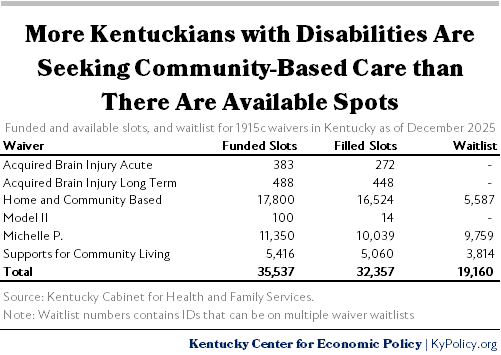
While there have been recent increases in the number of available spots, particularly during the 2024-2026 budget, the waitlist is growing much faster than funded openings and now totals roughly two-thirds of the slots funded. This growth has become a focus of many legislators. As they weigh how to address the backlog, understanding the context and importance of these services is paramount.
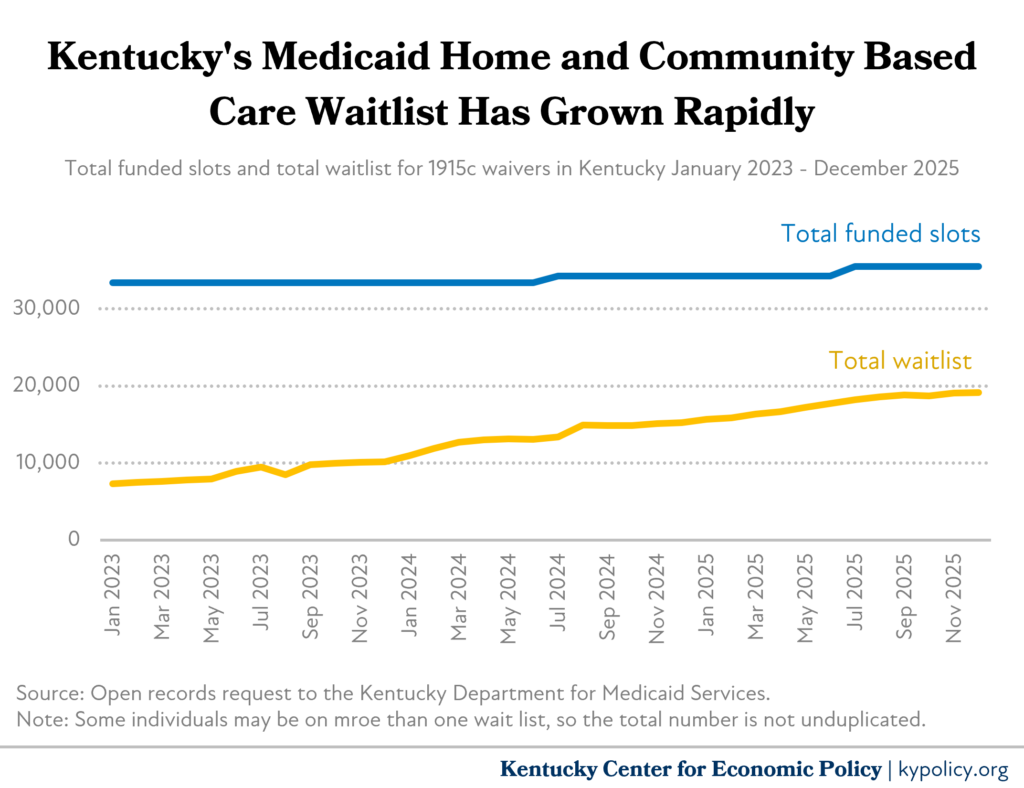
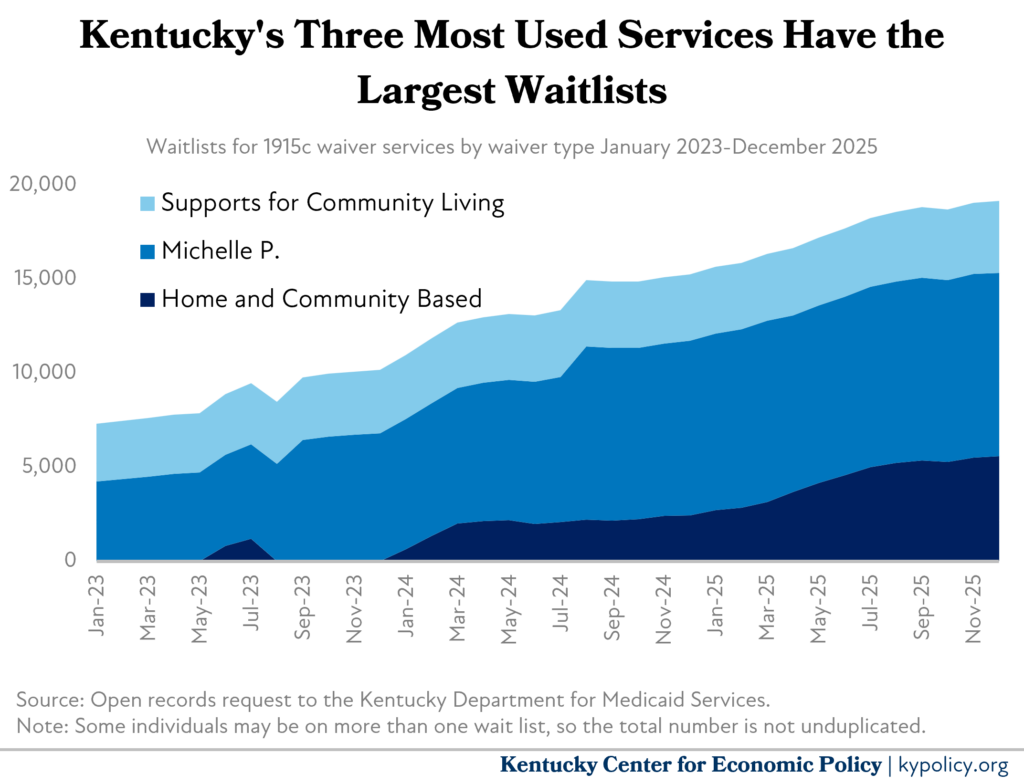
Of the three waivers with waitlists, HCB has seen the largest percent growth over the past two years. As waitlists backed-up for the Michelle P. waiver which has more restrictive eligibility criteria and fewer available spots, Kentuckians with intellectual and developmental disabilities turned to HCB, which offers a less comprehensive set of services than Michelle P. As spots filled up in HCB while people awaited available spots on Michelle P., a waitlist for HCB developed. Previously, HCB waivers were available for anyone who qualified.
Benefit of community-based care vs. institutional care
While some disabled individuals with higher level of needs may need institutional care in a residential facility, a large share would prefer to remain in their home and community while receiving the care they need. This preference is the primary benefit of 1915c waivers – an opportunity for care with dignity and without isolation.
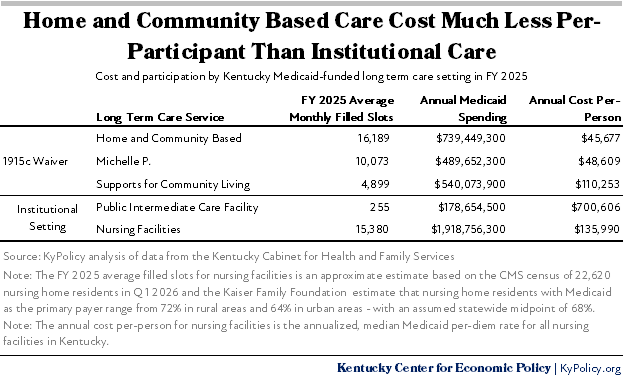
Beyond that advantage, it is also less expensive for the state to provide these waivers than placing people in an Intermediate Care Facility (ICF) or a nursing home. For example, the state has seven public ICFs that provide long term care to 255 individuals with disabilities, spending over $700,600 per person, per year on average. These settings are also very limited, with an average number of 255 individuals staying in ICFs per year.
Other long-term care facilities such as a nursing home are also more expensive for Medicaid to cover. The median Medicaid per-diem rate on an annualized basis for nursing facilities is $135,990. Those rates range from $279 to $514 per day depending on the facility, with some locations much more expensive for Medicaid to cover. The more expensive options are also in more populous areas like Louisville and Northern Kentucky.
The three main waiver services with waitlists cost far less. For HCB, the average annual amount spent on a per-person basis in FY 2025 was $45,680. For Michelle P., the state spent $48,330 per-person. And SCL (which has a residential option) costs $110,250 per-person. Even SCL, which is by far the most expensive option, per-person care is less expensive than institutional settings.
In addition to the personal and cost-saving benefits, home and community-based care is also an important benefit to local economies. First, state Medicaid investments leverage significantly more in federal dollars; for every $1 the state legislature puts in, the federal government provides approximately $3. Second, the Bureau of Economic Analysis assumes that for every $1 in new spending on health care, $1.70 is generated in the broader economy. Because HCB waiver services are, by definition, based in communities (as opposed to spending on prescription drugs, for example, which largely benefits out-of-state pharmaceutical corporations and pharmacy benefit managers), the funds spent on waivers are even more likely to stay in local communities. If the state were to invest in 10,000 new waiver spots (which is still inadequate to eliminate the waitlists) it would require $190 million in state funds but would pull down an additional $490 million in federal funds, generating at least $1.2 billion in total economic activity.
More slots and higher reimbursements are needed
Not all Kentuckians who are on a waiting list for waiver services end up being eligible, and nearly 15% are on more than one waiver’s waiting list with nearly one in three waitlisted Kentuckians already receiving a different waiver service. But because each waiver program offers different benefits and the medical needs of many waiver recipients are chronic, families are willing to wait to receive them. In the case of SCL, which offers a residential option for individuals with intellectual and developmental disabilities, the average family waits nearly eight years, demonstrating the pressing need for additional slots.
Not all Kentuckians who are on a waiting list for waiver services end up being eligible, and nearly 15% are on more than one waiver’s waiting list with nearly one in three waitlisted Kentuckians already receiving a different waiver service. But because each waiver program offers different benefits and the medical needs of many waiver recipients are chronic, families are willing to wait to receive them. In the case of SCL, which offers a residential option for individuals with intellectual and developmental disabilities, the average family waits nearly eight years, demonstrating the pressing need for additional slots.
Ultimately, the critical need is for increased investment from the General Assembly to preserve, and improve, access to these critical services. That includes funding for additional spots but also funding for improved payments to waiver service providers who struggle under inadequate payments. Payments to providers of these waivers are notoriously low, and cuts from the One Big Beautiful Bill Act (H.R. 1) and recent state cuts to reimbursement rates will further reduce those payments. As rates stagnant or fall, it becomes increasingly difficult for the state to attract providers to offer services, or for providers to hire an adequate workforce, regardless of the number of funded slots. Without both these components the waitlists will continue to grow as more people need the services, but fewer providers are able to offer them.
This pressure will only grow as Baby Boomers who have cared for their adult children with disabilities age out of being able to do so. The Centers for Disease Control and Prevention estimates that 8.6% of the population or approximately 394,000 Kentuckians have been diagnosed with a developmental disability. This population far surpasses the 34,566 funded slots for the three waiver services that care for an even broader population that includes aging Kentuckians and those with an intellectual disability. While House Bill (HB 2) from the 2026 session and other efforts will attempt to create a prioritization process for awarding waiver slots, it is clear that waitlists will only be mitigated through additional spots and increased number of providers able to serve people in those spots. While the upfront cost of doing so would be large, , it would not come close to the eventual cost of institutionalized care that many of those on waitlists would eventually receive.
The post More Kentuckians With Disabilities Need Care in Their Community Than the Legislature Has Funded appeared first on Kentucky Center for Economic Policy.