🌎 Resumen en español · traducción automática
Dan Wu, vicealcalde de Lexington, mencionó públicamente por primera vez en agosto su afiliación con la Abundance Elected Network, un programa que le proporcionó un pasante de Stanford para trabajar en temas de vivienda asequible. Según documentos filtrados de la organización matriz de la red, el programa está financiado por multimillonarios cuyos objetivos y contribuciones fueron descritos en documentos internos que no habían sido divulgados públicamente. Wu no había mencionado previamente su membresía en la red en sus campañas electorales ni en reuniones públicas, a pesar de ser identificado como miembro fundador en su biografía oficial de la ciudad.
Traducción y resumen generados por IA a partir del artículo en inglés. Puede contener errores; consulte el texto original.
On August 11, during a routine council work session, Vice Mayor Dan Wu said something he had never said in a public meeting before.
“As some of you might know, I’m part of the Abundance Elected Network and Abundance Fellowship,” he told his colleagues. “And through that program, I had the good fortune of picking up a student intern.” The intern, Daniel Stein, is a college student from Stanford, midway through an eight-week internship, “primarily working with my office on housing issues and trying to figure out how we can take down some of our barriers and create more housing, particularly affordable housing.”
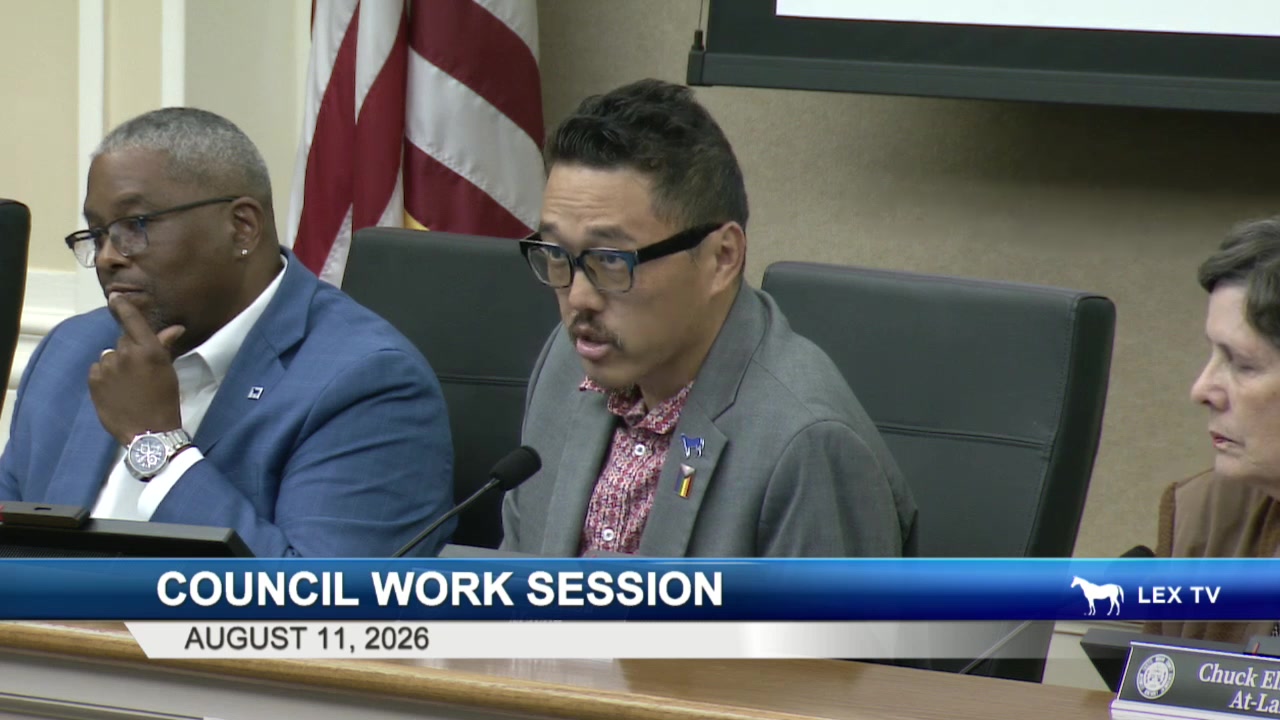
It was a passing introduction, the kind of housekeeping item that fills the front end of a work session. It was also the first time Wu had described the affiliation aloud in a public meeting — two days after The Lexington Times reported that his official city biography calls him a founding member of the Abundance Elected Network, and two months after the American Prospect published the fundraising documents of the network’s parent organization. A full-text search of The Lexington Times’ archive of the city’s meetings turns up no other instance of Wu saying the word “abundance” on the record. When he announced his re-election bid in a December radio interview and named affordable housing among his priorities, the network he had joined that fall went unmentioned. It appears nowhere on his campaign site. As far as we can find, no other news outlet anywhere has reported on his membership. The bio line and the August 11 introduction are the entire public trail.
Those leaked documents are why the introduction deserves more than a passing mention. They describe, in the movement’s own words and numbers, who is paying for it and what they believe they are buying. This is the deep dive: what the network is, who funds it, what its founders wrote when they thought only billionaires were reading — and what any of it has to do with Lexington.
What Wu joined
The Abundance Elected Network launched on September 3, 2025 as the local-electeds program of the Abundance Network, a San Francisco 501(c)(4) co-founded by tech executive Zack Rosen and Misha Chellam and organized around the “abundance” agenda popularized by Ezra Klein and Derek Thompson — the theory that liberal cities fail because they make it too hard to build, and that the fix is clearing regulatory and procedural barriers. The electeds program’s own About page describes it as “founded as part of the broader Abundance Network,” with “100 national members across 27 states” at launch; Axios put it at more than 120 officials in 31 states.
Wu’s tier within it is worth being precise about. His official city biography lists two affiliations on separate lines: “Abundance Elected Network – Founding Member” and “Abundance Network – 2026 Fellow.” The second claim is org-published: the network’s inaugural-fellows page names twenty officials nationwide, including the mayors of Chattanooga, Knoxville and Bellingham — and two Kentuckians, Wu and Louisville Metro Councilmember Ben Reno-Weber. The first is Wu’s own description of belonging to that founding cohort of about a hundred; the network publishes no list of founding members anywhere we can find. Neither affiliation appears on his campaign website, which does not mention abundance at all.
What Wu is not is network leadership. The organization has announced a ten-member inaugural steering committee — co-chaired by Knoxville Mayor Indya Kincannon and Phoenix Councilmember Anna Hernandez, with the mayors of Albuquerque, Boise and Durham among the members. Neither Kentuckian is on it.
The fellowship itself was designed by former Oakland mayor Libby Schaaf and is run by managing partner Giselle Hale. Of its twenty fellows, the network says their “custom projects will address housing shortages, permit inefficiencies, childcare, infrastructure needs, and more” in their cities. Nothing published names Wu’s project. Axios reported at the launch that the fellowship “is funded by Arnold Ventures” — the philanthropy of billionaire former hedge-fund trader John Arnold. That attribution matters, because it is the only one there is: the Abundance Network’s tax filings, which show revenues growing from $386,000 in 2021 to $2.15 million in 2023, disclose no donors, and no filing covering the network’s current scale is public yet.
What leaked
On June 12, the American Prospect published two internal Abundance Network documents — a fundraising pitch by Rosen aimed at donors “researching how to deploy $10M+/year into California politics,” and a political-history manifesto by Rosen and Chellam. The Bay Area watchdog group The Phoenix Project obtained the pitch and provided it to the Prospect; Rosen confirmed to the magazine that both documents are real.
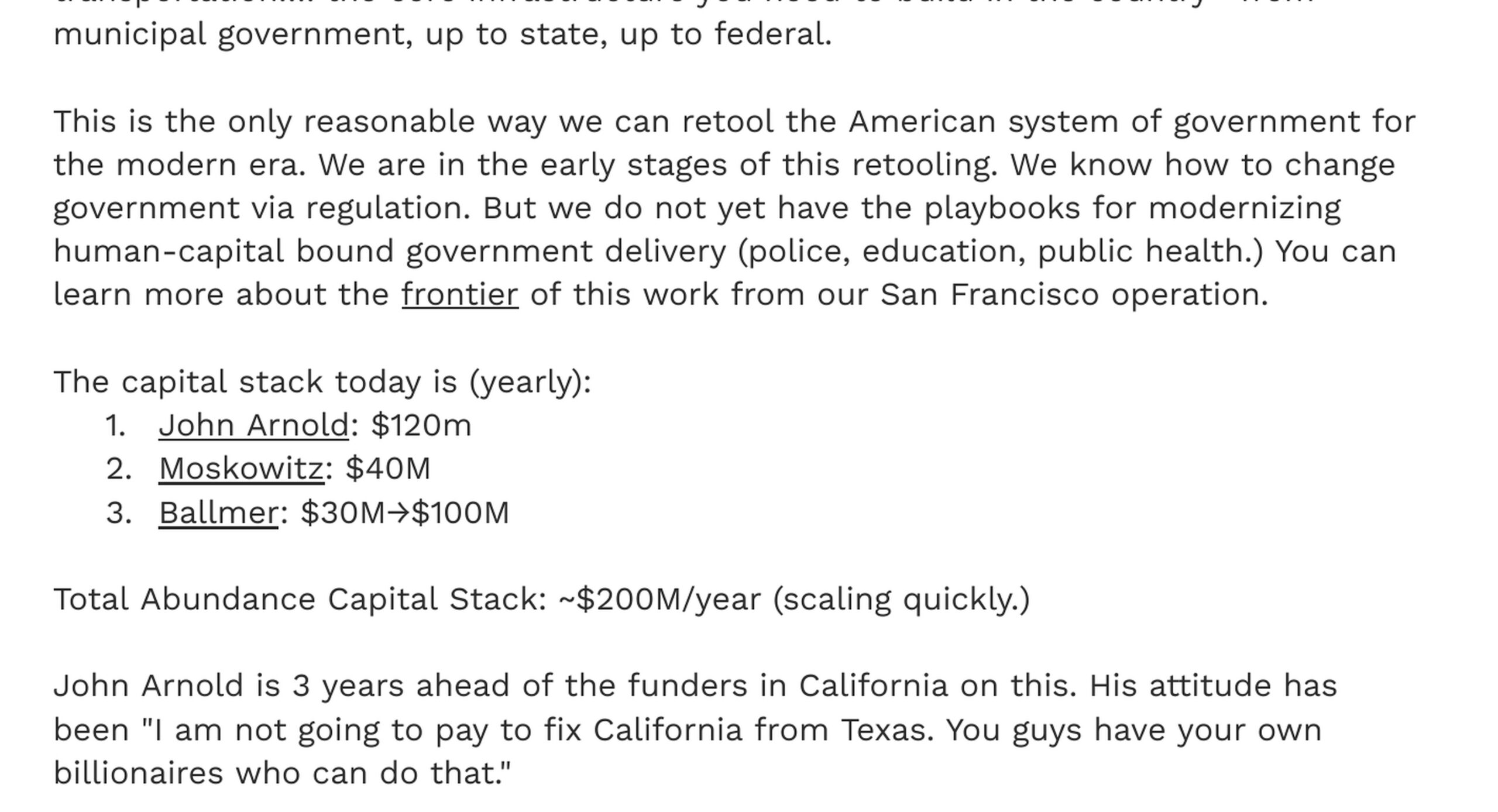
The pitch itemizes what it calls the movement’s money, under the heading “The capital stack today is (yearly)”: John Arnold, $120 million; Dustin Moskovitz, the Facebook co-founder, $40 million; Steve Ballmer, the former Microsoft CEO and Clippers owner, $30 million growing to $100 million. “Total Abundance Capital Stack: ~$200M/year (scaling quickly.)” (The Prospect’s story put the figure at $260 million a year — its own arithmetic, using the endpoint of Ballmer’s ramp; the document’s prose elsewhere says $250 million. The document’s own itemized total is the number we cite.)
Rosen disputed the figures when the Prospect asked, saying the committed-capital number “was an estimate,” that actual grants are “probably closer to $40M,” and — in the Prospect’s paraphrase — that the Arnold figure was incorrect. He did not respond to the magazine’s questions about the Ballmer and Moskovitz figures. Whichever end of that range is true, none of these commitments appears in any required disclosure; the sums live in a private pitch.
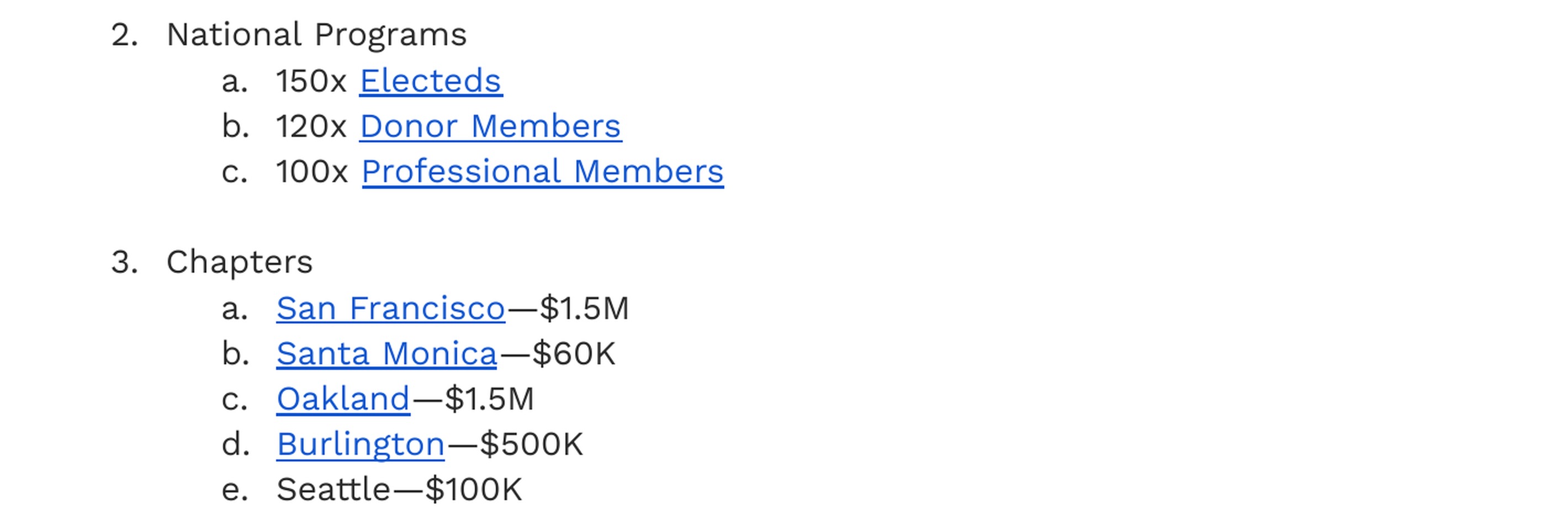
The pitch also describes what the money buys. Under “National Programs,” it lists three lines: “150x Electeds,” “120x Donor Members,” “100x Professional Members.” The “Electeds” line is a hyperlink. It points to abundanceelected.com — the network Wu belongs to, listed in a pitch to billionaires as the first of its three national programs.
The documents are strikingly candid about what the electeds are for. Donors who fund campaigns one race at a time are “gambling,” Rosen writes; the model he prefers is “the house” — in the pitch’s words, “Get a 2pt edge, and sustain it” — with Roe v. Wade’s reversal cited as proof that “the big stuff has to be done this way.” Elected officials, the pitch explains, remember who stays: donors who cannot demonstrate staying power will find that electeds “discount your ability to execute by 90%.”
And they are candid about what the movement is against. The Rosen-Chellam manifesto lists the crises it calls “Maszlow’s monsters” — the misspelling is the document’s — as “Urban conflagrations, floods, deteriorating norms, and the rebellion against elites.” The problem with Democratic politics, in their telling, is “the abdication of elites”: business leaders who withdrew from civic life instead of running it. “Small dollar internet fundraising makes politics dumber,” the document argues. “The old gatekeepers were political professionals who could count cards; small dollar donors today are amateurs yanking the handles of ActBlue slot machines.” The Prospect’s summary of the project: a political infrastructure that “reorients politics away from anger at economic elites.”

The track record they’re selling
The pitch’s brag list is mostly real. In March 2024, a moderate slate backed by roughly $2.2 million took 18 of 24 seats on the San Francisco Democratic County Central Committee — the New Republic identified the group running the slate as the one “recently rebranded as the Abundance Network,” with its affiliated Abundant SF committing $850,000. Santa Monica’s 2024 council races drew a record $1.4 million with an “Abundant Santa Monica” PAC on the field; the pitch claims that council was “flipped.” Sunset Dunes Park — “the largest pedestrianization project on the West coast” in the pitch — exists, though the west-side neighborhoods nearest it voted against the road closure that created it, and an effort aimed at reversing the closure is underway for November.
Other claims wilt on inspection. The Prospect checked the pitch’s assertion that Mississippi went “from worst-in the nation education performance to best-in the nation” against the pitch’s own source: Mississippi improved from 49th to 21st in fourth-grade reading.
The billionaires
John Arnold made his first fortune trading natural gas at Enron, his second running the Centaurus hedge fund, and now sits on Meta’s board. His Arnold Ventures is the name at both ends of the chain around Wu’s fellowship: Axios reported it funds the fellowship, and the leaked pitch lists Arnold at $120 million a year — with an attitude the pitch quotes directly: “I am not going to pay to fix California from Texas. You guys have your own billionaires who can do that.” Arnold Ventures also co-funds the $120 million Recoding America Fund announced in October 2025 by Jennifer Pahlka — who is herself listed as a senior advisor on the Abundance Network’s team page.
Moskovitz’s philanthropy, Coefficient Giving (formerly Open Philanthropy), announced its own $120 million Abundance and Growth Fund last year. Ballmer’s presence in the pitch was previously unreported; he is otherwise in the news this year over allegations — which an NBA investigation reportedly found no evidence to support, though the probe has not formally closed — that a company he invested in funneled off-book pay to Kawhi Leonard. The Prospect also reported the network “has received significant donations” from Michael Bloomberg and from Ripple co-founder Chris Larsen, whose company gave nearly $5 million to Donald Trump’s inauguration and, in the Prospect’s words, “received significant regulatory relief” from the SEC months later. And the pitch names the funders of the network’s sister organization, California YIMBY, plainly: “tech founders: Mark Zuckerberg, Dustin Moskowitz, Patrick Collison, Ken Duda are 80%+ of the funding.”
The Kentucky footprint
Here is where the money actually touches Lexington, and it is smaller and stranger than either the network’s boosters or its critics would guess.
No billionaire on that list appears anywhere in Wu’s campaign filings. We screened every itemized contribution he has reported to the Kentucky Registry of Election Finance against the movement’s founders, funders and their companies — Rosen, Chellam, Arnold, Moskovitz, Collison, Ballmer, Larsen, Pahlka, Schaaf, Pantheon, Arnold Ventures, the YIMBY organizations. Nothing. Wu’s donor base is overwhelmingly local; out-of-state money is $3,425 of his $75,662 in itemized individual contributions, about 4.5 percent.
What his filings do show is this: in statewide Kentucky filings back to 2016, only three contributions have ever come from anyone listing the Abundance Network as an employer. Two of them — $750 across checks given at Wu fundraising events on February 2 and March 19 of this year — went to Dan Wu, from Kait Saier of Nicholasville, the network’s Director of Membership. Saier is, by her own bio, the network’s money person — a career fundraiser who has led “major giving programs and donor networks.” Her photo was uploaded to the network’s team page in November 2025, the month of Wu’s first fellowship weekend; she appears on the page by late December, and by February she was listing the network as her employer on contribution records. (The third contribution: Alicia Ariatti — whose title is Abundance Elected Program Manager, meaning she manages the program Wu belongs to, and whose bio lists a previous role as chief of staff at Kentucky’s largest housing authority — gave $250 to a Louisville legislative candidate in December.) The two network staffers with Kentucky addresses in state filings are, it turns out, professionals of exactly the two crafts the leaked pitch describes: raising money and managing electeds.
Our August 9 column reported that no Abundance money had reached Wu’s campaign that we could find. Saier’s contributions were in the filings we searched, and we should have caught them. They are personal contributions from a staffer — Kentucky law bars the organization itself from giving — so the distinction the column drew between the network and Wu’s campaign money stands, but the sentence as written did not, and we have appended a correction to that column.
Wu’s campaign has filed nothing since the post-primary report: his newest itemized receipt is dated May 22. That is a fact about his campaign’s filing calendar, not the state’s — all five of his at-large rivals have reported receipts into June and July.
The fit, honestly
Does Wu govern like the movement’s man in Lexington? The record is more interesting than a yes.
On the region’s defining growth question — the 2023 expansion of the urban service boundary — Wu was not a build-more vote. The clerk’s records show three votes in June 2023: on June 1, with Wu presiding, the committee direction to expand by “no less than 2,700 acres but no more than 5,000 acres” passed 10–3 with Wu voting no. On June 13, Wu backed three failed attempts to cap the expansion, moving the tightest of them — “up to 2700 acres” — himself, and losing 3–10. On June 15, he voted with the 13–2 majority to adopt the amended goals — the final vote our earlier column reported. (His record on the question is not purely preservationist: on June 1 he also moved, unsuccessfully, to hand the full 5,000 acres to the Planning Commission if the process dragged past a deadline.) A movement built on the premise that cities must build more would struggle to claim that boundary record; Wu tried repeatedly to hold Lexington’s expansion to the minimum, and lost.
Where the fit is real is inside the boundary. Fifteen days before the network launched, at an August 2025 committee meeting, Wu was asking whether Lexington was “putting too many potential barriers towards development,” calling for “denser housing, missing middle housing, the kind of housing we’d really need,” and worrying aloud about the small developer who wants to build “one quadplex.” That is the abundance agenda, fluently spoken, before the network existed — which is the honest version of this story’s causation. The movement did not make Dan Wu. It recognized him, in a way consistent with the model its documents describe: sustain the infrastructure around electeds already moving your direction. Sixteen days after his first fellowship weekend, Wu introduced the Preservation and Growth Management Program he has championed since. The sequence proves nothing about causation, and we are not claiming it does. It is simply what the record shows the relationship looks like in practice: a vocabulary, a peer group, a Stanford intern working housing policy in his office — and a curriculum for “Winning: Political Skills for Getting Hard Things Done.”
Fairness also requires the other column: the abundance framework has no slot for tenants against landlords, but Wu’s committee work does — an eviction-diversion and right-to-counsel item — listed among the items in committee on his official bio — was before the Social Services and Public Safety Committee in May, months before our column raised the tenants question.
The fight he joined
Wu joined this network in the middle of a war over what the Democratic Party is for. Sen. Elizabeth Warren, D-Mass., said in a January speech at the National Press Club that abundance “has become a rallying cry — not just for a few policy nerds worried about zoning, but for wealthy donors and other corporate-aligned Democrats who are putting big-time muscle behind making Democrats more favorable to big businesses.”
The movement’s defenders answer that the critique gets the direction of causation backwards. The Breakthrough Institute’s Alex Trembath, in an essay titled “Bottom-Up Abundance”, wrote: “We were not herded and orchestrated: we found each other.” Ezra Klein — who a New York Times spokesperson says has “no official or paid relationship with the Abundance Network or any similar group” — told Axios that politicians will campaign on “abundance, populist and anti-oligarchal themes,” and that “talented politicians aren’t just one thing.” Wu’s own record — the boundary votes, the eviction item — is arguably a case for Klein’s version.
And the documents’ provenance deserves the same scrutiny we give the documents. The Prospect’s author is a senior researcher at the Revolving Door Project, an avowedly progressive watchdog; the leak came through The Phoenix Project, a San Francisco 501(c)(4) built as a progressive counterweight in that city’s factional wars, whose stated mission includes a “radically redistributive society” and whose president co-bylined a follow-up in The Nation. We found no mainstream outlet that has independently matched the leak’s reporting. The documents themselves, though, are not in dispute: Rosen confirmed they are real, and their words are quoted here from the documents, not from anyone’s summary of them.
What we asked, and what to watch
Lexington’s ethics ordinance does not appear to prohibit any of this. The gift rules expressly carve out fellowships “awarded on the same terms applied to other applicants,” and the disclosure form reaches board seats, income, and organizations in which an official holds a private or financial interest — not memberships as such. Whether Wu’s statements of financial interest mention the fellowship — or any travel it has paid for — is not something we can check online; the filings sit with the council clerk, available on request.
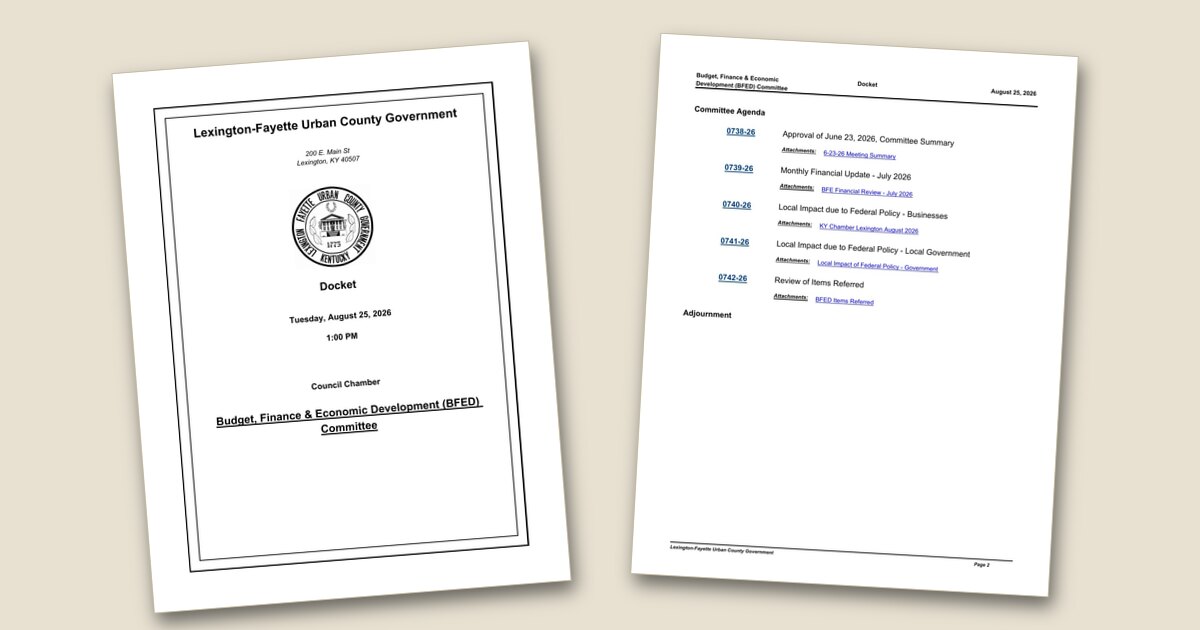
We sent Wu’s office and campaign five questions on Friday: what his Abundance Elected “custom project” for Lexington is; what founding membership involved; whether the leaked documents reflect the movement he joined; whether the fellowship provides travel or anything else of value, and — since the network’s first member meeting, in Washington on December 9, is free for members — who pays for the trip if he attends; and anything else he believes readers should understand. Wu did not immediately respond to a request for comment. We will update this article if he does.
Until then, the record is what it is. A network whose pitch to billionaires lists his program as an asset. A founding-member claim the network doesn’t document. A fellowship whose reported funder made his first fortune at Enron. Seven hundred fifty dollars from the network’s fundraiser at his own fundraisers. One Stanford intern. And one passing introduction from the dais on an August afternoon that is — so far — the only account Dan Wu has given his constituents of any of it.
Sources
- The American Prospect: New Documents Detail Nine-Figure, Silicon Valley–Funded Abundance Movement (June 12, 2026)
- Leaked document: “Memo: Unlocking California” (Zack Rosen, Abundance Network)
- Leaked document: “AN’s Reading of American Political History” (Rosen and Chellam)
- City of Lexington: Council At-Large and Vice Mayor Dan Wu (official biography)
- Axios: New group organizes Democrats around the abundance agenda (September 3, 2025)
- Abundance Elected — About
- Abundance Elected — 2026 Fellows roster
- Abundance Elected — Member Meeting 2026 (steering committee)
- LFUCG Council Work Session, August 11, 2026 (Granicus, clip 6849)
- Budget, Finance and Economic Development Committee, August 19, 2025 (meeting archive)
- Sen. Elizabeth Warren, “Big Tent” speech, National Press Club (January 12, 2026)
- The Breakthrough Institute: Bottom-Up Abundance (Alex Trembath)
- The New Republic: San Francisco DCCC moderate slate and its funders
- The Nation: An Abundance of Influence (July 8, 2026)
- Coefficient Giving: Abundance and Growth Fund
- ESPN: NBA investigation of Clippers/Aspiration allegations (August 17, 2026)
- WUKY: Dan Wu re-election interview (December 8, 2025)
- Kentucky Registry of Election Finance — itemized contribution search
- The Lexington Times: Commentary: The sentence Dan Wu never finished (August 9, 2026)
This investigation was researched and drafted with AI assistance (Claude Fable 5) by The Lexington Times’ newsroom agent team and finalized for publication by the editor. Every figure and quotation was verified against primary sources: the two leaked Abundance Network documents published by The American Prospect (quoted from the documents themselves, with audio and page-image verification), the organizations’ own websites and tax filings, KREF itemized contribution records pulled August 21, 2026, official LFUCG clerk records and meeting video, and the cited news reports. The cover and inline images are unaltered crops of the leaked documents.
Republishing: This is original Lexington Times reporting, licensed under Creative Commons CC BY-ND 4.0. You may republish this article, in full and unaltered, for free — including commercially — with credit to The Lexington Times and a link to the original.