
🌎 Resumen en español · traducción automática
En el segundo año de vigencia de la Ley de la Casa 5 de 2024 en Kentucky, los cargos por "acampada ilegal" aumentaron a 460 casos en 41 condados entre julio de 2025 y julio de 2026, comparado con 438 casos en 31 condados el año anterior. La mayoría de los cargos se concentraron en los condados de Jefferson (42%) y Fayette (14%), y la mayoría fueron por primera ofensa, que se castiga con multa de hasta 250 dólares. Este aumento es preocupante considerando la crisis de vivienda asequible y los recortes a programas de seguridad social en el estado.
Traducción y resumen generados por IA a partir del artículo en inglés. Puede contener errores; consulte el texto original.
During the first year after House Bill (HB) 5 (2024) took effect, an average of more than one unhoused person per day was cited or arrested for “unlawful camping” in Kentucky. New data from the Administrative Office of the Courts (AOC) shows the situation worsened in year two. Between July 15, 2025 and July 14, 2026, law enforcement agencies filed 460 unlawful camping charges in district court across 41 counties, up from 438 across 31 counties during the previous year.1 This upward trend is especially concerning amidst the growing affordability crisis, cuts to critical safety net programs, and inadequate state and local investment in housing.
Kentucky’s unlawful camping statute states that a person is guilty of unlawful camping when, lacking authorization, they knowingly enter or remain in a public area with the “intent to sleep or camp” there, with the definition of “camp” including the use of “camp paraphernalia” such as sleeping bags. A first offense is categorized as a violation, which carries a fine of up to $250 and requires appearing in court. Unlawful camping is a Class B misdemeanor when a person is charged with a second or subsequent offense, or “if during the first offense the individual refuses to cease the offense,” which results in arrest and carries a maximum punishment of 90 days in jail and a fine of up to $250. In year two of HB 5, 434 of unlawful camping charges were for a first offense, 21 were for a second/subsequent offense, and five were for “refusal to cease the offense.”2 Most of the charges were in Jefferson (42%) and Fayette (14%) counties, followed by Boyd (7%), Franklin (5%), Daviess (4%) and Bell (3%).
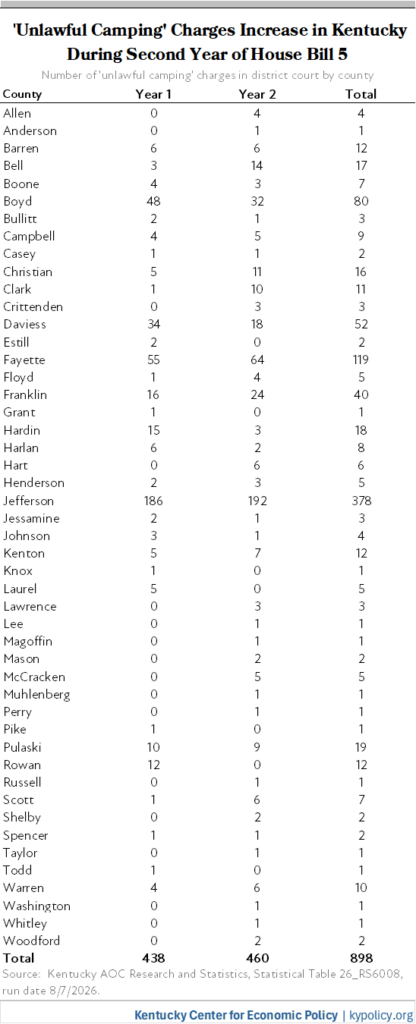
Seventeen of the 41 counties with unlawful camping charges in district court in year two had none the previous year: Allen, Anderson, Crittenden, Hart, Lawrence, Lee, Magoffin, Mason, McCracken, Muhlenberg, Perry, Russell, Shelby, Taylor, Washington, Whitley and Woodford. There were seven counties that had unlawful camping charges in year one but none in year two: Estill, Grant, Knox, Laurel, Pike, Rowan and Todd.
Even with this increase, the actual number of relevant charges is likely significantly higher because the data does not capture people who may be charged under other statutes, such as criminal trespass, in circumstances involving sleeping or camping in public spaces.
HB 5 should serve as a cautionary tale as more states consider street camping bans and the Trump administration attempts to shift U.S. Housing and Urban Development (HUD) funding away from housing subsidies and toward the forced treatment of substance use and mental health disorders. According to proponents of these policies, criminalizing street camping will move people out of homelessness by mandating a choice between citation/arrest and treatment/other services. Instead, HB 5 is further destabilizing peoples’ lives by increasing their involvement in the criminal legal system rather than providing housing and other supports that actually address homelessness.
The post ‘Unlawful Camping’ Charges Increase in Second Year of House Bill 5 appeared first on Kentucky Center for Economic Policy.