
Working Kentuckians find themselves in an increasingly difficult labor market in 2026, with no net job growth in the state over the last two years, rising costs due to inflation and wages that aren’t keeping up with those costs. Tariffs, war in Iran, immigration crackdowns and federal budget cuts are contributing to a slow economy. Though Kentucky is not seeing layoffs or unemployment in large numbers, employers are hiring at the slowest pace since the Great Recession, leaving job seekers with few options.
The issues facing workers on the horizon are also of serious concern. The significant federal budget cuts coming to Medicaid through the One Big Beautiful Bill Act will begin in 2027 and ramp up thereafter, threatening health care employment, one of the few bright spot in the labor market over the past two years. And as artificial intelligence (AI) becomes more integrated into the workplace, the pressure on information-based jobs is expected to increase. Policy makers will need to take significant steps to build worker power, increase wages and open new employment opportunities to ensure that workers are protected as the next chapter in Kentucky’s economy is written.
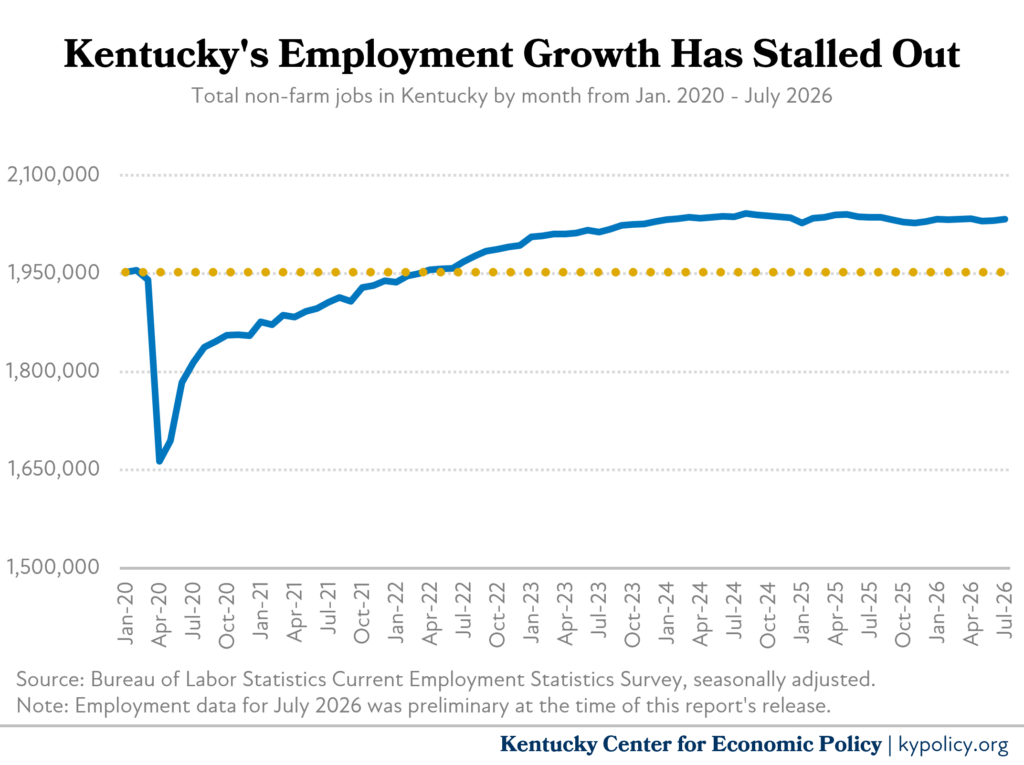
Job growth has stalled for two years
The primary way Kentuckians contribute to the state and provide for their families is through a job. Unfortunately, jobs growth has all but stalled in Kentucky. After a robust recovery from the COVID-induced downturn from May 2020 through January 2024, employment has flattened for 30 months now. The on-again, off-again trade wars, major federal cuts to programs that economically benefit Kentucky and immigration crackdowns have all contributed to a weakened economic landscape that has slowed hiring to a rate not seen since the Great Recession. As of the most recent data (December 2025), new hires were only 3.1% of the Kentucky’s labor force, which is roughly the same pace as hiring in the slow recovery of 2009.
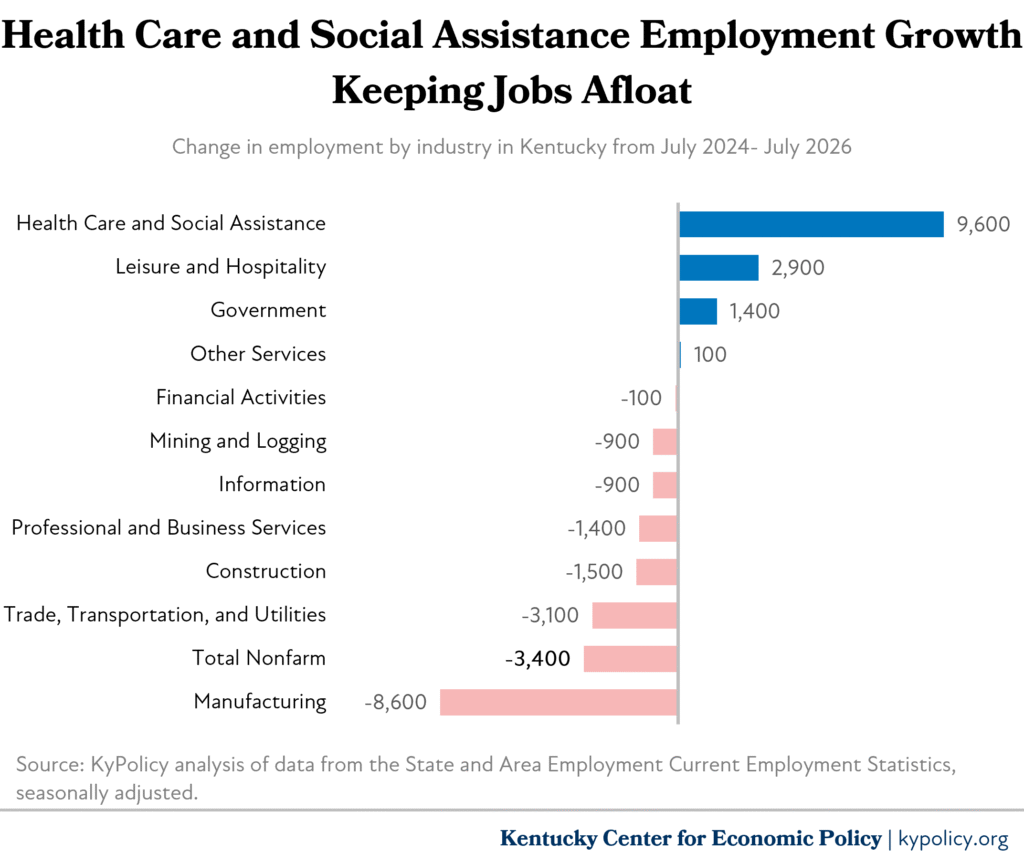
Looking at job growth within Kentucky’s individual industries, robust hiring in health care and social assistance prevented a large loss in jobs over the past two years. While total non-farm employment fell by 3,400 jobs since July 2024, employment in health care and social assistance rose 9,600 in that same timeframe. While leisure and hospitality, government, and other services still saw marginal job growth, they would not sufficiently make up for the job losses in other industries, particularly manufacturing (-8,600) which has been impacted by recent trade wars and the reversal of many industrial policies in the Inflation Reduction Act.
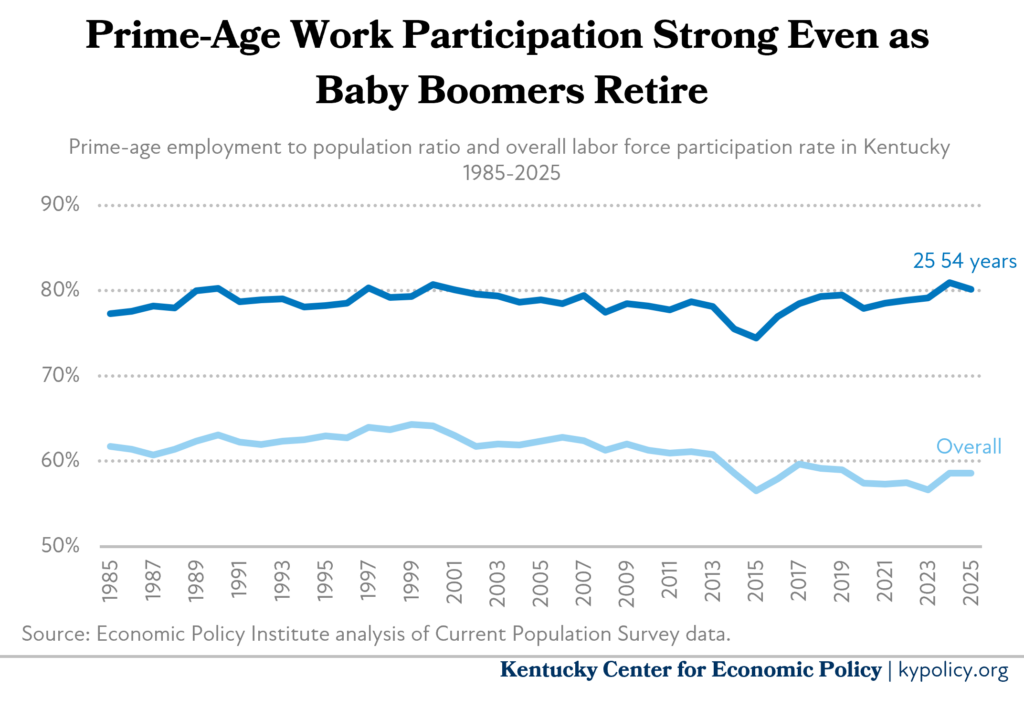
Despite a near-frozen job market, participation in the labor force remains strong among “prime-age” workers. As of 2025, 80.1% of Kentuckians age 25 to 54 were participating in the labor force (either working or actively looking for work). This is a relative high-water mark for our prime age labor force participation, on par with the late 90s and early 2000s. The high prime-age labor force participation rate has offset a reduction in the participation rate of Kentuckians 55 and older, which has fallen to roughly three in 10 as the baby boomers age into retirement. This has left the overall labor force participation rate at 58.6% over the past two years.
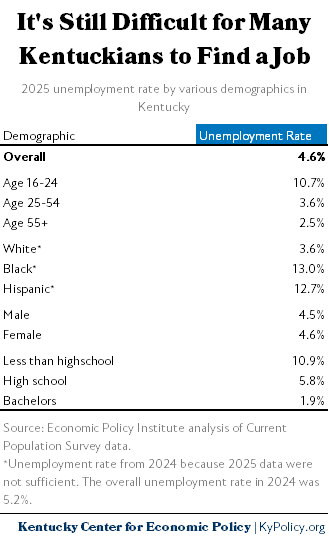
The number of Kentuckians actively looking for a job but not currently working (unemployed) is not especially high right now at 4.6%, but it is elevated compared to full employment. For some Kentuckians, finding a job is very difficult. More than one in 10 workers ages 16-24 are unemployed compared to just 3.6% of prime-age Kentuckians, and 2.5% of Kentuckians 55 and older. Kentuckians without a high school diploma also face a stiff job market with an unemployment rate of 10.9%. Historic and systemic barriers to opportunity have left Black and Hispanic Kentucky workers with 13% and 12.7% unemployment rates respectively.
Wage growth is not keeping up with inflation
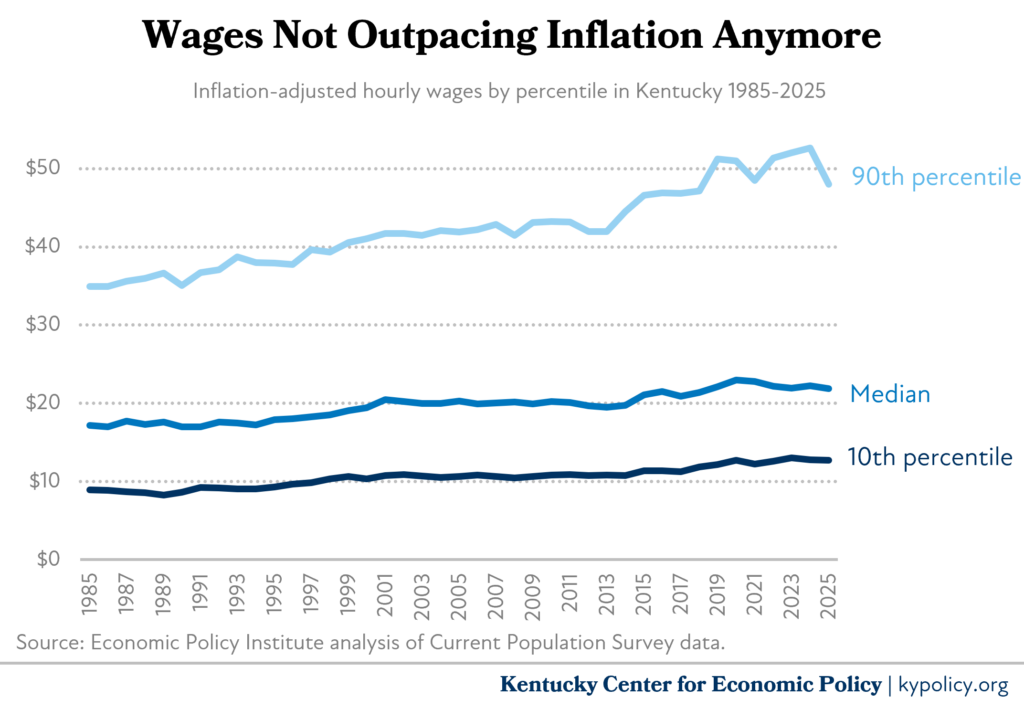
Wages have been relatively flat across the middle and bottom in recent years, and have fallen behind inflation since 2020. On an inflation-adjusted basis, the median hourly wage peaked in 2020 at $22.99 per hour, but has since slipped to $21.89 in 2025. The bottom 10th percentile of workers by wages have seen their inflation-adjusted wages slip from their 2023 inflation-adjusted peak of $13.02 down to $12.74 in 2025. Highly paid workers, however, have seen significant wage growth in recent years.
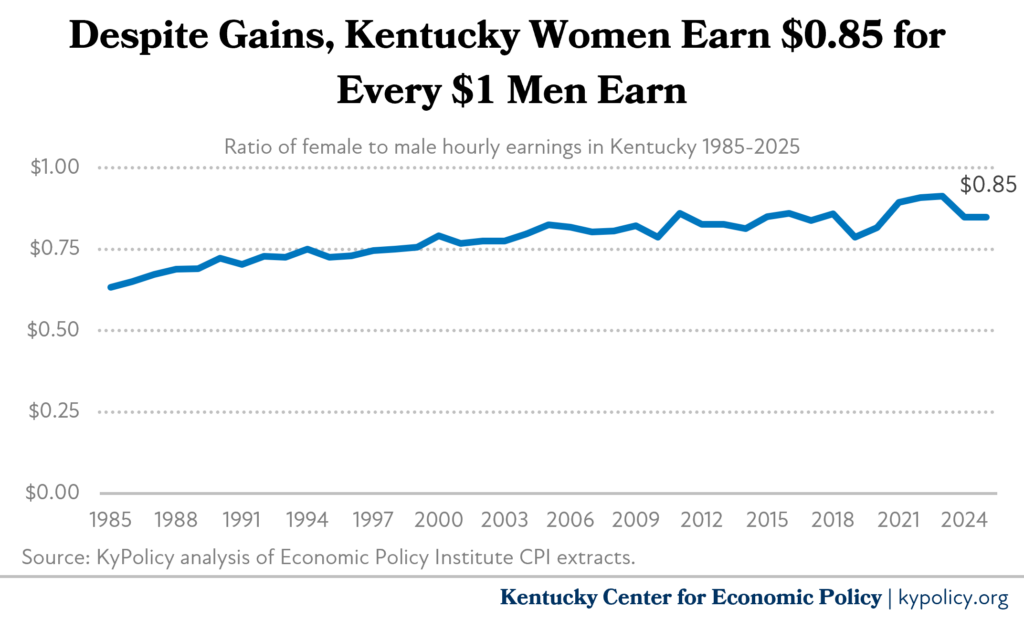
There are also still many disparities in wages among different types of workers within the state. For example, the median wage among Hispanic Kentucky workers is $18 per hour, for Black Kentuckians it is $20 per hour, and for White Kentuckians it is $23 per hour. While the gender-based disparity in pay has significantly shrunk over the past several decades (in part because male workers are making less), female workers are still earning $0.85 on the dollar compared to their male counterparts.
These disparities have many causes – for example, women overwhelmingly make up the workforce in the child care, domestic worker and home health industries, each of which have historically low wages. A longstanding history of racialized criminal justice policies has led to many Black Kentucky workers with criminal convictions that make good paying jobs harder to reach.
To some degree, the slump in wage growth is related to the frozen labor market. During the 2022 “Great Resignation,” employers aggressively recruited new employees and many Kentuckians quit their jobs to take other, higher-paying or better-fitting jobs. Employers raised wages to retain the employees they had and attract others seeking better opportunities (as well as to keep up with very high inflation). With hiring down, workers are more hesitant to look for new work, and the wage increase from switching jobs has dropped significantly from 20% in 2022 to 7% by July 2025.
A failure to increase the minimum wage has contributed to a lack of job growth at the bottom of the labor market. Kentucky’s minimum wage has not increased in 17 years, which is the longest our state has gone without a minimum wage increase since its creation in 1938. Because of this inaction, there are now 470,300 Kentucky workers who earn below $17 an hour, the proposed wage floor in the most recent Raise the Wage Act in Congress. If the minimum wage were to be raised to $17 per hour, 27% of wage earners in Kentucky would see a direct raise, and many more would see their earnings increase as employers adjust other higher-earning employees’ paychecks to avoid wage compression. Doing so would also help address the gender wage disparity as 62% of those earning below a $17 hourly wage are women.
It is still expensive to get by in Kentucky
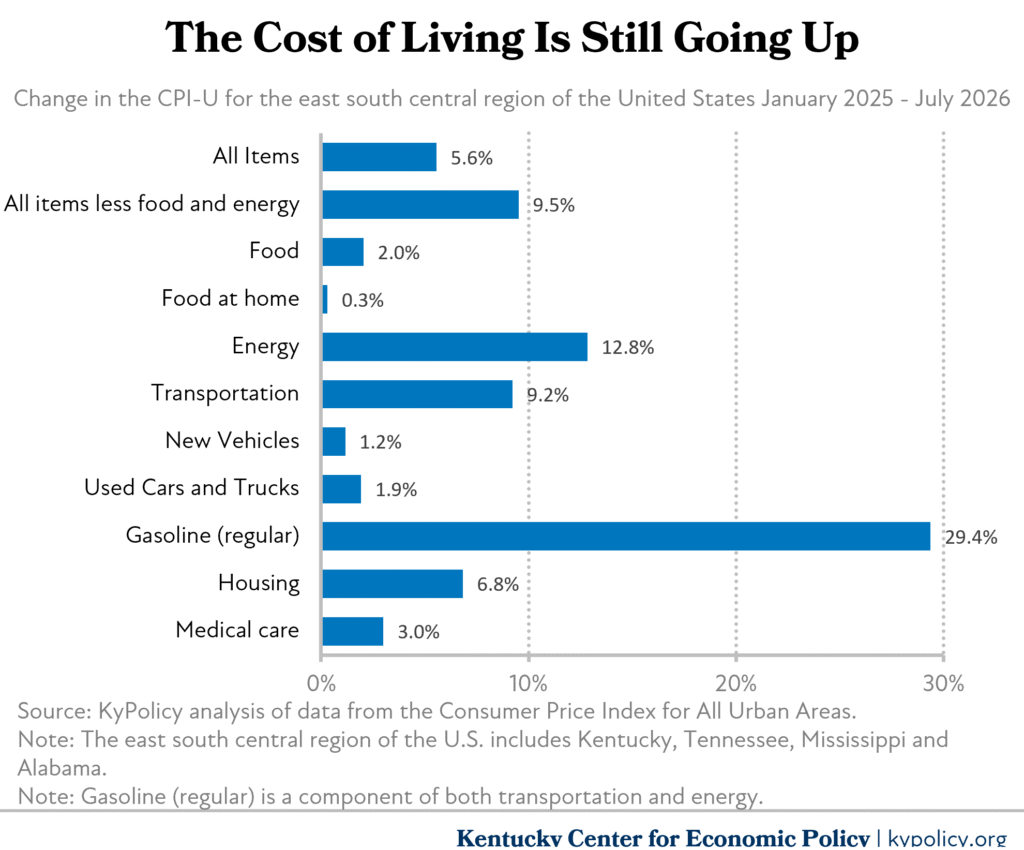
The cost of living continues to rise at a rapid pace, particularly as the U.S. intervention in Iran has led to rising gas prices, which translates to higher prices for many goods that rely on petroleum . With the deportation of some immigrants, and the threat thereof, the risk of inflation is even higher as a key component of the construction, agriculture, health care and other industries’ labor force shrinks.
From January 2025 to July 2026, the cost of living in the east south central region of the U.S. (which includes Kentucky and three nearby states) rose 5.6%. While inflation has cooled from its peak in 2022, some categories such as housing (6.8%) and transportation (9.2%) remain high. Regular gasoline has risen 29.4% over the past two years, largely because of Iran’s closure of the Strait of Hormuz due to the U.S. bombing campaign there.
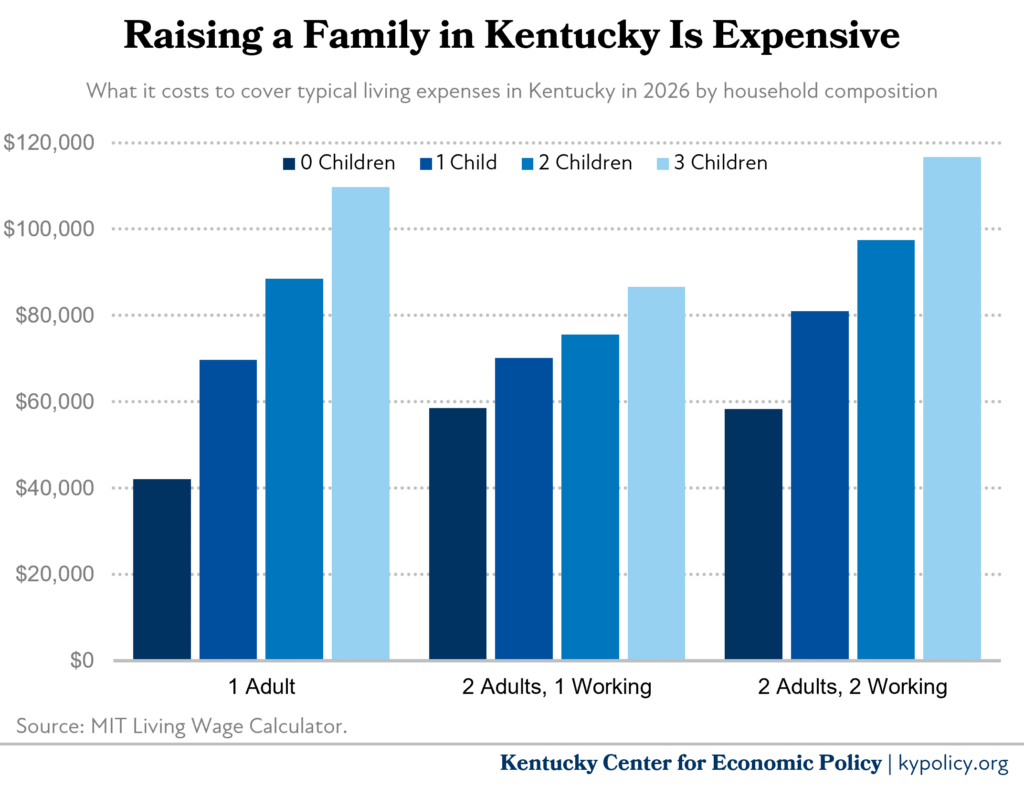
For Kentuckians trying to raise a family, everyday costs are even more difficult to meet, particularly families in which two parents are working, and must therefore pay for child care. According to the MIT living wage calculator, a Kentucky household with two children in which both parents work must pay $97,400 in typical expenses each year to make ends meet. If one parent can stay home with the same number of children, that number falls to $75,500.
Challenges on the horizon for Kentucky workers
The labor market is somewhat stable, if largely frozen, now. However, several significant changes in the economy and society will impact working Kentuckians moving forward. One is the increased deployment of AI across every sector of the economy. While many employers are not yet reducing their workforce due to the use of AI, some have reported that AI has increased worker productivity, and their expectations for its impact on their operations are high. AI does not seem to have had a significant impact on existing jobs yet, even among young college grads who have a higher exposure to AI-automating occupations. That could change moving forward, however. One poll of employers in the Midwest found many are only just starting to implement the use of AI in their operations, and half said that so far it has had “no noticeable effect on staffing” or has resulted in a “slight reduction in staffing needs.” Data centers may provide a short-term opportunity for some construction jobs, but the pushback from communities due to impacts on quality of life, the environment and utility rates raise serious questions about how many data centers will be built.
Another massive shift in the state is the aging of the large baby boomer generation. With so many workers leaving the labor force, entering into retirement and seeking an increasing amount of medical care, major changes in Kentucky’s economy are inevitable. The share of Kentuckians over 80 years old will nearly double by 2040, and the workforce needs to care for an aging population will grow too, creating significant opportunities in the health care and social assistance sectors. At the same time, the overall labor force participation rate will continue to drop, a problem only worsened by the reduction in Kentucky’s immigrant workers.
Finally, major federal cuts to Medicaid starting in 2027 threaten the main bright spot in Kentucky’s labor market, health care and social assistance. Aside from providing needed care to low-wage-earning workers that allows them to work, Medicaid is an economic engine, injecting tens of billions into local communities across the state every year. That funding, particularly the reduction in participation and provider payments, will lead to fewer federal monies flowing into the state and lead health care providers to pull back on employment, and possibly close their doors. The parts of the state most vulnerable to Medicaid cuts are rural, eastern Kentucky counties where jobs are already difficult to find.
Each of these and other challenges will require intentional policy interventions in order to protect Kentucky workers and their families. Policies that support building worker power, increasing wages and opening new employment opportunities will be critical.
The post This Labor Day, Kentucky Workers Face Stalled Job Market, Flat Wages and Higher Prices appeared first on Kentucky Center for Economic Policy.