Committee weighs action on illegal machine gun conversion devices
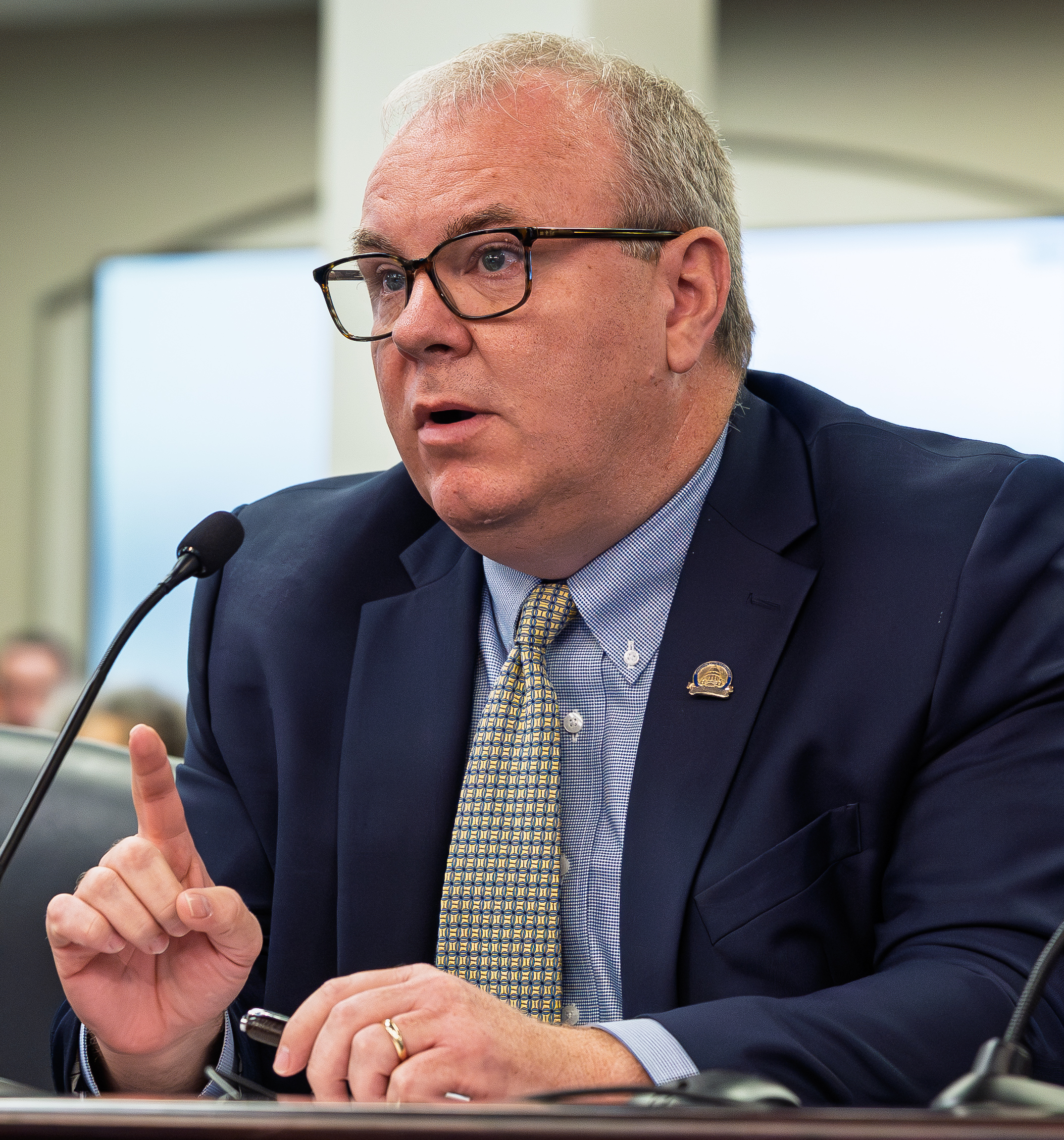
House Majority Whip Jason Nemes, R-Middletown, asks the Interim Joint Committee on Judiciary to consider passing a state law that mirrors an existing federal ban on machine gun conversion devices. A high-resolution photo can be found here.
FRANKFORT — A Kentucky lawmaker and other stakeholders are asking the Kentucky General Assembly to consider making a state law that would mirror an existing federal ban on machine gun conversion devices.
House Majority Whip Jason Nemes, R-Middletown, said during the Interim Joint Committee on Judiciary’s meeting Thursday that he’s planning to file legislation next year. The devices are often known as “auto sears.”
“It does not make anything unlawful that isn’t currently unlawful,” Nemes said. “I cannot possess an auto sear today. It violates federal law. That does not change.”
Machine gun conversion devices are made of metal or plastic and can easily be attached to the back of a pistol to turn a semiautomatic device into a fully automatic weapon, Louisville Metro Police Department Chief Paul Humphrey said. The devices are easily made by 3D printers.
Humphrey said LMPD has seen the device used in crime more frequently in the last few years, with 80 seized in Jefferson County last year.
“We’re not talking about something that helps with accuracy or that helps with self-defense,” he said. “We’re talking about something that actually makes the weapon far less accurate and far more dangerous to everyone around.”
While LMPD does report the use of the devices to the federal Bureau of Alcohol, Tobacco Firearms and Explosives, Humphrey said the agency doesn’t have the manpower to prosecute every reported case.
Since there is no law prohibiting the devices at the state level, Humphrey said local law enforcement and prosecutors cannot fill the gap on their own.
“We understand the impact of the violent crimes that are going on on our streets and in our neighborhoods, and this is exacerbated greatly by this problem,” Humphrey said. “And what (the legislation would do) is it turns the ability for us – the local police officer, the local prosecutors – to be able to take some kind of action on these that we currently cannot take.”
Reviewing a draft of the potential legislation, committee co-chair Rep. Daniel Elliott, R-Danville, asked Nemes if the class C felony charge is in-line with federal law as well.
Nemes said he thinks the proposed penalty is the same as the federal law, noting that class C felonies carry a penalty of five to 10 years.
After asking a few questions about the bill’s language and the intent, Rep. T.J. Roberts, R-Burlington, said he has constitutional concerns due to pending litigation in federal court.
Nemes said if a federal court order finds the law to be unconstitutional, it would no longer be enforceable.
“I think they’re lawful,” Nemes added. “…. I think the courts will hold that’s a constitutional restriction, and I think we should fall in line.”
Roberts said he would prefer the legislature focus on expanding the right to self-defense rather than impose more restrictions.
Rep. John Blanton, R-Salyersville, said he is supportive of the Second Amendment and the proposed legislation. He said the conversion devices also pose a risk to law enforcement.
“You guys in law enforcement have to have some type of protection there,” Blanton said. “These are the types of things that people are using more for an offensive stance than defensive stance.”
The Kentucky General Assembly cannot act on legislation until the 2026 legislative session begins on Jan. 6.
A draft of Bill Request 8 can be found here.
The next Interim Joint Committee on Judiciary meeting is scheduled to meet at 11 a.m. on Oct. 16.