By Melissa Patrick
Kentucky Health News
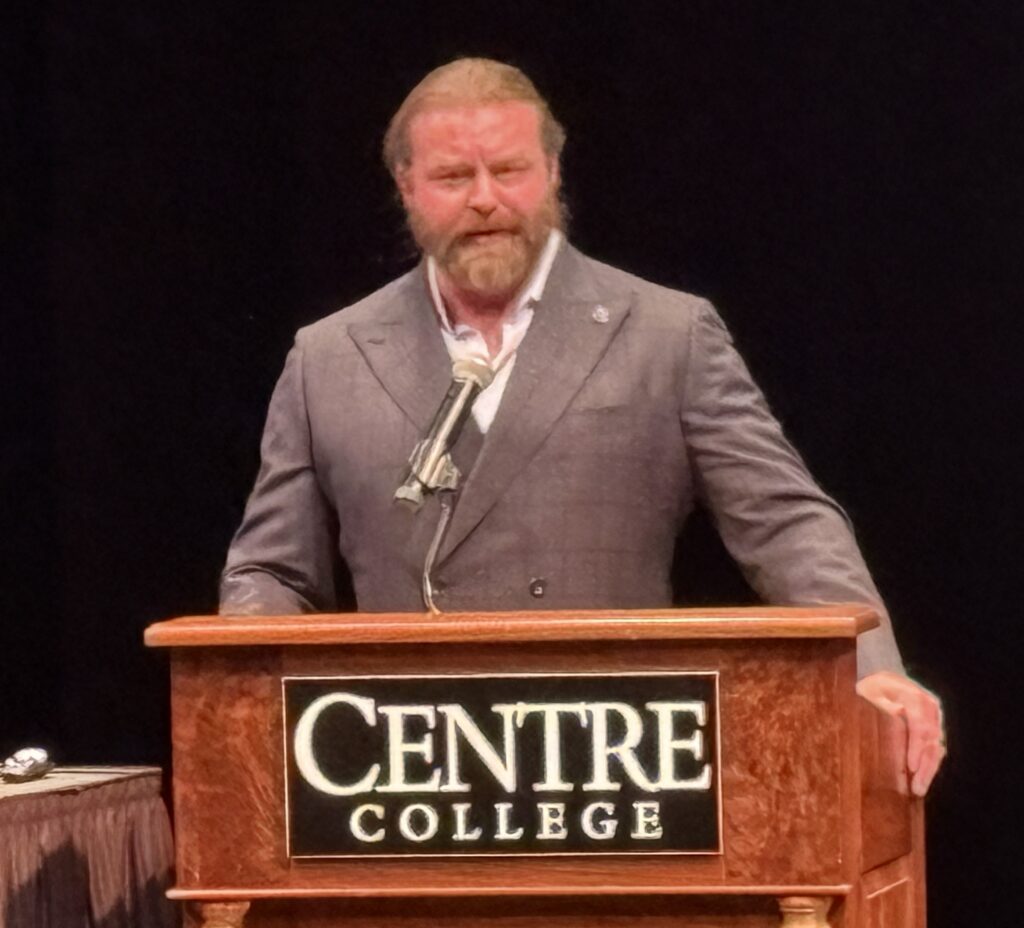
Bryan Hubbard, CEO of Americans for Ibogaine, talked to an audience of about 200 people at Centre College recently about a psychedelic drug called ibogaine as a potential treatment for drug addiction and trauma, with a large part of the conversation centering on Kentucky’s reluctance to support it.
“Promising scientific results, together with ibogaine’s non-addictive nature, suggest that it may be a transformative treatment for opioid dependency,” he said.
Ibogaine is a naturally occurring compound found in the root bark of iboga, a West African shrub. It is illegal in the U.S., but is used in some countries, including Mexico, to treat substance-use disorder.
So far, no placebo-controlled, double-blind trials have been conducted on the use of ibogaine to treat substance-use disorder, which is needed for it to be approved by the U.S. Food and Drug Administration.
 Hubbard said ibogaine can heal neurochemical brain injury and alleviate withdrawal symptoms within 36 to 48 hours.
Further, he said ibogaine treatment would offer great savings to the state of Kentucky, noting that ibogaine costs $61,000 per recovery attempt, compared to $139,000 per attempt for traditional treatment, calculated by using Medicaid payment data.
Hubbard recognized that ibogaine carries potential cardiac toxicity, but said this can be safely eliminated with proper screening and medical supervision.
The event, titled “Ibogaine: A Conversation with W. Bryan Hubbard,” was part of a convocation series, co-hosted by Centre College and the Boyle County Republican Party. It was held Tuesday, Sept. 30, on Centre’s campus.
Lost opportunity
Hubbard was the first chair of the Kentucky Opioid Abatement Advisory Commission, appointed by then-Attorney General Daniel Cameron. While in that role, he proposed that the commission commit $42 million of the opioid settlement money, or 5% of it, to be used for clinical trials on ibogaine as a treatment for addiction, to be spent through a public-private partnership anchored in Kentucky. Hubbard’s proposal was ultimately shut down by Attorney General Russell Coleman when he took over the commission.
Hubbard spent a good bit of his time talking about what he described as three high-profile opponents that he holds responsible for shutting down his ibogaine proposal — the University of Kentucky, Gov. Andy Beshear and Coleman — saying they are opposed because of financial ties to the opioid maintenance industry.
Offered the chance to respond, Coleman’s spokesperson pointed to prior comments that he made before the Opioid Commission on March 12.
After first noting that the commission would be “responsible stewards” of the settlement fund, Coleman said: “In that spirit, I respectfully ask this Commission to step back from previous proposals to allocate $42 million to ibogaine research and the unproven and incredibly expensive clinical trial for a psychedelic that is currently illegal as a Schedule 1 drug. These vital resources – that some call “blood money” – are too precious to gamble away.
“That’s not to say that this Commission shouldn’t be on the cutting edge of innovation. I believe we can push the boundaries of addiction response, and we should. I will ask Director (Christopher) Evans to bring before this Commission a proposal to establish a $5 million pool for research and innovation grants. With a new fund tailored to big ideas, Kentucky can keep pushing the outer limit in this space.
“And, if someone brings forward an ibogaine research proposal that fits the criteria of this new innovative grant program, I hope the Commission would give it full and fair consideration.”
Scottie Ellis, communications director for the governor’s office, said in an e-mail: “As attorney general, Gov. Andy Beshear filed more lawsuits against opioid companies than any other AG in the country, recognizing that millions of dollars would be needed to fight our drug epidemic and save lives. Knowing how important these dollars are, the governor opposed Mr. Hubbard’s attempt to use these dollars to fund research for a private company he self-selected for a drug that is not authorized by the FDA.”
A University of Kentucky spokesperson, Kristi Willett, on behalf of Sharon Walsh, Ph.D. , and Dr. Michelle Lofwall, who were specifically named by Hubbard during his talk, stated that the consultation work of these two researchers in the area of pharmaceutical development for substance use disorder treatment is “standard practice.”
“This type of collaboration is standard practice in pharmaceutical development and essential to translating research into real-world medical advancement, ensuring that academic expertise informs the development of safe, effective treatments,” Willett said in a statement.
Willett also wrote: “Drs. Walsh and Lofwall are supportive of the pursuit of all potential new therapies for opioid use disorder and other substance use disorders.”
She also said, “Indeed, if a study protocol approved by the FDA, along with funding, were available, the University of Kentucky could participate in a study on ibogaine, as there is a long history of drug development research at the university.”
What’s next?
Hubbard, who is the architect of the Texas Ibogaine Initiative that earmarked $50 million toward funding for FDA-approved clinical trials of ibogaine for the treatment of substance-use disorder, said he anticipates a multi-state coalition will emerge.
“What Texas has done is monumental, and what’s going to play out over the next 18 to 24 months is the emergence of a multi-state coalition that’s going to do something that’s never been done in history,” he said.
A spokesperson for Americans for Ibogaine told Kentucky Health News that 25 states, including Kentucky, have signed up to learn more about ibogaine at the upcoming American Ibogaine Meeting, to be held in Austin, Nov. 6-9.
Rep. Sam Creekmore, a Republican from Mississippi, told Kentucky Health News that he plans to introduce a bill similar to the Texas bill, but will only ask for $5 million. He said the money would come from the state’s opioid settlement funds.
Creekmore said Mississippi held a recent hearing about ibogaine that included testimony from Mississippi veterans and nurses who “have been made whole again” after taking ibogaine.
Asked why it’s important for Mississippi to be a part of this, he said, “I think that the legislature is not doing its job if they do not consider doing the trials. . . . I think it’s definitely worth the money and the effort if there’s a drug that’s making people whole 80% of the time after one procedure.”
Sen. Donald Douglas, R-Nicholasville, also plans to introduce an ibogaine bill to allow for research in the upcoming legislative session.
Asked about Douglas’ bill after the meeting, Hubbard said, “There is a cadre of legislators in the Senate and in the House who are interested in trying to make this a reality, but the reality that they have to face is that the fundamental factors that killed this the first time are unchanged.”
He later added that he hopes Coleman changes his stance on this topic if he sees the potential for success. He added that Kentucky doesn’t have to come up with $42 million to participate in this initiative.
“I’d offer him the grace of being a partner if that’s where he lands,” he told Kentucky Health News.
Hubbard concluded his remarks at the meeting with a call for Kentucky to join the movement to avoid being left behind and asked the attendees to reach out to Senate President Robert Stivers and House Speaker David Osborne for their support, saying, “If they want it, it’ll get done.”
Asked what he would say to them if he had the opportunity, he said: “The first thing I’d say is, gentlemen, please remove the lens of the generational perspective that looks at all things psychedelic as the deleterious, subversive substances of a debauched left-wing counterculture. Ibogaine shouldn’t be caught in that dragnet. This is a very serious medication, and it can deliver some very serious improvements.
“The next thing that I would likely articulate is a question: Are you satisfied with where we’re at? Are you satisfied with the return on investment that you have seen incinerated for 30 years now, through Medicaid, through the prison system, through the foster care system, through everything that keeps us in a downward spiral, doom loop of generational repetition? Have you had enough, or do you just want to keep doubling down on everything we’ve already seen?”
All that said, Hubbard said the ibogaine movement will proceed regardless of Kentucky’s participation.
“This is going to be a reality whether this state participates or not,” he said.