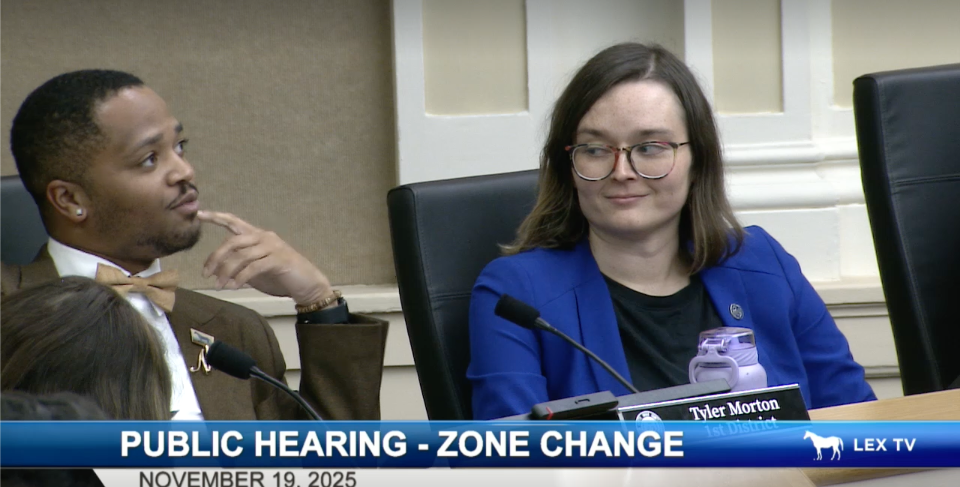
If you listened only to the speeches, you’d think Lexington was about to boldly tackle its housing crisis.
Six hours of testimony. Dozens of speakers. Councilmembers invoking “affordable housing,” “historic character,” and “the fabric of our community” like they were auditioning for a planning textbook. And then, with an 8–7 vote, they quietly killed an eight-story, 322-unit student apartment project at Maxwell and Rose — roughly 1,000 beds between downtown and UK’s campus.
The zone change died. The housing shortage did not.
Here’s the twist: the block is already zoned R-4. The developer has demolition permits in hand. They can still level the block and build a four-story, 75-foot building by right, with zero additional public input.
So the real choice was never “preserve the neighborhood or build high-density housing.” It was:
Do you want a taller building with more beds and negotiated conditions, or a shorter one with fewer beds and no leverage at all? Council picked Door #2, then congratulated itself for standing up for affordability.
That’s the tell.
Lexington is somewhere around 22,000 housing units short, depending on which study you cite. Rents are climbing. Students are spilling out into older housing stock. Families are being outbid. Every nonprofit that deals with housing will tell you the same thing: we don’t have enough units, at any price point, in the places people actually need to live.
This project — proposed by Core Spaces, the out-of-state company behind the existing Hub buildings — wasn’t some social housing miracle. It was market-rate student housing. It would have raised plenty of fair questions about design, quality, and how long the building lasts before the spreadsheet wins and the siding loses.
But it also would have put about a thousand beds within walking distance of campus, the hospitals, downtown, and transit. That’s not nothing.
When students move into new, higher-priced units, they vacate older, cheaper ones. That’s how filtering works: yesterday’s “luxury” becomes tomorrow’s “normal” stock. Blocking those new units doesn’t make the old apartments cheaper. It just forces more renters to fight over the same shrinking pool of older places — driving prices up and pushing people further out Nicholasville Road and Man o’ War.
But you wouldn’t know that from the floor speeches.
Over and over, opponents on Council framed the vote as a stand for “affordable housing,” insisting that because this project wasn’t deeply affordable, it was fair game to kill. District 4 Councilmember Emma Curtis said it plainly: when she asked if the project would create more affordable housing, “the answer was a simple one word no,” and that Lexington is “not short any number of luxury student housing.”
That line sounds righteous until you zoom out.
If we’re short more than twenty thousand units overall, and student demand is chewing up the existing supply, then every bed you add near campus is a bed that isn’t competing for a duplex in Cardinal Valley or a four-plex off Tates Creek. Even Housing Advocacy Commissioner Charlie Lanter, not exactly a developer lobbyist, said it bluntly: “We’re really not in a place to be picky. We just need housing.”
Instead, Council got picky.
Some members leaned hard into historic preservation — even though the block, while eligible, isn’t locally landmarked, and even though planning staff and the Planning Commission both said the zone change fit the city’s own growth plan. Others fretted about traffic on Maxwell, as if forcing 900 students to live farther out somehow reduces car trips.
And a surprising number of the “no” votes came from councilmembers who brand themselves as pro-housing, pro-equity, or the voice of a new generation.
If you’re keeping score at home, that means several of the people who talk the most about Lexington’s housing crisis just voted against one of the few large infill projects that actually made it through our process.
This is the pattern that wears people down.
Council will absolutely declare a “housing crisis” when it’s time to approve a comprehensive plan, or when they’re defending tight farmland boundaries in the Rural Service Area. They’ll say all the right things about density, infill, and walkable neighborhoods.
But when a real, imperfect, noisy project shows up on an actual block, the rhetoric suddenly develops an allergy to height, shadows, and out-of-state capital.
You hear it in the public comments too. Everyone is for more housing “in theory.” Just not this one. Not here. Not like that. Not run by them.
Meanwhile, rents in the Maxwell area now exist in a fun little Schrödinger’s box: too high to be defended as “affordable,” but apparently not high enough to justify building more supply.
None of this means neighbors’ fears are fake. Students are loud. Big buildings can loom. Historic streets can get steamrolled if the city doesn’t set guardrails.
But this Council didn’t choose guardrails. It chose vibes.
It had a chance to say: “Yes, we’ll allow height here — but only with strong design standards, tenant protections, and maybe some income-targeted units baked in.” It could have used the zoning change as leverage to lock in better outcomes than a by-right R-4 box.
Instead, it sent the project back to the only place where Lexington always seems comfortable negotiating housing: behind closed doors, between a developer and a zoning code that hasn’t caught up to its own talking points.
In a city that insists we must “build up, not out,” you’d expect a downtown, pedestrian-oriented, student-heavy project to be the easy call. This was about as textbook an infill site as Lexington is going to get.
Council said no anyway — and then, with a straight face, kept talking about affordability.
That’s the real historic character we’re preserving. Not the houses on Maxwell, but the old Lexington tradition of loving the idea of housing, right up until the moment it might actually get built.
Republishing: This is original Lexington Times reporting, licensed under Creative Commons CC BY-ND 4.0. You may republish this article, in full and unaltered, for free — including commercially — with credit to The Lexington Times and a link to the original.