Lexington History, continued — part six of tonight’s overnight series from the original newspapers. The 1911 pages shown are in the public domain. A content note: this story involves prostitution, violence and the death of a child’s innocence long before any of the glamour the legend later attached to it.
The legend and the ledger
Every city keeps one legend it tells with a wink, and Lexington’s is Belle Brezing: the orphaned girl who became the most famous madam in America, ran “the most orderly of disorderly houses” on Megowan Street for a quarter century, entertained the horse world’s millionaires in a mansion with a mirrored parlor — and supposedly lives forever as Belle Watling, the kind-hearted madam of Gone with the Wind. The wink does a lot of work in that telling. The documentary record — and Lexington has an unusually good one, because the University of Kentucky’s special collections hold her scrapbook, her photographs and her papers — tells a story that is darker at the start, harder in the middle, and stranger at the end.
Mary Belle Cox was born in Lexington in June 1860, the daughter of a dressmaker who worked part-time in prostitution and a stepfather, George Brezing, who ran saloons and drank his own stock. The documented childhood is brutal in the plainest ways: assaulted at twelve by a middle-aged merchant who then courted her with gifts; pregnant at fifteen; married off at three months along to a cigar maker who promptly vanished from her life; a daughter, Daisy May, born in 1876, the same spring Belle’s mother died and the teenager was effectively homeless. The boy widely assumed to be the baby’s father was found dead of a gunshot days after the wedding — ruled a suicide, gossiped forever after as something else. She entered the trade on Christmas Eve 1879, at a house run by the madam Jenny Hill on West Main — a building with its own astonishing résumé, having earlier been the girlhood home of Mary Todd Lincoln.
Megowan Street
By July 1881 — the same summer Capt. Neale Hendricks was shot in the saloon a few blocks west, in the story that opened tonight’s series — the 21-year-old was renting a house on North Upper Street and running it herself. She was arrested for keeping a bawdy house in 1882 and, in the kind of detail that tells you everything about Gilded Age Kentucky, pardoned by the governor. By the 1890s, bankrolled in part by a smitten Philadelphia newspaper millionaire named William M. Singerly, she bought and rebuilt the big house at 153 Megowan Street — at the top of the hill east of the courthouse, in the heart of the district the papers called the tenderloin. After an 1895 fire she rebuilt it grander, adding a floor. The house ran on champagne-economy rules: evening dress, high prices, discretion, and a clientele that followed the racing calendar to Lexington and treated the address as part of the itinerary.
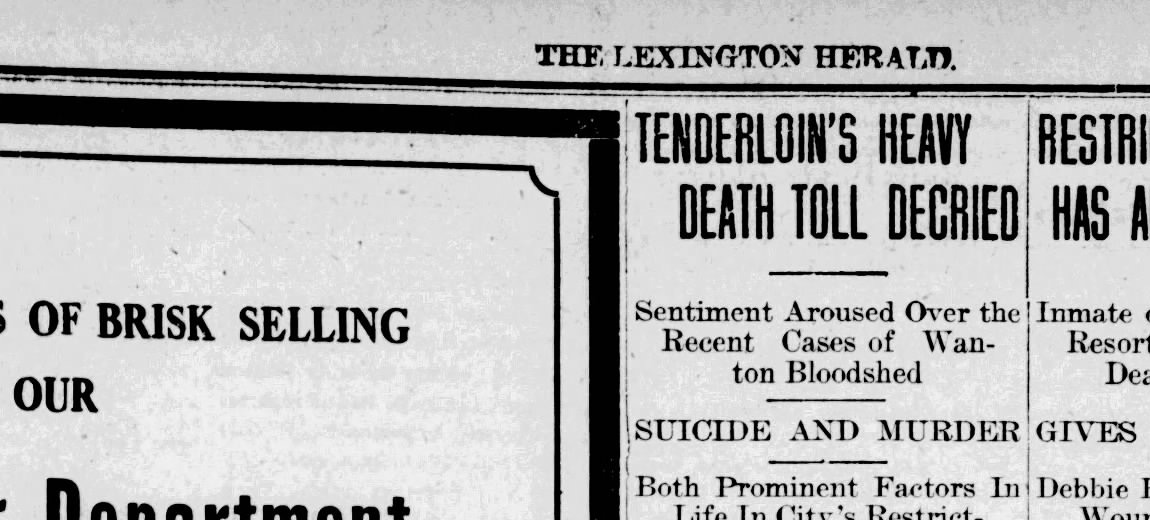
It is worth being precise about what surrounded that one famous house, because the legend tends to crop the frame. Lexington’s restricted district was not a charming institution; it was a poverty economy with a body count, tolerated by the city on the theory that vice confined was vice controlled. The Lexington Herald of July 11, 1911 — the public-domain page shown above — spent a full column under the headline “TENDERLOIN’S HEAVY DEATH TOLL DECRIED” simply cataloguing the district’s recent dead: a woman shot at a “resort” by a Louisville contractor’s son the previous September; a woman found dead in a room on Wilson Street in January; a café manager who shot a woman and killed himself in April; a young farmer who shot a woman through the head in June while, the paper noted, awaiting trial for shooting at his own wife. That was one year on one street. The same summer, a woman named Debbie Harvey was murdered in the district, and when no one claimed her, it was Belle Brezing who paid for a decent burial — a documented act of grace that says more about her, and about the world she worked in, than the mirrored parlor ever did.
The closing
What finally closed Megowan Street wasn’t the pulpit or the petition — citizens had petitioned against her houses as early as 1889 — but the War Department. In 1917, with the country mobilizing and an Army training camp’s worth of soldiers in reach of Lexington, federal orders shuttered red-light districts near training facilities nationwide, and in November of that year the lights went out on the hill. It had already been a bad year for Belle: Billy Mabon, the bookkeeper who had been her companion for three decades, died that February. She was 57. She never reopened, never sold, and never really left. For 23 years she lived on in the great house as it faded around her, increasingly reclusive, managing a long morphine dependence that had begun as medicine, while the city below traded stories about her. The girl who collected newspaper clippings in a scrapbook had become one.
She died of cancer in the house on August 11, 1940 — six months after Gone with the Wind swept the Oscars. The national press marked her passing; even Time magazine took notice of the famed Kentucky madam, and Lexington’s own papers eulogized her on the front page. The auction of her estate drew enormous crowds picking through the furniture of the legend. The Margaret Mitchell question — whether Belle Watling was Belle Brezing — has been argued ever since: Mitchell’s husband had lived in Lexington during the house’s heyday, the parallels were obvious enough that Lexington believed it instantly, and Mitchell herself denied it. The denial and the belief have proven equally durable, which is about right for Belle: the record and the legend, sharing the same address.
The house at what’s now 459 Megowan — the street was renamed and renumbered, today’s Eastern Avenue — lost its upper floors to fire in 1973, and souvenir hunters bought the bricks. Her grave in Calvary Cemetery reads “Blessed Be the Pure in Heart.” Her scrapbook is at UK, where researchers have spent the last decade doing what tonight’s series has tried to do all night: putting the newspapers back next to the legend, and letting them argue.
Sources: The Lexington Herald, July 10–11, 1911 (public domain); Wikipedia, “Belle Brezing,” and the scholarship it cites, including Maryjean Wall, Madam Belle (2014), and the Belle Brezing Photographic Collection and papers at the University of Kentucky Special Collections Research Center; UKNow features on the UK collections; KET, “Belle Brezing” documentary materials.