Lexington History, continued — part three of tonight’s overnight series from the original newspapers. The 1886 pages shown are in the public domain.
“The city without a theater”
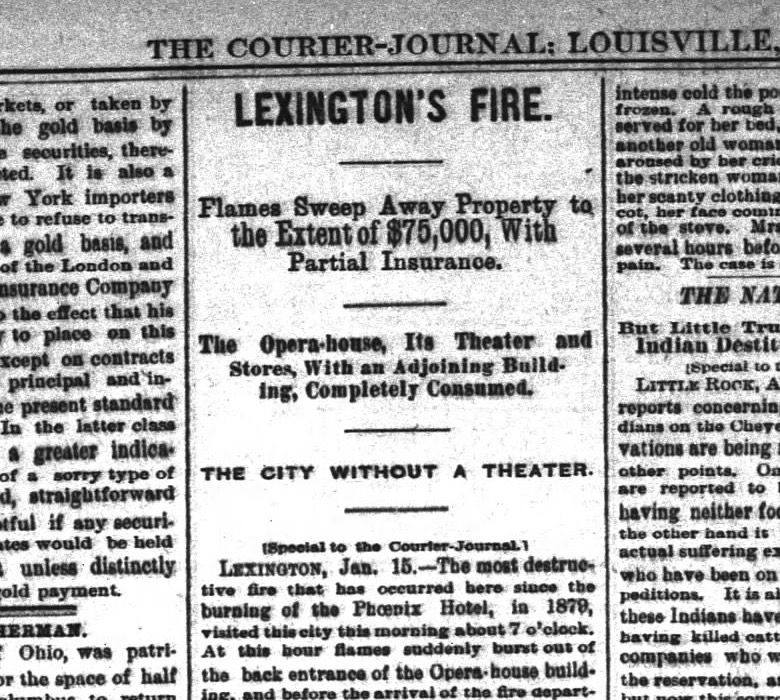
At about seven o’clock on the freezing morning of Friday, January 15, 1886, flames burst from the back entrance of the Opera House building at Main and Broadway. The fire department arrived within minutes and could do almost nothing: the water was frozen in the mains, and by the Courier-Journal’s account the firemen spent the first half hour essentially watching the building go. By the time water flowed, the structure was past saving, and the companies turned to protecting the neighbors — which they did, twice heading off what the paper reckoned would otherwise have been the worst conflagration in the city’s history.
The next morning’s Courier-Journal told the state what Lexington had lost under a stack of headlines that read like a eulogy: “LEXINGTON’S FIRE. Flames Sweep Away Property to the Extent of $75,000, With Partial Insurance. The Opera-house, Its Theater and Stores, With an Adjoining Building, Completely Consumed.” And then, in small capitals, the line that stung: “THE CITY WITHOUT A THEATER.”
The fire had apparently started below the stage, not on it — in the rear of R. H. Innes & Sons’ wholesale grocery, which occupied the ground floor beneath the theater along with an Adams Express Company office. A nineteenth-century opera house was rarely just an opera house; it was a commercial block with a theater upstairs, which meant the auditorium sat on top of someone else’s stockroom. Stage scenery, drop curtains and seat upholstery made “ready food for the flames,” as the correspondent put it, and the whole interior went. It was, the paper noted, the most destructive fire in Lexington since the Phoenix Hotel burned in 1879 — a sentence that tells you something about how regularly nineteenth-century Lexington burned, since the Phoenix fire was itself only seven years old, and the Phoenix had burned before that, and would be rebuilt again.
Five months to a cornerstone
What happened next is the part Lexington can still walk into. Within five months, construction had begun on a replacement — not on the old corner, but a block north on Broadway at Short Street. The investors hired Oscar Cobb of Chicago, one of the most prolific theater architects in America, and what he delivered was a jewel box: about 1,250 seats, two horseshoe balconies, paired boxes flanking the stage, hundreds of gaslights, dozens of sets of stock scenery, and orchestra seats upholstered in velvet and Turkish morocco, with little conveniences built into the boxes — hat racks, holders for canes and umbrellas — for an audience that dressed for the theater.
The new Lexington Opera House opened on July 19, 1887, eighteen months after the fire, with a concert by the Cincinnati Symphony; its first staged production followed that August. Over the next four decades practically everyone who toured America crossed its stage — Sarah Bernhardt and Lillian Russell, Will Rogers and W. C. Fields, Al Jolson, Harry Houdini. For Lexingtonians of that era it was simply where you went: the young Forest Brewer, whose 2000 housing story we told earlier tonight, remembered from his hospital bed going downtown to “the old Lexington Opera House” to watch Gene Autry pictures — because by then the Opera House had made its long slide from playhouse to movie house. The last live performance of the old era came in 1926, and the building spent the middle of the twentieth century as a cinema, increasingly shabby, increasingly forgotten.
The second rescue
It nearly ended in the 1970s the way the first opera house ended in 1886 — as a vacant shell coming down, this time by neglect and wrecking ball rather than flame. A 1973 windstorm collapsed part of the roof, and demolition was the obvious next step for a derelict movie house in an era when Lexington was flattening whole blocks of its downtown. Instead, in one of the city’s first great preservation victories, the building was bought, restored and reopened in 1976, in time for the nation’s bicentennial — the gaslight-era auditorium rebuilt for Broadway tours. The Opera House at 145 North Broadway now hosts on the order of 85,000 patrons a year, and it is, by a wide margin, the oldest room in Lexington where you can still do exactly what the room was built for.
Which makes the morning of January 15, 1886 a strangely happy disaster in hindsight. The fire that left “the city without a theater” produced, within a year and a half, the theater the city still has — and the frozen hydrants of that morning are a reminder of why so little of pre-1886 downtown Lexington survives at all. Wood-and-gaslight cities burned; the ones we inherited are the rebuilds.
Sources: The Courier-Journal, Jan. 16, 1886, “Lexington’s Fire” (public domain); Wikipedia, “Lexington Opera House”; Central Bank Center, Lexington Opera House history; The Lexington Times, “Misery for Rent” retrospective (2026) for the Forest Brewer recollection, drawn from the Lexington Herald-Leader of Aug. 31, 2000.