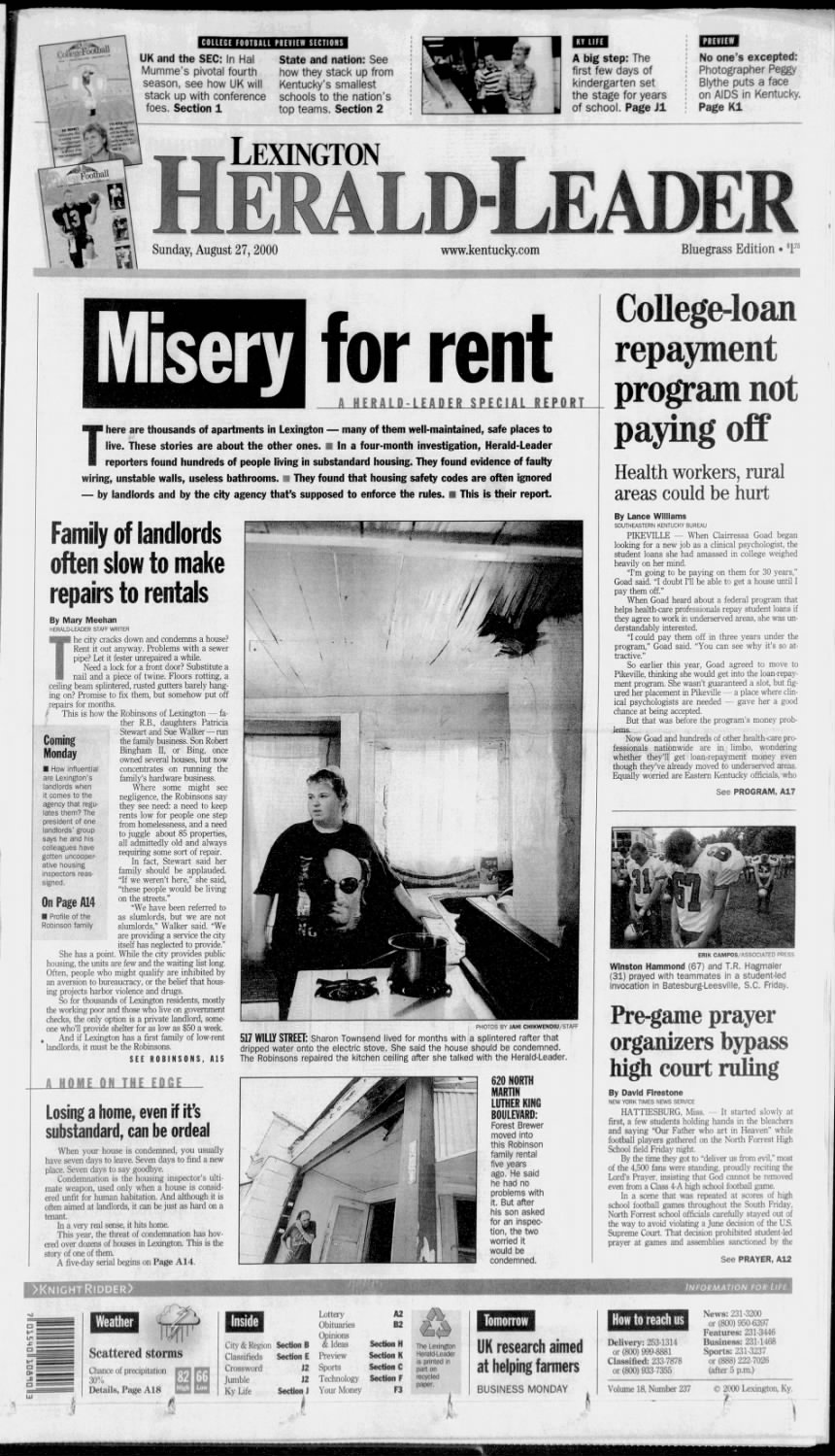
Lexington History is an occasional Lexington Times series revisiting the stories that shaped this city. This installment draws on the Lexington Herald-Leader’s 2000 investigative series “Misery for Rent,” reviewed in full through the Lexington Public Library’s NewsBank archive and the bound-page record. The original reporting belongs to the Herald-Leader and the four journalists who produced it; what follows is The Lexington Times’ summary and assessment of what they found, what happened next, and what it still means. We encourage readers with library cards to read the original series — every Fayette County cardholder has free access to the full Herald-Leader archive through lexpublib.org.
The week Lexington found out who was inspecting its worst apartments
On Sunday, August 27, 2000, Herald-Leader subscribers opened their paper to a front page that promised something different: a four-month investigation into the city’s substandard rental housing, written by Tom Lasseter, Mary Meehan and Linda J. Johnson, with Geoff Mulvihill joining the follow-up coverage and staff photographer Jahi Chikwendiu shooting the houses and the people inside them. The series box was blunt about its scope — thousands of Lexington apartments were fine, and these stories were about the other ones: hundreds of people in housing with faulty wiring, unstable walls, and bathrooms that didn’t work, under safety codes ignored by landlords and by the city agency that existed to enforce them.
The series was called “Misery for Rent.” It ran across six papers — August 27, 28, 29 and 31, and September 1 and 3 — and by the time it finished, the director of the Lexington Division of Code Enforcement had been reassigned to parks work, his interim replacement had been removed in under 72 hours, a supervisor with a million-dollar rental portfolio had resigned, the mayor had hired two independent counsels, and the complaint-only inspection system that made the whole mess possible had been ordered replaced with neighborhood-by-neighborhood sweeps.
Twenty-five years later, it remains one of the most consequential pieces of local journalism in Lexington’s modern history — and one of the least remembered, because it ran in the dead week before a presidential-election Labor Day and its biggest effects unfolded quietly over the following years.
What the reporters found
The investigation worked on two tracks at once. The first track was the housing itself. Reporters physically inspected a dozen properties belonging to the family the paper described as Lexington’s first family of low-rent landlords — R.B. Robinson, then 78, and his daughters Patricia Stewart and Sue Walker, who together controlled roughly 85 properties worth about $3 million, more than half of them valued under $25,000 apiece. Every one of the dozen had problems. The tenants the paper introduced became the series’ moral core: a handyman on North Upper Street whose burst sewer line backed sewage into his tub for months while the “repair” sat as an open hole in the walkway; a 24-year-old mother on Willy Street heating her children’s room with an open oven door under a splintered rafter that dripped on the stove; a 65-year-old man on West Seventh Street whose doors were secured with chains and a padlock he had to reach through broken windows to open — a fire-trap arrangement a city inspection that January had simply not recorded.
The family’s defense, offered on the record, was that they were providing housing the city would not: their tenants lived on disability and Social Security checks of around $500 a month, and $200-to-$400 rents were all those checks could bear. In a 1997 deposition unearthed by the paper, R.B. Robinson himself — after joking that the lawyer shouldn’t tell the inspectors — agreed that most of the family’s units were substandard. The same profile documented the family’s side businesses cashing checks and making small loans against tenants’ government checks at their North Limestone hardware store, where one oxygen-dependent tenant described borrowing $160 against the next month’s check at a $20 charge.
The series’ narrative engine was a five-part serial, “A Home on the Edge,” that followed one condemnation from beginning to end: 620 North Martin Luther King Boulevard, a Robinson-family rental where Forest “Buddy” Brewer — 56 years old, illiterate, a tobacco-farm worker from age 12 until his health failed, beloved on his block — had lived for five years at $300 a month. His son Kenny, newly out of prison, called code enforcement over his father’s objections after discovering the rear unit’s toilet emptied onto the floor. The inspector recorded 67 violations and condemned the house. What followed was a tragedy of the commons in miniature: the landlord’s promised repair crews never came; Forest landed in Good Samaritan Hospital spitting blood from stress-aggravated ulcers; he paid another month’s rent on a condemned house he says he was told he could stay in; and when he finally moved — to a clean, sound apartment off Georgetown Street — he was miserable anyway, cut off from the only neighborhood he knew. By the epilogue, the condemnation on his old house had been lifted and the rent raised $100. The serial’s most quietly devastating detail: the inspector, filling out his paperwork, predicted the tenant would simply end up in another house owned by the same landlord.
The second track: the agency
The other track was the Lexington Division of Code Enforcement itself, and this is where the series turned from sad to explosive.
The division enforced housing safety almost entirely by complaint — no complaint, no inspection — which meant an inspector at the door signaled to the whole street that somebody had reported their landlord. Even when complaints came in, the paper found, inspectors sometimes never opened a case at all if they knew the landlord well, resolving things with a phone call and taking the landlord’s word that repairs were made. The division’s director, Chuck Mallory, defended the practice as expeditious rather than informal, and called it coincidence that the landlords his staff knew well were mostly members of the Lexington Landlords Association — a 230-member group whose properties housed roughly 7,000 tenants, whose monthly meetings at a Red Mile Road steakhouse drew politicians at election time, and whose president boasted to a reporter, at a board meeting the reporter attended by invitation, that the group had gotten code-enforcement people fired.
The paper’s data work — an early and excellent example of computer-assisted reporting in a Kentucky newsroom — showed what that culture did to enforcement. Of the most urgent cases in the division’s own database, those requiring repairs within 24 hours, nearly half showed no follow-up check until long afterward; five case files simply couldn’t be produced; cases listed as open for years were abruptly marked closed in June 2000, a month after the newspaper requested the records. An award-winning case-tracking computer system from 1992 had decayed to the point that only 4 percent of nearly 22,000 closed cases recorded both a first and last inspection date. Six laptops bought for inspectors at $1,500 apiece had never worked — the winning vendor’s bid hadn’t included programming — and sat around, in the paper’s memorable framing, as doorstops.
And then there was Green Hills. In October 1997, the division’s entire staff had swept an 88-unit complex on Jennifer Road and recorded 833 violations, preparing condemnation orders for all eleven buildings. The orders were hand-delivered to the landlord’s attorney — and then never executed. The director had reached an off-the-record arrangement letting the landlord repair without the formal reinspection schedule, explicitly, by his own account, so a condemnation wouldn’t depress the property’s sale price. The complex sold for $1.5 million in 1999 — owner-financed, with rents assigned back to the seller. No file documented that the 833 violations were ever verified as fixed, and a May 2000 inspection at the complex was still ordering the immediate installation of a smoke detector first required three years earlier. Confronted with the agency’s own database showing a condemnation code, the director first denied any condemnation had happened, then denied the agency used that code, then conceded the papers existed but argued the notices weren’t “official” because they’d gone to the landlord’s lawyer instead of the landlord.
The conflicts of interest
The most damning thread was the simplest: the people enforcing the housing code were in the rental business themselves. Five of the division’s eleven employees owned rental property. A supervisor had bought more than $1 million worth in three years — including six houses purchased from the president of the landlords’ association his agency regulated — through a company whose corporate filings didn’t carry his name, with one mortgage co-signed by a fellow inspector. When colleagues finally inspected two of his rentals, they cited 56 violations. He resigned. So, within the week, did two other staffers.
The city’s policy on such purchases had actually been tightened in May 1999 — and then quietly loosened on July 31, 2000, weeks after the paper started asking questions, in a way that retroactively made the supervisor’s spring purchases permissible. At the time of those purchases, one of the selling landlord’s rental houses was under active violation notice; that house was co-owned by a sitting Urban County Council member.
Even the cleanup became a story. The commissioner brought in as interim director after Mallory’s removal lasted less than three days: the paper requested records showing he had pressed the agency the year before on behalf of his father-in-law, whose condemned East Fourth Street house had been cited since 1994, never fined, and granted extension after extension following a meeting between the father-in-law’s case and three of the most senior officials in the chain of command. The father-in-law’s summary of the arrangement to the reporter — that family is family, and you’d expect a son-in-law to do something — said more about the division’s culture than any policy memo could.
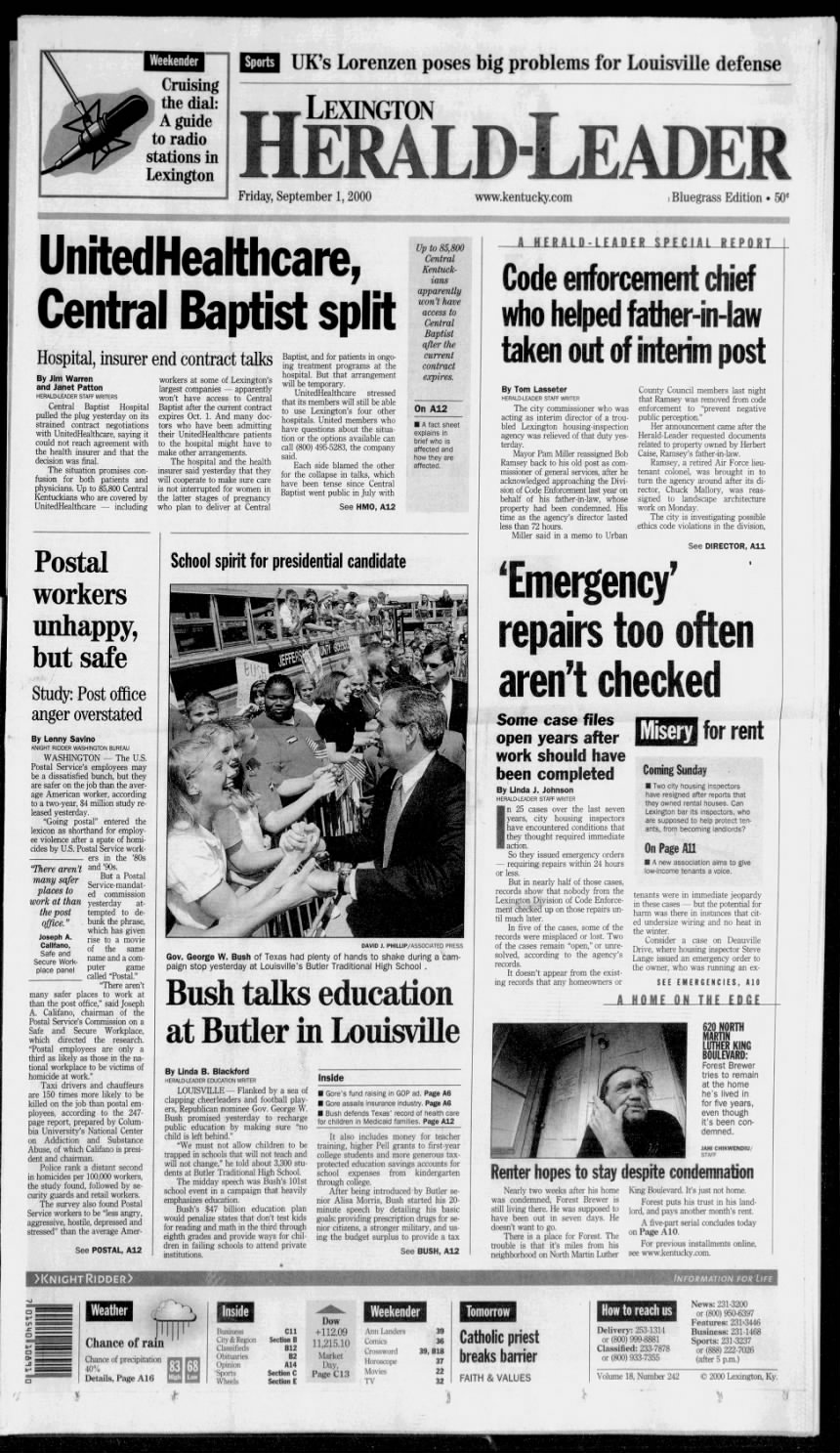
By the end of September, a special task force inspecting the inspectors’ own rental properties had already logged more than 300 code violations — with many units not yet entered, and the inspections announced far enough in advance for owners to tidy up first.
What changed — and what it cost to learn
The institutional response was fast by Lexington standards. Mayor Pam Miller put the division under independent investigation, ordered comprehensive neighborhood sweeps to replace the complaint-only model, had outside inspectors examine employees’ rental properties, and hired counsel to study whether code officers could be barred from the landlord business outright — a ban two University of Kentucky law professors told the paper would be perfectly constitutional. The Herald-Leader’s editorial board, in the middle of its own paper’s reporting, called the division rife with violations from roof to foundation and demanded both new management and a community-wide commitment to housing the near-homeless.
The community answered in at least two durable ways. That September, the Low Income Housing Tenants Association held its first meeting at the Catholic Action Center — then brand-new on East Fifth Street — organized by Ginny Ramsey, who would spend the next quarter-century as Lexington’s most persistent advocate for the unhoused. And eleven area churches, moved directly by the series, pooled $106,000 and formed the Faith Community Housing Foundation; by 2004 it had rehabilitated or built a dozen homes and announced 34 more across downtown’s leftover lots, lease-to-own, backed by $1.1 million from the Federal Home Loan Bank of Cincinnati and more than $2 million in state housing tax credits. The image of that 2004 announcement — a hospital cafeteria worker weeping as she took the key to a 13-foot-wide house on Smith Street with a yard for her kids — is the series’ true epilogue.
The journalists scattered the way good newsrooms scatter. Tom Lasseter left the Herald-Leader for Knight Ridder’s Iraq coverage in 2003 and went on to run McClatchy’s Moscow and Beijing bureaus before becoming an editor at Reuters, where he shared in Pulitzer-recognized international reporting. Jahi Chikwendiu, whose photographs carried the series, joined The Washington Post the following year and became one of the most decorated photojournalists in the country. Mary Meehan and Linda J. Johnson stayed and kept doing exactly this kind of work for Kentucky readers for years. Geoff Mulvihill went on to a long career with The Associated Press.
Why it still matters
Read in 2026, “Misery for Rent” is striking for how little of its underlying physics has changed. Lexington still has no rental registry or routine proactive inspection program for rental housing; code enforcement still depends overwhelmingly on complaints from tenants who — exactly as the series documented — risk displacement by complaining, because the inspector’s strongest tool condemns the building rather than compelling the landlord. The catch-22 a friend of Forest Brewer articulated on a porch on North MLK in June of 2000 — keep quiet and live with it, or speak up and lose your home — is still a fair description of the bargain facing the city’s lowest-income renters. The 60-plus condemnations in the first half of 2000 have their echo in every present-day condemnation notice stapled to a door on the north side, each one solving a building and unhousing a person.
What the series proved, and what makes it worth remembering, is that the conditions were never a mystery requiring discovery. The city’s own database held the 833 violations and the un-condemned condemnation; the deposition in which Lexington’s biggest low-rent landlord conceded his houses were substandard had been sitting in a divorce file for three years; the inspectors’ property holdings were in the deed books. It took four reporters four months to assemble what the institutions responsible already collectively knew. That is the recurring lesson of investigative journalism in this city, and the reason The Lexington Times keeps returning to the public record: the documents usually know. Somebody has to read them.
Sources: “Misery for Rent,” Lexington Herald-Leader, Aug. 27–Sept. 3, 2000 (reporting by Tom Lasseter, Mary Meehan, Linda J. Johnson and Geoff Mulvihill; photography by Jahi Chikwendiu), including the five-part serial “A Home on the Edge” and follow-up coverage through Sept. 30, 2000; “Foundation provides for low-income renters,” Herald-Leader, May 5, 2004; all accessed in full text via NewsBank’s Access World News through the Lexington Public Library. Career information on the series’ journalists from Reuters and published profiles.