Lexington History, continued — part four of tonight’s overnight series from the original newspapers. The 1879 pages shown are in the public domain.
The corner that kept burning
Every story we’ve published tonight keeps walking past the same address. The Courier-Journal measured the 1886 Opera House fire against it. A waiter from it was shot at the polls on the election day in 1881 when Capt. Neale Hendricks died. Forest Brewer’s old Water Street neighborhood ran up against the back of it. And the park that finally replaced it is where Hendricks’ name is carved today. So before the sun comes up, the Phoenix Hotel gets its own chapter — Lexington’s most persistent building, at Main and Limestone, which burned and rose so many times the name stopped being a metaphor and became a job description.
The corner started as Postlethwait’s Tavern, opened around 1800 — the stagecoach stop where the road from the river met the center of town. Aaron Burr stopped there in 1806, between his vice presidency and his treason trial. By the 1820s the place had burned at least once — a fire in 1820 took dozens of rooms — and when the innkeeper Sanford Keene rebuilt, the new house took the name everyone already understood: the Phoenix, risen from its own ashes. (The Kentucky Gazette of 1879, telling the story to readers who’d just watched it burn again, traced the name to Keene’s rebuild in the mid-1820s.) For the next century and a half the Phoenix was Lexington’s front parlor — the place where the stage arrived, where politicians caucused, where Henry Clay’s toasts were drunk, where the hemp and horse money did business.
Race week, 1879
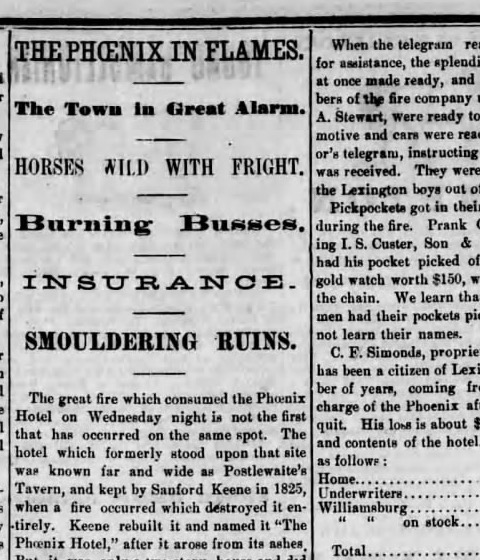
On Wednesday evening, May 14, 1879 — spring race week, the hotel full, the town arguing about that day’s results and handicapping the next — fire broke out around eight o’clock in Wolverton’s omnibus stable behind the hotel, among the very buses that hauled guests from the depot. The churches were in mid-prayer-meeting; the congregations poured into the street. The Gazette’s headline stack three days later is a little poem of catastrophe: “THE PHŒNIX IN FLAMES. The Town in Great Alarm. HORSES WILD WITH FRIGHT. Burning Busses. INSURANCE. SMOULDERING RUINS.”
The account beneath it has everything a fire story of the gaslight era should have. Flames leaping from the stable to the hotel while guests dragged trunks into Main Street. Genuine fear that if the fire crossed Main or Limestone “there is no telling how far it would have extended.” Mayor Frazer telegraphing Frankfort for help, and help actually coming. And, inevitably, the pickpockets, who worked the spectacle so thoroughly that one onlooker lost a gold watch and chain worth $150 — about a year’s rent on a workingman’s house — while watching someone else’s property burn. The hotel was a ruin by morning; the seven-year-old fire that Lexingtonians would still be using as their benchmark when the Opera House burned in 1886.
And then, of course, it rose again. The third Phoenix went up promptly — three stories, with a large metal phoenix mounted above the front wall, in case anyone missed the point — and in 1910 an eight-story wing made it a proper twentieth-century hotel. This is the building Lexingtonians of living memory knew: the lobby where generations met “under the clock,” the Water Street entrance that shows up in the old photographs, the ballrooms that hosted everything from horsemen’s banquets to political machines.
The fire that was a wrecking ball
The Phoenix survived every fire but the economy. It closed in 1977, and in 1981 it met the one force in Lexington history more destructive than frozen hydrants: a developer with a rendering. Wallace Wilkinson — later governor — demolished the entire block to build the World Coal Center, a skyscraper intended to make Lexington the office capital of the coal industry. The tower was never built. The hole in the middle of downtown sat for most of a decade, until the Park Plaza apartments went up on part of the site in 1987 and the rest became Phoenix Park, with the public library beside it.
It is, if you think about it, the bleakest version of the bird: the building that had risen from its ashes three times was finally killed not by fire but by confidence, and what rose this time was a lawn. But the lawn remembers. The park keeps the name, and along its edge stands the Fayette County Peace Officers Memorial — the monument where tonight’s first subject, Capt. C. N. Hendricks, killed in a Water Street saloon in 1881 a block from the Phoenix’s side door, has his name in the stone. Lexington paved over the hotel and kept the ghosts.
A hundred and forty-six years after the Gazette set “SMOULDERING RUINS” in display type, the corner of Main and Limestone holds a park, a library, a memorial, and no phoenix at all — unless you count the habit, which Lexington has never broken, of building the next thing directly on top of the story of the last one.
Sources: The Kentucky Gazette (Lexington), May 17, 1879, “The Phoenix in Flames” (public domain); Wikipedia, “Phoenix Hotel (Lexington, Kentucky)”; Kentucky Historical Society marker records and the Phoenix Park historical marker; the Kaintuckeean, “Only a Park Rose from the Ashes of the Once Mighty Phoenix Hotel” (2012); Kentucky Photo Archive, “Phoenix Hotel, 1981”; The Courier-Journal, Jan. 16, 1886, and Aug. 2, 1881, for the cross-references in tonight’s companion pieces.