Editor’s note: This story first ran in The Lexington Times on December 29, 2022, built from bound volumes of the Lexington Daily Press and Lexington Daily Transcript in the Lexington Public Library’s Kentucky Room. The original was lost in a site migration. This updated edition restores it and adds new material from a 2026 sweep of digitized Kentucky newspapers — including the Louisville Courier-Journal’s day-by-day coverage, a Louisville Argus obituary that fills in Hendricks’s war record, and one detail that reframes the whole scene: it happened on election day.
Lexington, Ky., Monday, August 1, 1881
August 1, 1881 was state election day in Kentucky, and Lexington spent it at a boil. The Courier-Journal’s correspondent estimated that “not less than fifty fights occurred” in town that day. A man stabbed a woman several times. Dick Morgan, white, shot a waiter from the Phoenix Hotel at the polls. “The most outrageous drunkenness and disorder prevailed all day,” the correspondent wrote, “the trouble being largely confined to the Democrats themselves.” By nightfall, “the yells of drunken men woke the echoes on every hand.”
What happened at the Short Line Saloon, the C-J told its readers the next morning, was simply “the bloodiest affair of the day.”
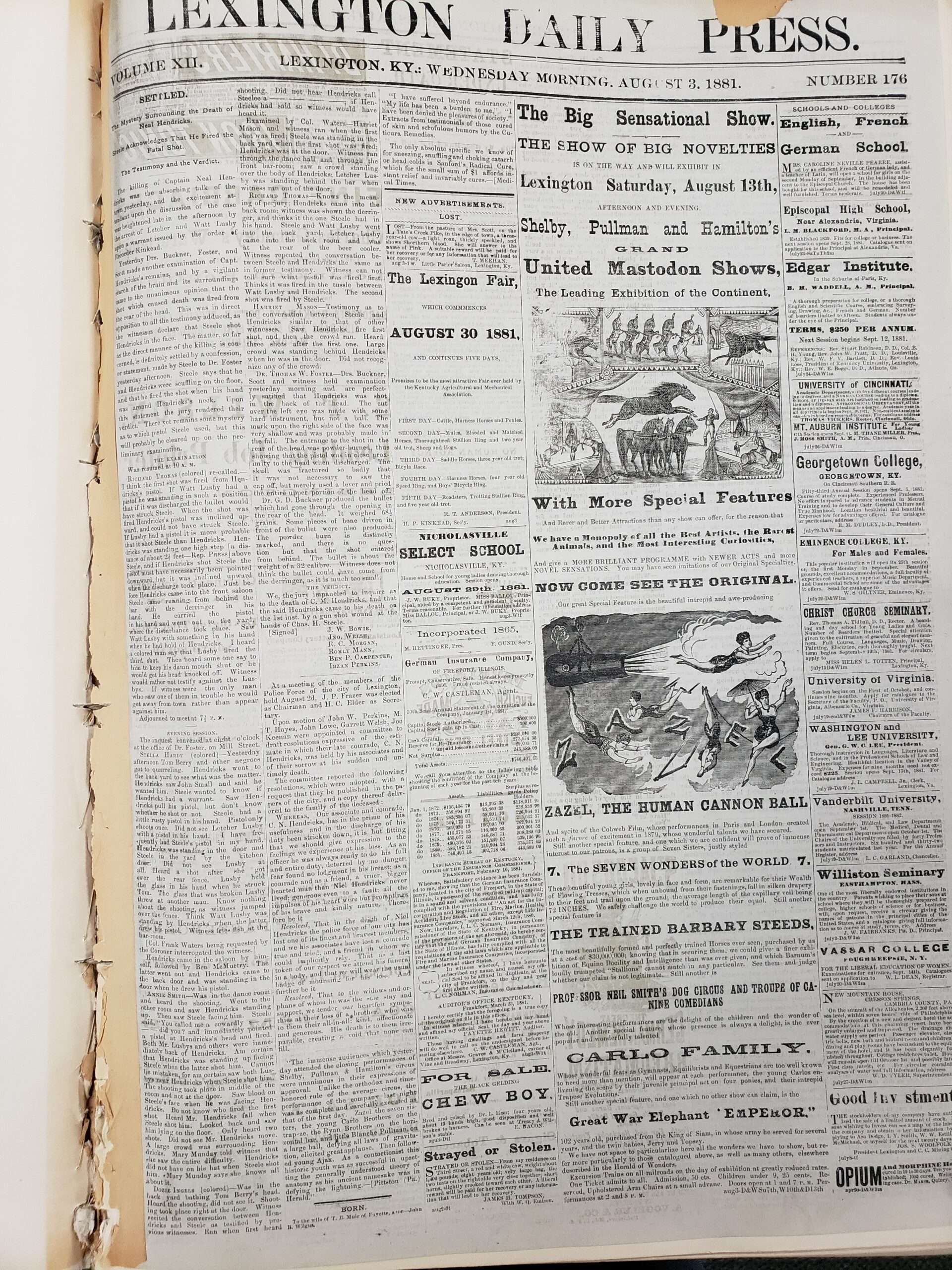
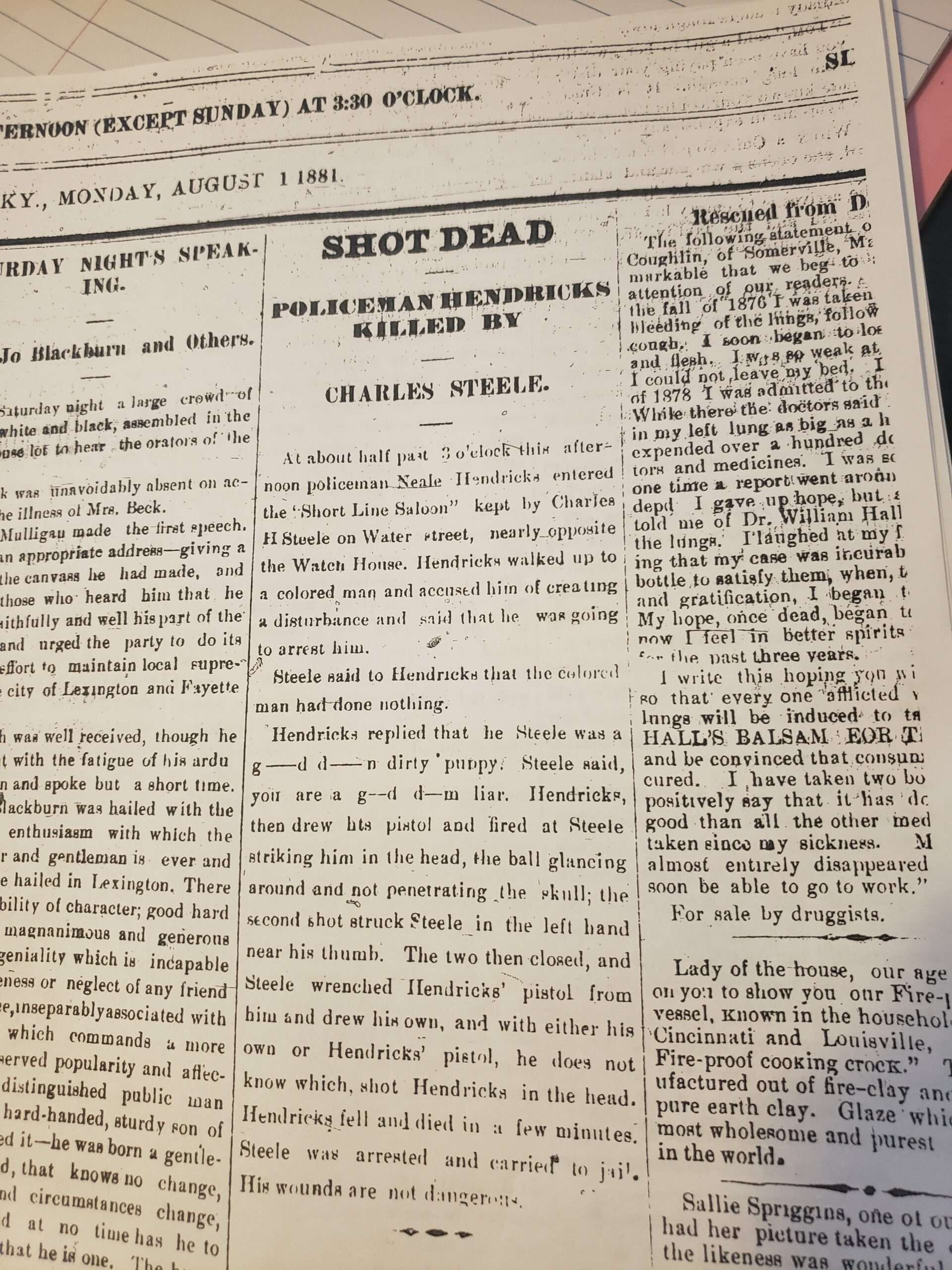
About half past 3 o’clock, policeman Neale Hendricks entered the Short Line Saloon on Water Street. The saloon, kept by Charles H. Steele, sat “nearly opposite the Watch House,” according to the Lexington Daily Transcript’s reporting at the time.
Hendricks, a captain on the force, heard a disturbance at the saloon from his position at the watch house and headed over with two other officers to check it out. Water Street was a bustling commercial center at the time. Its proximity to the railroad, market, and courthouse made it a popular destination for all walks of life. Nestled right in the middle of downtown, there were industrial works, restaurants, hotels, 20 saloons (at least), a candy kitchen, and more on the street, where the LexTran Transit Center sits today. Water Street was shortened in the modern era, when the railroad tracks that ran down the middle of it no longer served a purpose. McCarthy’s Irish Pub is a decent modern-day reference point for where the Short Line Saloon stood; the best guess for the historical location is now occupied by, you guessed it, a parking garage.
There had indeed been a disturbance at the Short Line Saloon that afternoon, but it had settled by the time Captain Hendricks entered the building. The other two officers headed back to the station. Hendricks walked a few steps into the bar and peered through the back door to the yard, where a crowd had gathered. Tom Berry was sitting on the ground, getting a cut on his head washed out by Watt Lusby. Lusby’s brother Letcher, the bartender, had hit Berry on the head with a beer glass for causing trouble in the saloon. This was not particularly unusual for a Monday afternoon on Water Street in 1881 — let alone an election-day afternoon. As Hendricks approached the back door, he spotted John Small, whom he’d been looking for. He also spotted Charles Steele.
Two soldiers of the Orphan Brigade’s regiment
Charles Steele and Neale Hendricks were not strangers. They had served together in the Confederate Army’s Second Kentucky Infantry during the Civil War — and an obituary the Louisville Argus ran after his death (reprinted in Lexington’s Weekly Observer on August 14, 1881) shows just how much history Hendricks carried. He enlisted in Company B of the Second Kentucky, first commanded by Captain Robert Breckinridge and afterwards by Captain Joel Higgins, and served as the company’s first sergeant. At the battle of Fort Donelson in February 1862 he was, by the Argus’s account, “the first man ever wounded in an action in the Second Kentucky Regiment” — shot while in the position of aim, the ball striking his right shoulder and coming out at the elbow. He was captured when the fort fell, and after the regiment was exchanged, his comrades elected him lieutenant. In 1874, as a captain of militia, he was hand-picked to command the Louisville troops sent into Breathitt County “to preserve order.”
Both men were described as “men of great courage” by the Louisville Courier-Journal in their reporting at the time. Steele was also described as having a “rather excitable disposition,” while it was said Hendricks “did not know what it was to fear anybody.”
Hendricks and Steele stared each other down. They hadn’t been friendly lately. Steele ran a lottery and a few other hustles on the side — the C-J noted matter-of-factly that he “keeps a saloon near the Short-line depot, and has charge of a lottery” — and he suspected Captain Hendricks was the cause of some recent indictments against him. On top of that, Hendricks had a pistol of his that he wanted back. At trial, Steele’s acquaintance J.R. Jewell testified Steele told him he planned to take the pistol back, because Hendricks, who had killed two men (one white and one black) since he’d been on the police force, “might be mean enough to shoot him with his own pistol.” Jewell also testified that Steele, who was very drunk at the time, told him that “perhaps some time he might get a chance, and if he did, he intended to lay him out or stretch him out.”
Steele would get his chance.
The killing
Hendricks pointed at John Small and said he’d been looking for him. “I wanna get a hold of you, you damn son of a bitch,” is what Watt Lusby testified Hendricks said to Small.
Small, who was Black, said he did not want to go anywhere with the mean ex-Confederate cop. It’s worth noting that several witnesses to the confrontation reported that there were only a handful of white people in the crowded saloon that day, besides Steele and the Lusbys. There was a dance planned at the saloon that day, so it’s not clear if the Short Line Saloon catered to a predominantly Black clientele, or if that event specifically drew the mostly Black crowd. (Lexington was about 55% white at the time.)
Steele intervened and asked Hendricks if he had a warrant, saying Small had done nothing wrong. When Hendricks could not produce a warrant, Steele told him he couldn’t take Small without one.
“Yes I will, and I will take you too, you cowardly little puppy,” Hendricks yelled, according to multiple witnesses at trial.
Steele howled back that Hendricks was a “god damn liar.”
Captain Hendricks did what any self-respecting 1881 cop would do in that situation: he drew his service revolver and shot Steele in the face. Watt Lusby, whose brother Letcher was tending bar, hollered out that he didn’t want any fuss inside the saloon and attempted to restrain Hendricks before he fired.
Guns weren’t as reliable in 1881 as they are now. Hendricks’ shot grazed Steele’s left hand before hitting his head, “the ball glancing around and not penetrating the skull,” according to the Daily Transcript’s reporting. Wounded, but still standing, Steele lurched forward with his head bleeding. “You called me a cowardly son of a bitch, did you?!”
Within moments, Captain Hendricks lay gasping on the floor, dying. When the crowd rushed back in, Steele was standing over him. “He shot me for nothing!” witnesses heard him say — and to Officer E.M. Garrett, minutes later: “God damn him, he shot me first, but I got the best of him, though.” Steele was hurried off to jail. “Intense excitement prevailed immediately after and all the evening,” the C-J reported.
At the end of it, Captain Hendricks’s skull was reportedly so shattered that medical examiners “were able to lift the top of his skull without the aid of a saw” during the autopsy.
August 2, 1881 — “Was it Murder.”
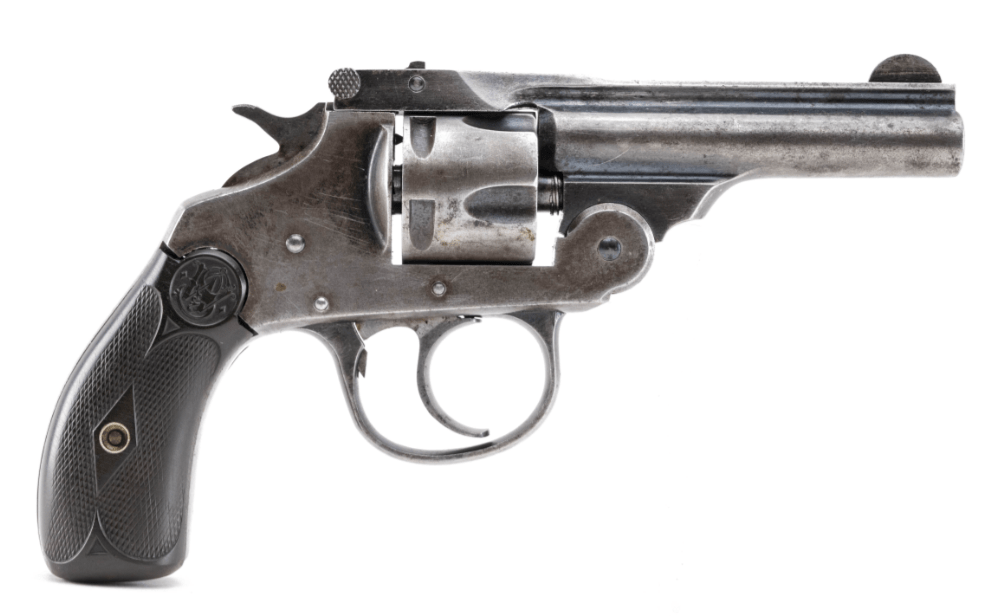
Charles Steele was taken to Lexington City Jail. The first-day reporting had two balls entering Hendricks’s forehead — one from a derringer over the left eye, another over the right eye “ranging down into the neck.” But when Drs. G.D. Buckner, Thomas W. Foster and Scott re-examined the remains, the geometry flipped: the fatal ball had entered the back of the head, its entry wound powder-burned — the muzzle had been pressed nearly against Hendricks’s skull — and exited in front. The wound over the left eye was a contusion from “some hard instrument, but not a ball.” The bullet pried out of the brain was a .32 Short. The .32 Short is smaller than the .41 load used by a derringer — it fit neither the derringer in evidence nor Hendricks’s own large revolver.
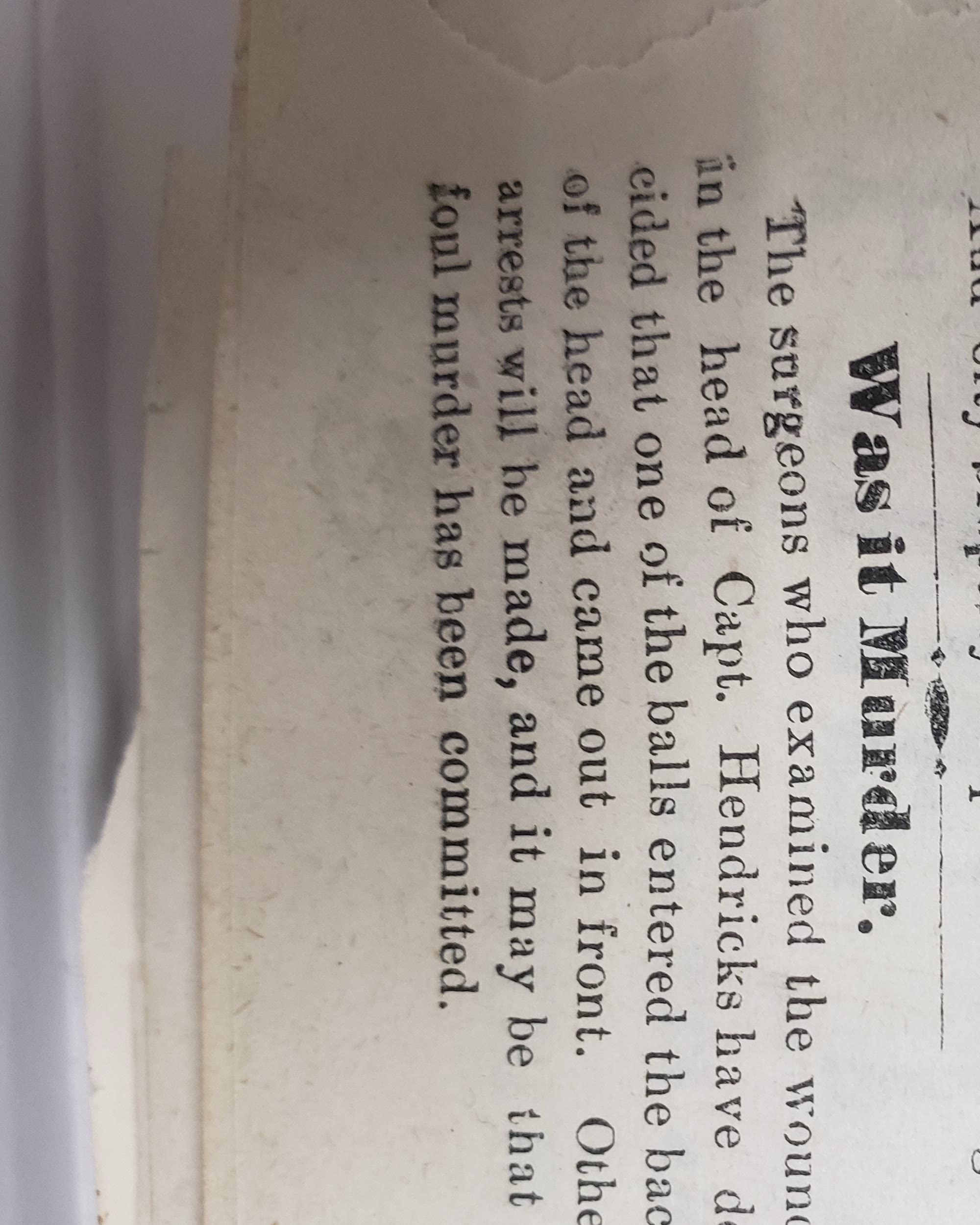
The Lexington Daily Transcript put the obvious question in a headline: “Was it Murder.” The surgeons’ finding, it reported, meant “other arrests will be made, and it may be that a foul murder has been committed.”
That same day, after a court hearing, the brothers Watt and Letcher Lusby were arrested on warrants as accessories. According to the Lexington Daily Press, their arrest heightened discussion of a case that was already “the absorbing talk of the town.”
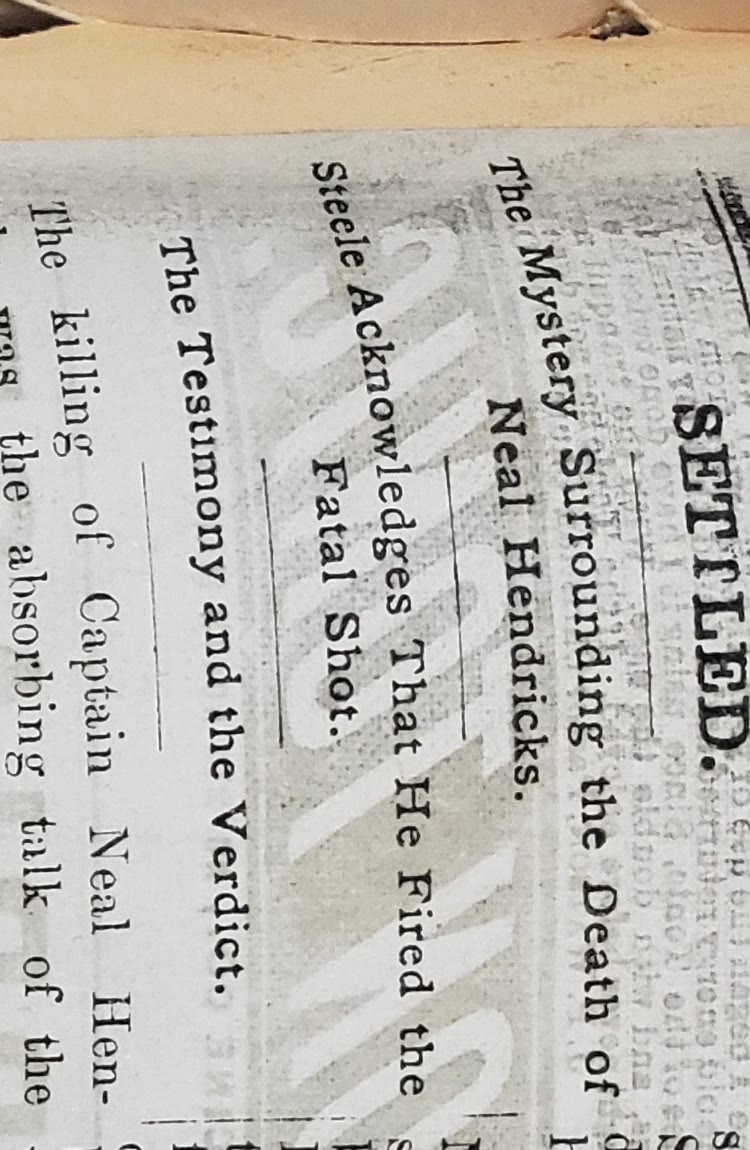
At 10 a.m. on Tuesday, August 2, Richard Thomas testified to a Coroner’s Jury that he’d seen Steele run from behind the bar to the backyard with a derringer to break up a fight before Hendricks arrived. He thought the first shot was from Hendricks’s pistol, but said he also saw Watt Lusby with something in his hand when he was struggling with Hendricks. He testified that he heard someone say Lusby fired the third shot, then heard someone else tell him to “keep his damn mouth shut or he would get his head knocked off.” Thomas stated that he did not want to testify against the Lusbys and would skip town if he were the only witness. He was arrested as a material witness to keep him from doing exactly that.
At 8 p.m., Stella Hardy, who fried fish at the bar, testified she saw Hendricks pull his pistol. By the time she heard the first shot she had already jumped the fence, though, so couldn’t say who had fired. Annie Smith, who had been in the dance room, testified she saw Steele facing Hendricks with blood on his face. He yelled, “you called me a cowardly son of a bitch, did you?” before pointing a pistol at Hendricks’s head and firing.
The mystery of the rear entry wound deflated when Steele himself explained the mechanics to Dr. Foster: he and Hendricks were scuffling, “and he fired the shot when his hand was around Hendricks’s neck,” according to the Lexington Daily Press — a contact shot fired mid-grapple, from a hand wrapped around the back of the officer’s head. Physicians who examined Steele in jail corroborated the geometry from the other side: Dr. L. Beecher Todd found the inside of Steele’s hand was powder-burnt, and Dr. Buckner saw a powder burn on his shirt sleeve. And the .32 Short pointed at one more irony: the small revolver found behind the counter with one fresh load out was, by the weight of the testimony, Steele’s own pistol — or, as some of the evidence suggested, Hendricks may have been killed with a gun Steele had snatched in the melee. The man who feared Hendricks “might be mean enough to shoot him with his own pistol” had settled the question with a pistol at point-blank range.
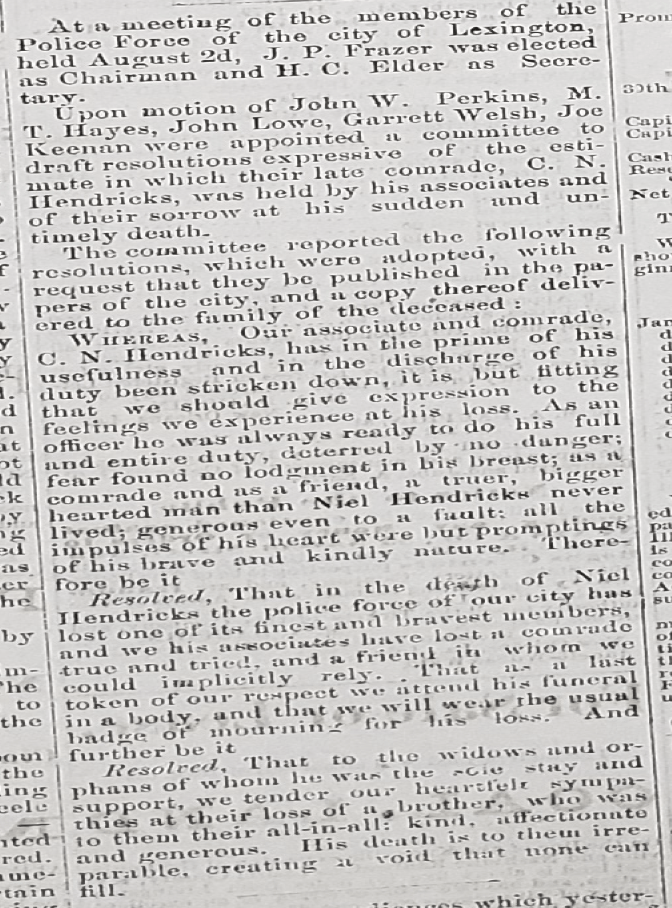
Upon Steele’s statement, the Coroner’s Jury found there was enough evidence to proceed. Hendricks was buried Tuesday afternoon at half past 3 — almost exactly 24 hours after the shooting. Lexington Police officers formed a committee and passed a resolution honoring his courage, saying “fear found no lodgment in his breast.” His funeral was “very largely attended,” and per the Courier-Journal, “a great number of ex-Confederate soldiers, who served with him during the war, were present and in the procession.” (Lexington papers did not report this detail.)
August 3, 1881 — The Commonwealth v. Charles Steele
With the Coroner’s Jury having found enough evidence to proceed, the next step was a preliminary examination before Recorder George B. Kinkead — the docket reading Commonwealth of Kentucky vs. Charles Steele. Murder. Col. Frank Waters assisted the prosecution; Gen. Huston and Morton & Parker appeared for the defense. If the court found sufficient evidence, Steele and the Lusbys would be held for a full jury trial. Otherwise they would walk.
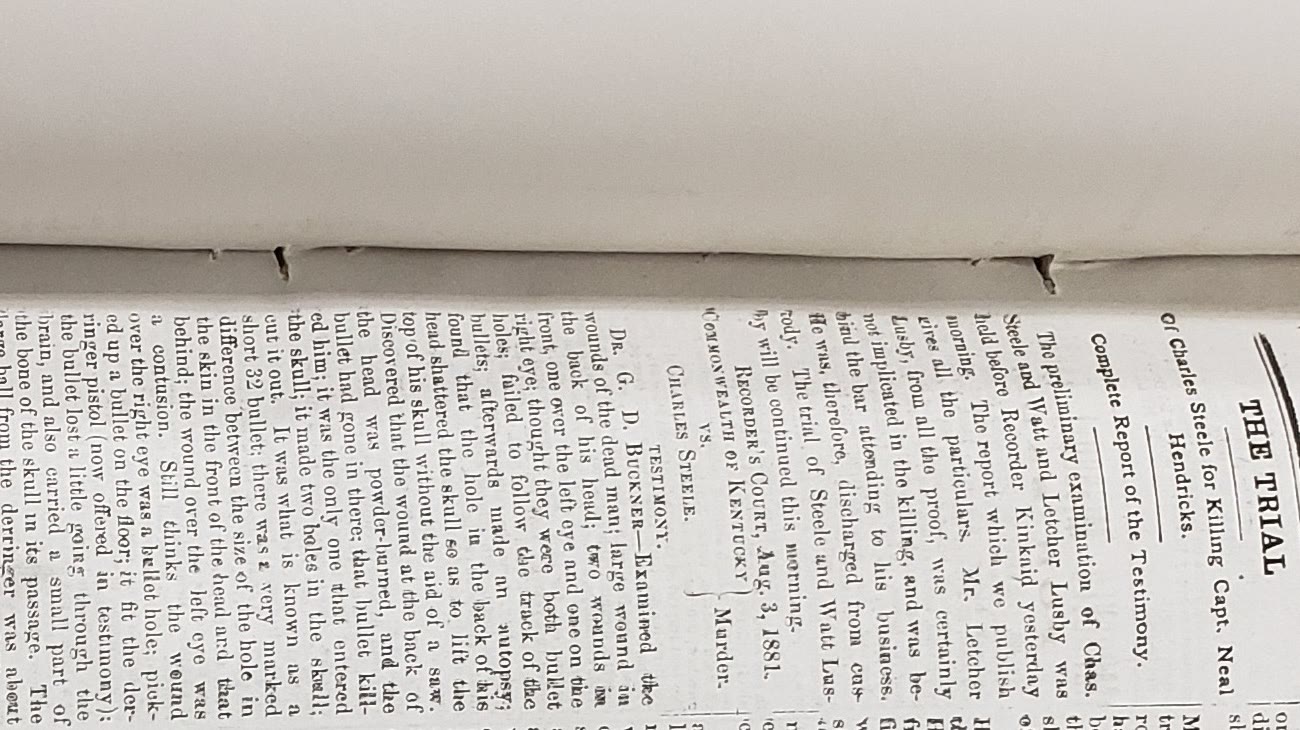
Dr. G.D. Buckner testified and confirmed it was a .32 Short to the back of the head that killed Hendricks. Additionally, Hendricks was shot with a derringer above the right eye (the bullet bounced off his forehead) and he sustained a contusion over the left eye caused by a “violent blow.” Buckner testified that nothing about Hendricks’s clothes indicated a scuffle — except both hands dirty from the dust of the floor — and there were no scratches on his neck or bruises on his back or chest. He said a man standing in front of Hendricks could not have fired the fatal shot. The shot’s direction was “forward, downward, and a little inward,” and in his opinion it would have been impossible to reach around and fire it from the front. “A man receiving such a wound,” he added, “would be instantly powerless.”
E.M. Garrett, a policeman, had responded to the disturbance alongside Hendricks but left when they found it already quieted. He testified he’d just made it back across the street to the station when he heard the first shot. He ran back, and the last shot was fired as he got to the door. Hendricks’s pistol was about three feet from the dying officer’s hand; Steele was four or five feet from it.
Charles Mills, a gunsmith, testified that he examined Hendricks’s pistol and it was his opinion it had not been fired. The gun was missing one round when shown to him, but was in such bad condition it would not revolve. There was rust in the barrel and chamber and no powder dirt in the barrel — though he allowed the rust could have accumulated in only a few hours in the conditions. Policeman M.T. Hayes went further: Hendricks’s pistol was not a good one; they had once tried to put down a dog with it, “but it snapped and would not go off.”
John Shannon testified that he found Hendricks’s pistol in the hands of Letcher Lusby, who was fiddling with it, seeming to try to make it revolve; Shannon told him not to fool with it, and Lusby put it back on the shelf behind the bar. Nat Williams, Hendricks’s brother-in-law, got into the saloon before Hendricks died and saw Letcher Lusby behind the bar with the pistol; Lusby told him one load was out of it, and one out of the derringer too. The chain of custody of every gun in the room, in other words, ran through the defendants’ side of the bar.
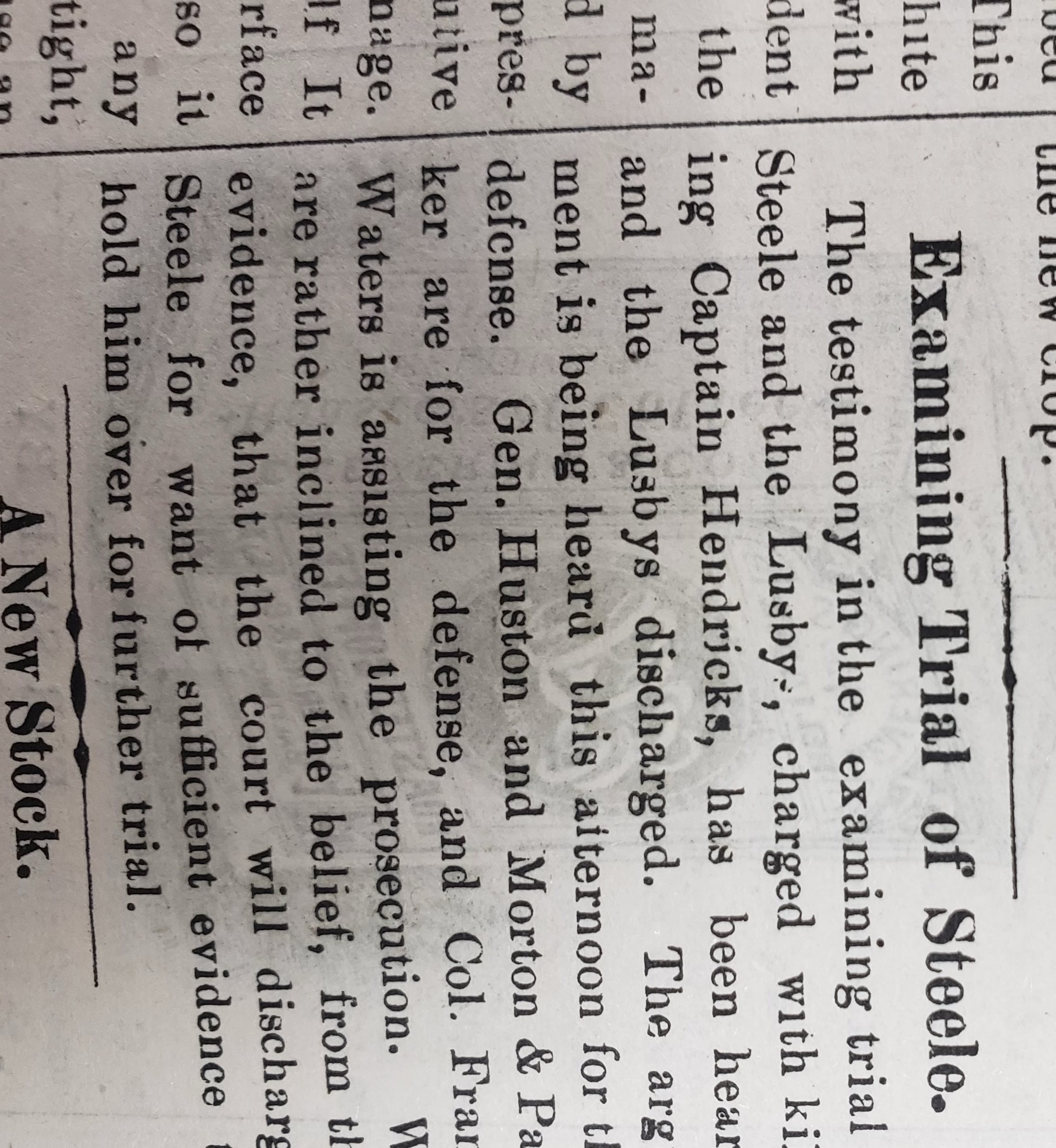
Richard Thomas, compelled to testify, relayed the same account as before: a puff of smoke rising from the area of Watt Lusby’s and Hendricks’s hands at the first shot, Steele then stepping forward with the derringer, Lusby letting go as Steele fired, Hendricks staggering back, his pistol falling to the floor. John Berry, one of the only white patrons, heard two shots, never saw a pistol in Watt Lusby’s hands, heard someone yell “There, he’s done shot Mr. Steele,” and then saw Steele draw and “crack loose” at Hendricks.
The prosecution announced a surprise witness who could prove Watt Lusby’s connection to the crime, to testify the next morning. The charges against Letcher Lusby — who “from all the proof, was certainly not implicated in the killing, and was behind the bar attending to his business,” as the Daily Press put it — were dismissed, and court adjourned.
August 4, 1881 — The judgment
The prosecution’s surprise witness was a dud, to put it lightly. Henry Allen repeated a similar story as most of the other witnesses, and eventually identified Letcher — whose charges had already been dropped — as the Lusby he saw. It’s not clear if Allen was the sensationalized witness prosecutors were referring to, or if that individual had skipped town, or if someone had been persuaded overnight to keep quiet.
After Allen testified, the defense moved to dismiss the charges against Watt Lusby and Charles Steele. Kinkead sustained the motion as to Lusby, whose testimony he desired to hear. Lusby then took the stand and gave the defense’s version whole: Hendricks demanded John Small, Steele said not without a warrant, Hendricks said he’d take Small — and Steele too — if he wanted, adding, “More than that, you are a damn cowardly son of a bitch.” At that, Hendricks drew. Lusby rushed in and grabbed the pistol by the muzzle; it went off; he crawled on all fours behind the counter and saw no more.
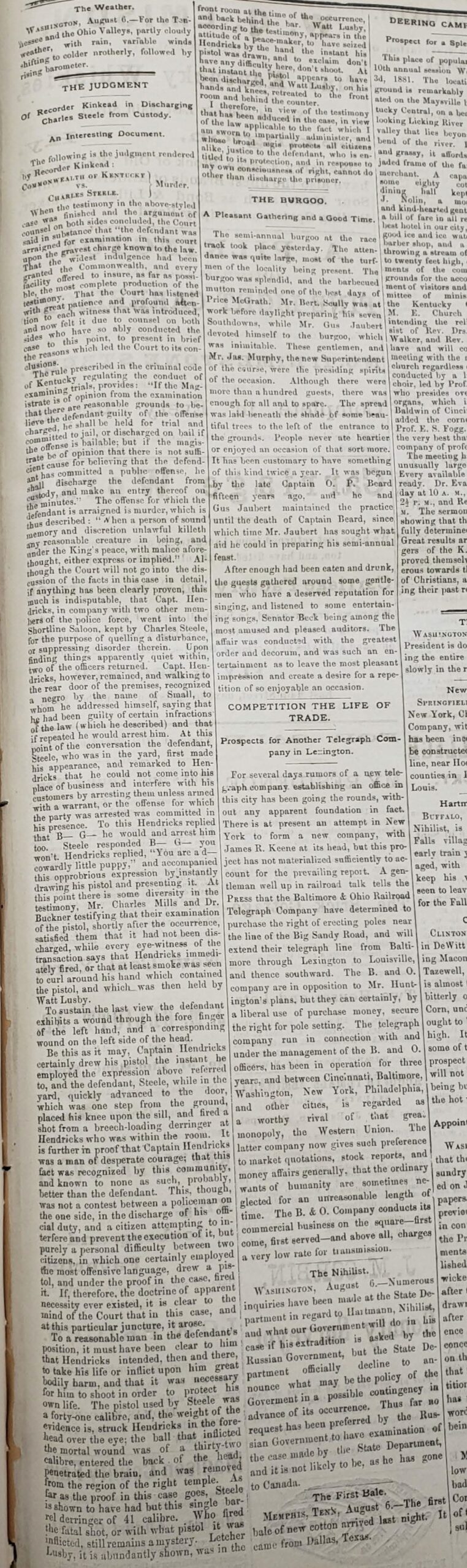
Then came the ruling. After argument by Col. Waters for the Commonwealth and Capt. J.R. Morton for the defense, Recorder Kinkead delivered a lengthy written opinion reviewing all the testimony — and dismissed the murder charge against Charles Steele. The announcement was met with applause in the courtroom.
Kinkead noted that Hendricks called Steele a “cowardly little puppy, and accompanied this opprobrious expression by instantly drawing his pistol and presenting it,” and that while the gunsmith and Dr. Buckner doubted Hendricks’s pistol had fired, “every eye-witness of the transaction says that Hendricks immediately fired, or that at least smoke was seen to curl around his hand which contained the pistol, and which was then held by Watt Lusby.” He continued:
Be this as it may, Captain Hendricks certainly drew his pistol the instant he employed the expression above referred to, and the defendant, Steele, while in the yard, quickly advanced to the door, which was one step from the ground, placed his knee upon the sill, and fired a shot from a breech-loading derringer at Hendricks who was within the room.
It is further in proof that Captain Hendricks was a man of desperate courage; that this fact was recognized by this community, and known to none as such, probably, better than the defendant.
This, though, was not a contest between a policeman on the one side, in the discharge of his official duty, and a citizen attempting to interfere and prevent the execution of it, but purely a personal difficulty between two citizens, in which one certainly employed the most offensive language, drew a pistol, and under the proof in the case, fired it.
If, therefore, the doctrine of apparent necessity ever existed, it is clear to the mind of the Court that in this case, and at this particular juncture it arose.
To a reasonable man in the defendant’s position, it must have been clear to him that Hendricks intended, then and there, to take his life or inflict upon him great bodily harm, and that it was necessary for him to shoot in order to protect his own life.
“Goes Scot Free” — how the story played across Kentucky
The next morning, the Courier-Journal put the outcome on page one of its statewide news column, under a headline that needs no gloss: “Charles Steele, Who Killed Officer Hendricks, at Lexington, Goes Scot Free.” The story rippled outward for weeks — the Frankfort Kentucky Yeoman carried the first dispatches on August 2, the South Kentuckian in Hopkinsville picked it up on the 9th and 16th, and the Weekly Maysville Eagle was still running the trial report on August 17. The Louisville Argus ran the respectful soldier’s obituary that Lexington’s Weekly Observer reprinted on August 14 — celebrating the Fort Donelson wound and the Breathitt County command, and noting only that Hendricks “was murdered at Lexington recently.”

And then: nothing. A sweep of digitized Kentucky newspapers through the end of 1882 turns up no grand jury indictment, no circuit court trial, no further proceeding of any kind against Charles Steele. Three days after a police captain died of a contact gunshot wound to the back of the head on the floor of a Water Street saloon, the case was legally over — and it stayed over.
Downtown Lexington’s last standing Confederate monument
Recorder Kinkead’s judgment clearly states that Captain Cornelius Neale Hendricks was not killed in the discharge of his official duties as a police officer. He was, in fact, killed in a “purely personal difficulty.” Nevertheless, Hendricks is still honored on the Fayette County Peace Officers Memorial in downtown Lexington, where the roster reads simply “C. N. Hendricks — 1881.” The Fraternal Order of Police describes him as “Shot and killed while attempting to make an arrest in a saloon on Water Street.” After downtown’s Confederate statues were removed following public outcry, the memorial became, in effect, the last remaining downtown monument honoring a Confederate soldier.
Hendricks — born April 8, 1838, dead at 43 — lies in Section B of the Lexington Cemetery. The Officer Down Memorial Page carries him as Captain Cornelius N. Hendricks of the Lexington Police Department, end of watch August 1, 1881.
This article was compiled using primary sources found at the Lexington Public Library’s Kentucky Room (Lexington Daily Press and Lexington Daily Transcript, August 2–6, 1881), with additional 2026 research in digitized newspapers: the Louisville Courier-Journal of August 2, 3 and 5, 1881; the Weekly Observer (Lexington) of August 14, 1881, reprinting the Louisville Argus; and a statewide sweep of Kentucky papers through 1882. Hendricks’s first name is spelled “Neale,” “Neal,” and/or “Neil” in various newspaper reports, though his given name was Cornelius. It has been reported in other places online that Hendricks had once been Chief of Police; the author could find no evidence to support this claim.