🌎 Resumen en español · traducción automática
La policía de Lexington ha realizado más de 400,000 búsquedas a través del sistema de lectores de placas Flock desde 2022, según auditorías trimestrales del departamento de policía. Sin embargo, todas esas auditorías fueron realizadas por el mismo departamento de policía, y la revisión que describen como independiente omitió completamente todo el año 2023 y desde mediados de 2025 solo examina 60 registros por trimestre sin importar cuántas búsquedas se hayan realizado.
Traducción y resumen generados por IA a partir del artículo en inglés. Puede contener errores; consulte el texto original.
Correction — Aug. 27, 2026
The version of this story published Aug. 26 reported that ten of the 27 Flock audits on Lexington’s license plate reader page returned a 404 error and that the program’s first two years of oversight records could not be read. That was wrong, and the error was ours.
All 27 documents download. The city’s links are double-encoded — the file names on the server contain literal %20 sequences — and our retrieval decoded them once before requesting, which produced a 404 that the city’s server never returned to an ordinary reader. Requested exactly as published, every link returns its memo.
We checked whether the city had quietly repaired the links after we published. It had not: all ten files carry a Last-Modified date of Oct. 7, 2024, unchanged for 23 months; the content server’s cache had been serving one of them continuously since about Aug. 16, ten days before our story ran; and the Internet Archive holds a successful capture of the same address from Jan. 1, 2025.
This story has been rewritten to report the full 27-document record, including the 2022–2024 audits we wrongly described as lost. The headline, summary and cover caption have been changed, and a photograph of the city’s 404 page has been removed. What the complete record shows is set out below — including a gap in the independent review that the earlier version missed. We regret the error.
Lexington police officers have run more than 400,000 searches through the city’s Flock license plate reader system since the cameras went up in 2022, according to the Lexington Police Department’s own quarterly audits. Every one of those audits was conducted by the police department itself. The review the department describes as independent skipped all four quarters of 2023, and since mid-2025 it has examined a flat 60 entries per quarter no matter how much searching happened.
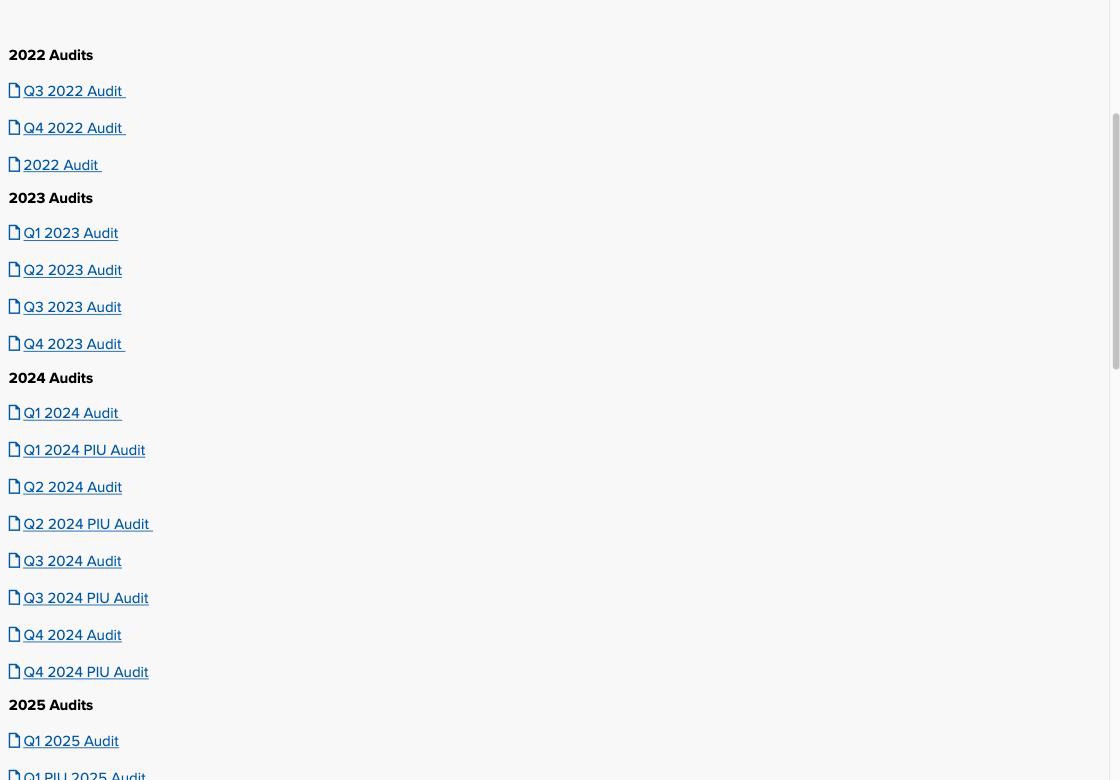
The Lexington Times downloaded and read all 27 audits the city publishes on its license plate reader audit page, covering the third quarter of 2022 through the second quarter of 2026. Every figure in this story comes from those documents.
The review comes as the cameras arrive at City Hall. On Thursday, Aug. 27, at 6 p.m. at 200 E. Main St., the Bluegrass chapter of the Democratic Socialists of America plans to hand the Urban County Council a demand letter asking Lexington to cancel its Flock contract, remove all 125 cameras within six months and delete the data they have collected. A companion petition had 297 signatures toward a goal of 1,000 as of Wednesday afternoon.
And on Wednesday, Aug. 26, the Lexington Herald-Leader reported that a Shively police officer has been charged with running 2,048 Flock searches on two registration numbers belonging to a single woman. Asad Zahir, 40, faces five counts of official misconduct and five counts of unlawful access to a computer; the complaint says that between Jan. 1 and May 2 he “harassed the victim in Indiana and made threatening comments to the extent that she filed and was granted a temporary protection order against him.” His superiors discovered the searches. He was arrested Aug. 25, released, and was set for arraignment Thursday in Jefferson County District Court. He has not entered a plea.
That case is about Shively’s system, not Lexington’s. But it raises a question a resident can reasonably ask here: if an officer did that in Lexington, what would catch it?
How the program started
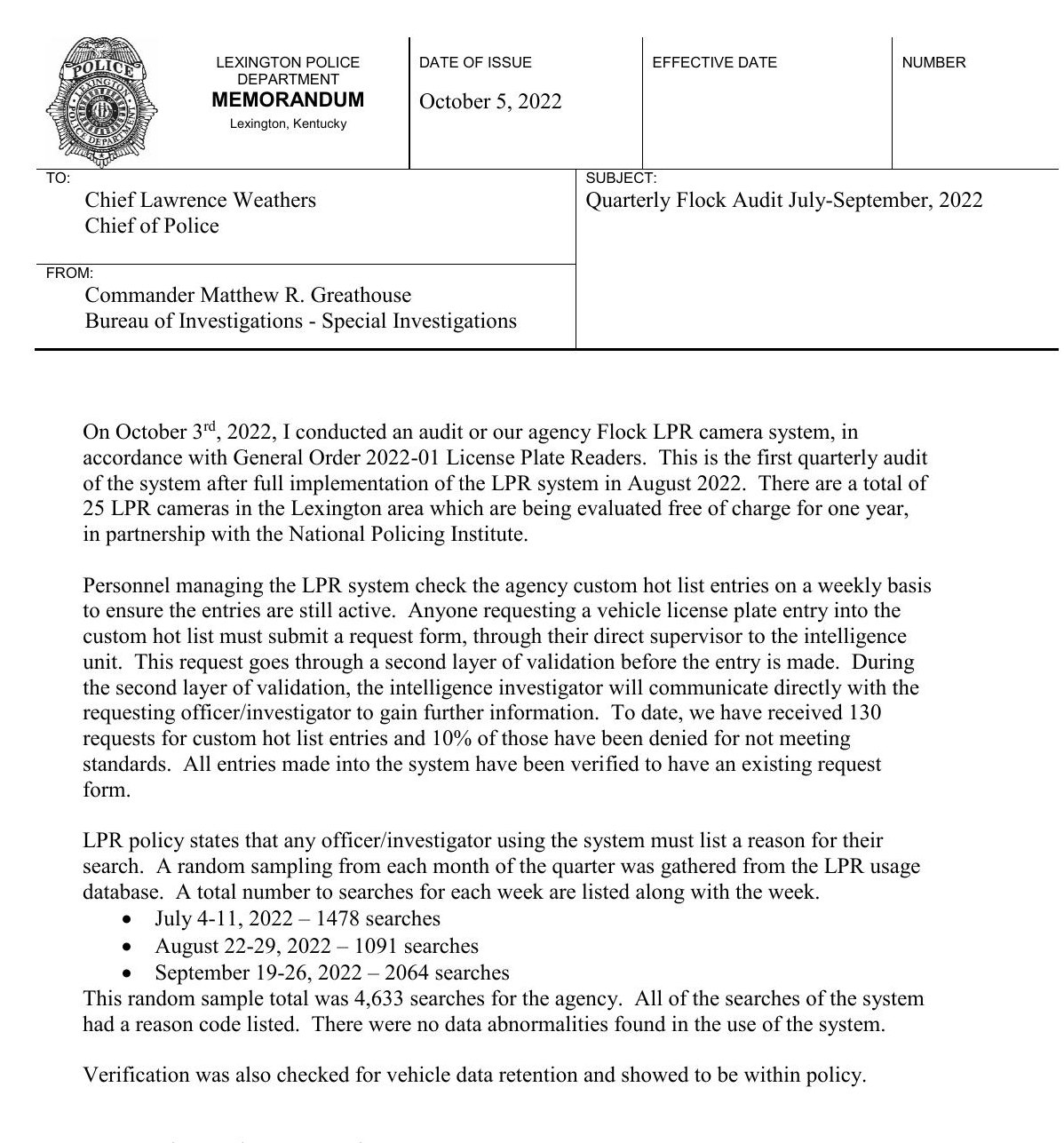
The first audit, signed Oct. 5, 2022 by Commander Matthew R. Greathouse, describes a pilot: 25 cameras “being evaluated free of charge for one year, in partnership with the National Policing Institute.” It did not report a quarterly search total. It sampled three single weeks — July 4-11, Aug. 22-29 and Sept. 19-26 — totaling 4,633 searches, and found “no data abnormalities.”
The camera count went to 43 by March 2023, 100 by June 2023 and 125 by September 2024, where it remains.
Four years of searching, in one table
Two figures run through these memos. “Total searches” counts every query an officer submits. The second figure counts distinct justifications — labeled “unique incidents or cases searched” in the 2023 memos and “unique search reasons” from 2024 on. The department did not report it at all before April 2023.
| Quarter | Cameras | Total searches | Unique reasons | Searches per reason | PIU entries reviewed |
|---|---|---|---|---|---|
| Q3 2022 | 25 | not reported | — | — | 30 (both quarters) |
| Q4 2022 | 25 | 15,117 | — | — | |
| Q1 2023 | 43 | 18,561 | — | — | none published |
| Q2 2023 | 100 | 27,713 | 2,157 | 12.8 | none published |
| Q3 2023 | 100 | 14,870 | 2,336 | 6.4 | none published |
| Q4 2023 | 100 | 16,554 | 2,828 | 5.9 | none published |
| Q1 2024 | 100 | 19,738 | 3,241 | 6.1 | not stated |
| Q2 2024 | 100 | 21,432 | 2,805 | 7.6 | 67 |
| Q3 2024 | 125 | 23,299 | 3,144 | 7.4 | 87 |
| Q4 2024 | 125 | 25,731 | 3,187 | 8.1 | 75 |
| Q1 2025 | 125 | 33,966 | 3,309 | 10.3 | 89 |
| Q2 2025 | 125 | 38,896 | 3,299 | 11.8 | 60 |
| Q3 2025 | 125 | 39,836 | 3,175 | 12.5 | 60 |
| Q4 2025 | 125 | 32,511 | 2,426 | 13.4 | 60 |
| Q1 2026 | 125 | 32,825 | 2,198 | 14.9 | 60 |
| Q2 2026 | 125 | 39,119 | 2,241 | 17.5 | 60 |
The 15 quarters that report a total come to 400,168 searches. The true figure is higher, because the program’s first quarter was never totaled.
The independent review skipped 2023
Lexington’s general order sets up two checks. The Intelligence Unit — the unit that operates Flock — audits the system each quarter and reports to the chief. Separately, the Public Integrity Unit is directed to “audit a sampling of the LPR system utilization from the prior period to verify proper use.” Each PIU memo states it was “conducted independently of the Bureau of Investigations Intelligence Unit, which maintains and operates the License Plate Reader (FLOCK) system.”
That separation is real, and LPD deserves credit for building it in: the unit checking the searches is not the unit running the cameras.
It has not run continuously. The city publishes a PIU audit covering the third and fourth quarters of 2022, signed by Lt. Jeff Jackson in March 2023. The next one covers the first quarter of 2024. In between — all four quarters of 2023, the year the system grew from 43 cameras to 100 and absorbed roughly 78,000 searches — the page lists four audits, and all four are Intelligence Unit memos signed by Lt. David M. Richardson. None of the four mentions the Public Integrity Unit. On the public record, the independent check did not happen that year, or happened and was never published.
The Q1 2024 PIU audit that ends the gap does not say how many entries it examined. It describes “a secondary review of the first quarter of 2024” performed May 30, 2024, states that “all audited items were found to be law enforcement related,” and gives no sample size. It is the only PIU memo in the set that omits one.
The sample shrank as the searching grew
Where the PIU does state a sample, the method changed twice.
The 2022 audit worked from a listed log: 15 entries for July-September, 15 for October-December, each row naming the incident number, the plate or vehicle description, the officer and the reviewing lieutenant.
From Q2 2024 through Q1 2025 the memos describe a proportional method: “A random number generator was utilized to audit 1% of the unique entries.” That produced 67 entries in Q2 2024, 87 in Q3 2024, 75 in Q4 2024 and 89 in Q1 2025.
Beginning with the second quarter of 2025, the language changes to a fixed number: “At random 20 of the unique entries for the months … was selected totaling 60 overall selections.” It has read that way in every PIU audit since — a flat 60 per quarter, no longer tied to how much searching happened.
Search volume did not hold still. Quarterly searches rose 68% from Q3 2024 to Q2 2026. The number of entries the Public Integrity Unit reviewed fell from 87 to 60.
Searches per stated reason — total searches divided by the unique reasons officers entered — rose in every quarter from Q3 2024 through Q2 2026, from 7.4 to 17.5, and has more than doubled since the Q4 2023 low of 5.9. The audits explain that one investigation legitimately generates many searches as officers hunt a vehicle. That is true. It also means each written justification now covers more than twice as much searching as it did two years ago.
Two cautions on the arithmetic, because both cut against an easy headline. The Q2 2023 ratio of 12.8 is higher than anything recorded until late 2025, so the trend is not a clean climb across the whole record; that quarter also used a different label for the denominator and fell in the middle of the rollout from 43 cameras to 100. And the Public Integrity Unit samples “unique entries,” while the Intelligence Unit counts “unique search reasons” — not the same figure. One percent of a month’s unique entries yielded 29 in a month the quarterly memo lists as 1,095 unique reasons. The 60 can be reported as a count. It cannot honestly be converted into a percentage of anything in the table, and LPD should be asked what the current denominator is.
The test that would flag a Zahir pattern was weakened, then replaced
The repeat-plate screen is the check most likely to surface the Shively pattern — one officer, one plate, over and over. It has three versions in the record, and it did not exist for the program’s first two years.
No audit before the second quarter of 2024 describes any review of how many times a single plate was searched. The screen appears for the first time in the Q2 2024 memo, and in that one quarter only it reads:
“If a search was conducted on a specific plate by a single user more than 10 times, further review was conducted including the reason for the search and the dates the search was conducted.”
From the third quarter of 2024 through the end of 2025, the words “by a single user” are gone. The test still asks whether a plate was searched more than 10 times, but no longer whether one officer did it — and a plate legitimately worked by a squad of detectives clears 10 searches easily, which is exactly what the audits report finding each time it ran.
In the first quarter of 2026 the method changed again:
“A review was conducted of license plates searched in the system and the days between searches. If a plate was searched with more than 7 days between searches, further auditing was competed.”
That is a different question. The old screen asked how many times one plate was searched. The new one asks how far apart the searches were. A concentrated burst of searches on one plate inside a single week would trip the original test and not this one. The Q2 2026 audit describes no repeat-plate screen of its own at all. The audits do not explain why the method changed.
The newest safeguard came from the vendor
The Q2 2026 audit reports a genuine improvement, and says where it came from:
“At the beginning of the 2nd Quarter of 2026, FLOCK introduced enhanced auditing capabilities.”
The system now automatically alerts LPD administrators to five categories: single-user plate searches, searches beyond a 30-day window, multiple case numbers for the same plate, exclusive external network searches, and narrow timeframes. In the quarter, 97 single-user plate searches and 88 beyond-30-day searches alerted. All 185 were reviewed and attributed to active investigations.
Two things follow. The alert most relevant to a single officer working one plate on his own now exists again — and it was built by Flock Safety, the contractor, rather than restored by the city. And “exclusive external network search” is now a named alert category, which means out-of-network searching is a recognized risk in the system’s own design.
What the audits do well
A fair reading of these documents does not support a picture of a department indifferent to misuse.
Hot List entries — standing watch lists for specific vehicles — cannot be created by individual officers. The audits state that during the 2022 rollout, LPD restricted creation to the Intelligence Unit, required authorization “vetted through two layers of supervision,” and set entries to delete automatically after seven days. Both units audit that process, and the 2022 memo records that of 130 hot list requests received in the first months, 10% were denied for not meeting standards.
More directly relevant to the Shively case: Lexington chose not to accept other departments’ Hot Lists. As the audits put it, the decision was made “to not accept other Department ‘Hot List’ from showing alerts due to Lexington Officers having no knowledge of the case.” That is a deliberate limit on exactly the cross-agency exposure a case like Zahir’s raises, adopted four years before it.
The early audits also show the department finding and fixing its own documentation problems: officers who entered “123456” or “investigation” as a search reason were traced, their supervisors notified, and refresher training delivered to all sergeants and lieutenants in August 2024.
Lexington also publishes its camera locations and these audits at all — which Louisville, citing Lexington as the transparent model, voted in April 2026 not to do.
Loose ends in the paperwork
Several memos contain errors that a reader should weigh, since these are the city’s accountability record.
The Q1 2024 PIU audit states it covered “the 1st Quarter of 2024, October through December.” The Q1 2025 PIU audit correctly covers January through March, then says its Hot List check drew “one entry per month … from the 4th Quarter of 2024.” The Q2 2025 PIU memo is headed “2nd Quarter 2025” but says in its first line that it audited the first quarter. The Q1 2026 PIU audit says it audited “the 1st Quarter of 2026, January through March,” then reports sampling “the months October, November, and December.” Both 2026 quarterly memos state “As of March 26, 2025, 125 ALPR cameras are being managed” — the prior year’s date. The Q2 2024 memo dates its camera count to “June 31, 2024,” a day that does not exist.
Two of the 27 documents — the Q4 2024 and Q2 2026 PIU audits — are posted as Microsoft Word files rather than PDFs, on a page where everything else is a PDF.
There is also a third retention figure now on the record. The Q2 2026 audit says “The Lexington Police department stores data for 60 days.” The signed contract order form lists a “Retention Period: 30 Days” alongside an “Extended data retention” add-on described in the 2024 expansion quote as “Up to 1 Year.” Thirty, sixty, or up to a year — the documents do not agree, and as we reported Tuesday, that is a fair thing to ask the department to reconcile in public.
What is not established
None of this is evidence that anything like the Shively case has happened in Lexington. Every audit reports no misuse and no complaints, and the Public Integrity Unit says it has received none.
The narrower finding is about what the record can and cannot show. On the public record, no one outside the police department has examined this system — no outside firm, no LFUCG internal audit, no Council-commissioned review — at any point since 2022. The independent internal check has a one-year hole in 2023 and does not state a sample size for the quarter that follows it. The quarterly sample no longer scales with the volume of searching. And the screen most likely to surface a high-volume pattern on a single plate arrived late, lost its single-user test after one quarter, and was replaced in 2026 with a different one.
In Shively, an audit did not catch the officer. His superiors did.
The Times sent written questions to the Lexington Police Department’s public information office on Wednesday, Aug. 26, asking whether the ALPR program has ever been audited by anyone outside the department; what denominator the 60-entry sample is drawn from; why the repeat-plate screen changed in 2026; which of the three retention figures in the record is operative; whether an outside agency can search Lexington-collected plate data and whether such a search would appear in LPD’s audits; and whether Flock’s new “exclusive external network search” alert has ever triggered. On Thursday, Aug. 27, the Times sent a follow-up withdrawing an earlier question about missing audit files, which was based on our own retrieval error, and asking instead why no Public Integrity Unit audit was published for any quarter of 2023 and how many entries the Q1 2024 review examined. This story will be updated with the department’s response.
Sources
- City of Lexington, “License plate reader audits”
- Beth Musgrave, “KY officer charged with using Flock camera info 2,000 times to track a woman,” Lexington Herald-Leader
- DeFlock the Bluegrass petition, Bluegrass DSA
- Bluegrass DSA demand letter (PDF)
- The Lexington Times, “Flock opponents plan to fill Council chambers Thursday”
- Lexington Police Department, quarterly Flock/ALPR audits, Q3 2022–Q2 2026 (all 27 documents, retrieved Aug. 27, 2026)
This article was researched and drafted with AI assistance (Claude Opus 5) for The Lexington Times and finalized by the editor. All 27 audits listed on the city’s license plate reader audit page were downloaded and read, and every figure reported here comes from those memos. An earlier version of this article was based on 17 of them, after a retrieval error on our part made the other ten appear to be broken links; see the correction at the top.
Republishing: This is original Lexington Times reporting, licensed under Creative Commons CC BY-ND 4.0. You may republish this article, in full and unaltered, for free — including commercially — with credit to The Lexington Times and a link to the original.