I’ll admit it: it’s kind of refreshing to see a candidate show up with energy.
In a city where too many campaigns feel like they were workshopped by a consultant who’s never paid rent, the enthusiasm is honestly… enviable. Lexington needs candidates who want to swing at big problems instead of politely circling them.
But that’s also why it matters when candidates start swinging at the wrong target.
The vacancy tax problem: we already have one — and it’s not what people think
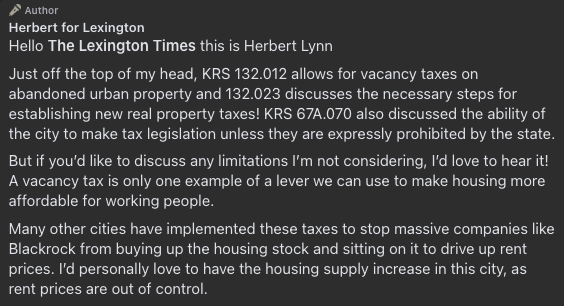
Council at-large candidate Herbert Lynn has floated a “vacancy tax” as a lever to make housing more affordable. And when asked how that would work legally in Kentucky, his campaign pointed to a handful of statutes including KRS 132.012 and KRS 67A.070, suggesting Lexington has the authority.

Here’s the issue: KRS 132.012 isn’t a broad vacancy tax at all. It deals with abandoned urban property — basically a blight tool, not a citywide policy instrument aimed at raising housing supply. In other words, it’s a “stop letting buildings rot” law, not a “stop leaving properties empty” law.
That distinction matters, because what most people hear when they hear “vacancy tax” is a big-city concept: a tax imposed on otherwise habitable housing being intentionally kept empty for long stretches — often associated with high-wealth speculation markets.
That’s simply not the same thing as abandoned property.
So if the campaign’s plan is really just: use the existing abandoned property framework more aggressively, that’s a valid policy discussion. But if the proposal is a broad new vacancy tax, the campaign needs to be honest: that likely requires enabling legislation from Frankfort, not a clever interpretation of city authority.
And that gets to the deeper concern: law matters. Councilmembers don’t just make speeches — they vote, draft ordinances, and defend them. If a candidate’s statutory foundation doesn’t match their policy pitch, it raises questions about readiness.
The “BlackRock” problem: Lexington isn’t Twitter
The campaign’s explanation also leaned on a familiar national villain: “massive companies like BlackRock buying up the housing stock and sitting on it.”
That may play well on social media. It’s also a very shaky claim in Lexington’s actual housing market.
Lexington has a real investor problem — but the best available local reporting suggests the story is not “Wall Street is holding Lexington vacant.” A 2022 Herald-Leader analysis found that investors played a major role in Lexington home sales — but the investors driving the market were not exactly BlackRock hoarding empty houses. (Of the 235 real estate investors who bought five or more properties since 2019, the Herald-Leader found that at least 18 were doctors by trade.)
There’s also a basic supply reality: Lexington isn’t swimming in idle inventory. Our rental market has looked tight (~95% multifamily occupancy, well above national averages) in third-party market reports — the kind of tightness that pushes rents up because there aren’t enough units, not because landlords are letting units sit empty for sport.
And that leads to a fair question the campaign hasn’t really answered yet:
What data shows Lexington has a long-term vacancy problem that is materially driving high rents?
Because without that, a vacancy tax starts to look like a policy imported from cities with a different housing pathology — big-city solutions for a medium-sized city.
There’s also the pass-through issue nobody likes to talk about
Even if you could implement a broad vacancy tax, you’d still have to grapple with the most common outcome of new costs in a tight market:
Landlords pass them on.
A tax doesn’t exist in a vacuum. If vacancy isn’t the real bottleneck, you risk creating a policy that feels satisfying but doesn’t produce new units — and may simply become another upward pressure on rents.
If you want democratic socialist housing policy, start where the math is
Here’s the part where I’ll say something friendly: the values driving this conversation aren’t the problem.
If the goal is affordability for working people, then the most on-brand, high-impact policy lane isn’t “vacancy tax Twitter discourse.”
It’s supply — specifically social housing and public/nonprofit ownership models.
If you’re going to swing, swing at the real barrier:
- build more units
- build permanently affordable units
- use public land and financing tools
- create housing that stays affordable even when the market doesn’t
That’s where democratic socialism becomes more than a vibe and turns into a plan.
The ask
If Herbert Lynn (or any candidate) wants to make housing affordability central to their campaign, here’s a simple standard:
- Show the data — what vacancy rate are you citing, and how are you defining vacancy?
- Match your policy to Kentucky law — and be clear when something requires state action.
- Lead with real solutions — especially those that increase long-term affordable supply, including social housing.
Enthusiasm is great. It’s welcome. It’s needed.
But housing policy isn’t a slogan contest — and Lexington can’t afford to trial-and-error its way through affordability with ideas that sound big and bold but don’t fit the city, the market, or the law.
If a candidate is serious, the good news is: there’s still time to level up the policy.
And honestly, I hope he does.
Republishing: This is original Lexington Times reporting, licensed under Creative Commons CC BY-ND 4.0. You may republish this article, in full and unaltered, for free — including commercially — with credit to The Lexington Times and a link to the original.