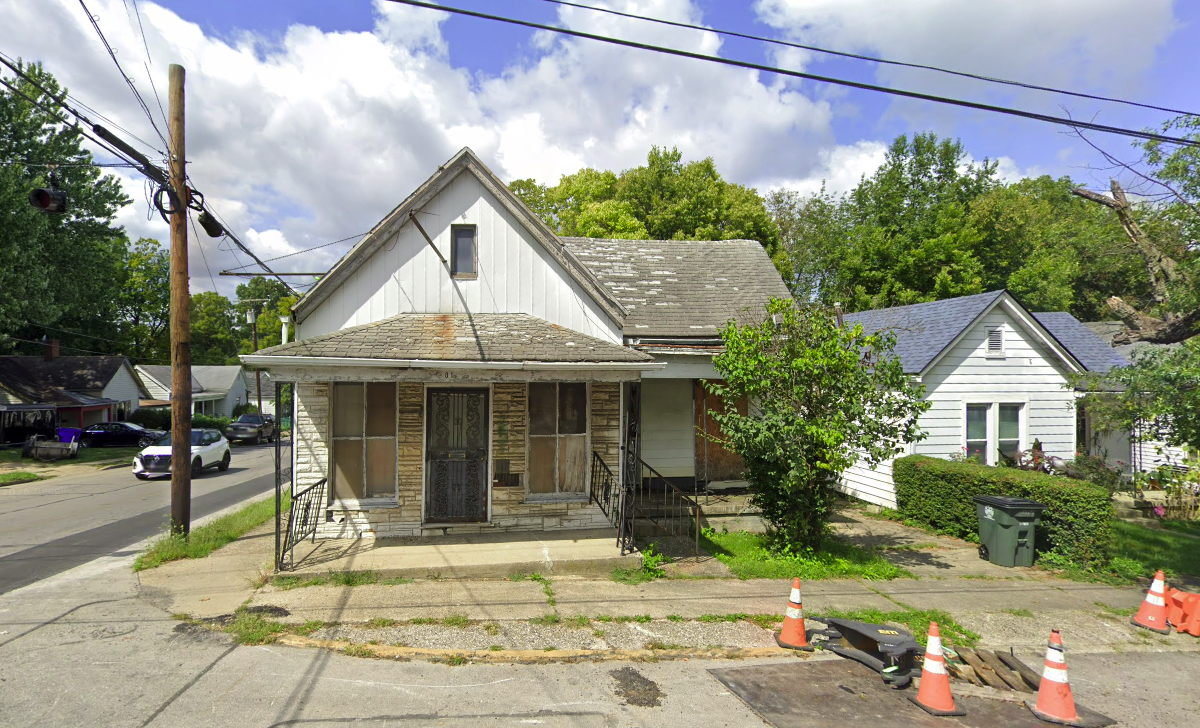
Democratic Socialist candidate for Lexington-Fayette Urban County Council At-Large Herbert Lynn has pitched a new “vacancy tax” on empty housing units as a signature solution to Lexington’s affordability crisis — a proposal he’s promoted while citing housing figures that do not withstand basic scrutiny.
But local experts contacted by The Lexington Times say the city likely does not have the authority under current Kentucky law to implement the kind of vacancy tax Lynn is proposing without significant changes at the state level — and possibly more.
During a recent Reddit “Ask Me Anything,” Lynn claimed Lexington has more than 63,000 vacant housing units, a number he cited as justification for taxing unused housing stock. When asked for a source, Lynn linked to a third-party site, Synergos Technologies, whose data listed Lexington as having roughly 576,000 occupied housing units — a figure that far exceeds not only Lexington’s population but even the total population of the broader Lexington metro area.
Lexington’s population is roughly 330,000. The entire Lexington-Fayette metropolitan statistical area — including Fayette, Bourbon, Clark, Jessamine, Scott and Woodford counties — has a population well under 600,000. A claim that Lexington itself contains more than half a million occupied housing units is not just wrong; it is mathematically impossible.
Still, Lynn’s broader argument — that vacant housing contributes to unaffordability — has gained traction in some cities nationally, where policymakers have debated vacancy taxes as a way to discourage speculative holding and push units back onto the market.
In Kentucky, however, the issue appears less about policy ambition and more about legal authority.
“Local government does not have that authority.”
Susan Straub, communications director for the Office of Mayor Linda Gorton, said Lexington currently lacks the power to create new taxes of that kind.
“Local government does not have that authority,” Straub told The Lexington Times in an email response relaying information from city officials.
Straub said local governments in Kentucky are limited by state law in what taxes they can levy, because local taxing authority is derived from the state.
“Local government’s ability to implement taxes is derived from state authority — local government is limited by state law as to the types of taxes it can levy,” Straub said. “To change the type of taxes we can levy, sometimes a change in state law is required … sometimes a constitutional amendment is required.”
She added that what would be required for a vacancy tax specifically “would depend upon how it is set up.”
The Fayette County Property Valuation Administrator’s office also expressed skepticism about whether existing state law could support such a tax — particularly for habitable property that is vacant but not blighted or abandoned.
David O’Neill, Fayette County’s PVA, said he was not aware of a legal interpretation that would allow a “vacancy tax” under a state statute that allows cities to levy additional taxes on vacant property, without tying it to deterioration or blight conditions.
“I am not aware of an interpretation of KRS 99.7xx that does not involve some aspect of blight, abandonment or deterioration,” O’Neill said.
When asked whether a vacancy tax could be implemented outside that statute, O’Neill said “I assume that would at minimum require a ballot initiative,” but indicated it was likely a question better directed to the city’s legal department.
Kentucky’s limits on local taxation
Under Kentucky law, cities and counties do not have open-ended authority to invent new categories of taxation. Instead, local tax structures are generally created and constrained by state legislation.
That means even if city leaders wanted to adopt a vacancy tax, the question isn’t simply whether a majority of the Urban County Council supports it. The bigger question is whether state law currently gives Lexington the ability to do it at all.
A key legal issue could be how the tax is structured — whether it is treated as a property tax, a fee, or some other kind of assessment — and whether it triggers constitutional or statutory requirements around uniformity, classification, and voter approval.
A signature proposal under scrutiny
Lynn’s campaign has framed the vacancy tax proposal as a way to discourage holding properties off the market and to generate funding for housing initiatives. But the response from officials suggests the policy’s first obstacle is not political will — but whether such a tax can legally exist in Kentucky without state-level changes.
It also places renewed attention on the accuracy of the data being used to justify the idea.
In an emailed statement, Lynn said his campaign has since “contacted policy makers, lawyers, and elected officials” to explore the legal issues surrounding a vacancy tax and received “mixed opinions.” He said his team ultimately concluded that implementing such a tax would likely be a “long fight” requiring action beyond the local level.
“Due to the heavy ties that the Kentucky state legislature has to real estate, they have done everything in their power to limit the self governance of Kentucky’s citizens in respect to making housing more affordable,” he wrote.
“Make no mistake, however; a vacancy tax … is something I am going to work towards,” Lynn continued. “Just because something is difficult to do does not mean it cannot or should not be done.”
Lynn did not initially respond to a question seeking clarification on the data he cited to justify the policy and gauge its potential effectiveness. After follow-up questions, he acknowledged the figure was “incorrect” and said it was drawn from a broader dataset.
For voters, the dispute highlights a deeper question as Lexington enters a hotly contested local election cycle: whether candidates are offering policies that can actually be enacted, or merely signaling populist solutions that may collide with Kentucky’s restrictive approach to local taxation.
This story has been updated to include Herbert Lynn’s response to a follow-up question received after publication.
Republishing: This is original Lexington Times reporting, licensed under Creative Commons CC BY-ND 4.0. You may republish this article, in full and unaltered, for free — including commercially — with credit to The Lexington Times and a link to the original.