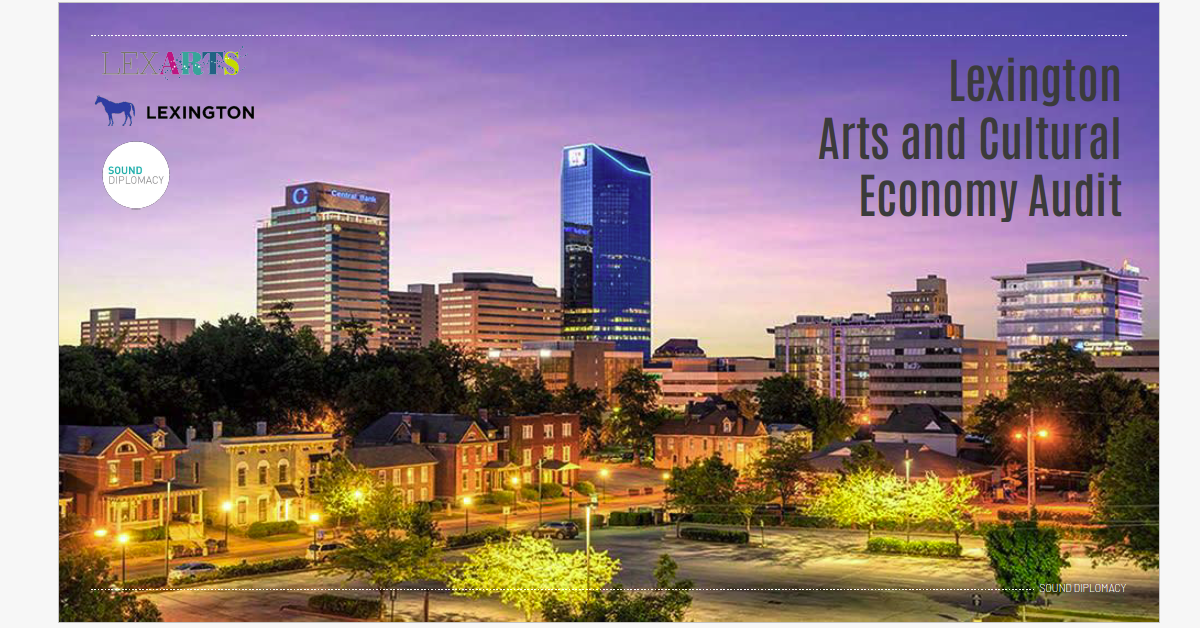
The LexArts audit tells us everything about the value of art in Lexington — and nothing about its meaning.
At Tuesday’s Budget, Finance and Economic Development Committee meeting, Council heard a slick presentation from Sound Diplomacy on their audit of Lexington’s “arts and cultural economy.” The slides were gorgeous. The charts were clean. The multiplier effects were impressive. And the entire thing was spiritually bankrupt.
I don’t say that to be dramatic. I say it because the phrase “arts and cultural economy” should stop us cold, and it doesn’t. We’ve become so fluent in the language of markets that we don’t even flinch when someone tells us a mural’s purpose is to generate $0.62 of “additional output” per dollar. We nod along when performing arts are sliced into “total employment” figures and “gross value added.” We accept, without question, that the proper way to understand a city’s creative life is through the same metrics we’d use to evaluate a logistics hub.
This is the water we swim in, and we are drowning in it.
The audit tells us Lexington’s arts and cultural ecosystem supports 7,080 jobs and produces $1 billion in total output. It tells us audiovisual and interactive media generate $438.9 million, while visual arts and crafts — the painters, the sculptors, the people actually making things with their hands in this city — account for $22.4 million. One sector outvalues the other by a factor of twenty. Does that ratio tell us anything about which matters more to the people who live here? Of course not. But the audit isn’t interested in that question. It can’t be. It has no vocabulary for it.
And that is the deeper problem. Not that the audit is poorly done — it’s competent, professional work. The problem is the frame itself. When you commission an “economic impact assessment” of the arts, you have already decided what counts. You have pre-answered the only question that matters: Why should we care about art? The answer, before a single survey was administered, was: because it makes money.
This should trouble us. It should trouble us that LexArts received $300,000 of public money — itself a one-time COVID recovery allocation — and the deliverable is a document that treats culture as an input to GDP. It should trouble us that the 24 recommendations read like a consultant’s playbook for optimizing any industry: streamline licensing, develop “audience pipelines,” create entrepreneurship programs, host a conference. Swap “arts” for “fintech” and not a single recommendation changes.
There is one passage in the audit’s findings that is more honest than it intends to be. The report notes that Lexington’s arts and cultural GVA fell from $771.8 million in 2017 to $648 million in 2021 — a decline of 16 percent — even as the metro area’s overall GDP grew. Read that again. The broader economy expanded while the arts contracted. The audit presents this as a problem to be solved through better policy. But what if it’s actually the system working exactly as designed? What if the arts shrink precisely because we’ve structured a city around the things that generate higher returns? When land goes to the highest bidder, studios become condos. When public investment requires an ROI justification, a children’s theater will always lose to a parking garage. The audit doesn’t cause this dynamic — but it ratifies it. It says: your art matters, and here is the exchange rate.
Consider what’s missing from the presentation. There is no accounting of how many artists left Lexington last year, or why. There is no measure of how many people in this city have access to a creative life outside of consumption — not attending a show, but making something. There is no reckoning with the fact that “cultural education” as a sector employs just 184 people across the entire metro. There is nothing about the interior experience of making art in a city that increasingly treats you as a line item.
The audit recommends creating a “database of Lexington arts stakeholders.” Stakeholders. Not artists, not dreamers, not the woman who teaches guitar out of her living room on Versailles Road and has never applied for a grant in her life. Stakeholders. The word tells you everything about who this document was written for and what it thinks people are.
I’m not naïve. I understand that in order to advocate for public funding, you need to speak the language of public budgets. I understand the political utility of walking into a council meeting and saying “this sector produces a billion dollars.” I’ve made that argument myself. But we should be honest about the cost of that framing. Every time we justify art on economic grounds, we concede that art which can’t be justified on economic grounds doesn’t deserve to exist. We accept the premise that a city’s relationship to its culture is fundamentally a business transaction. And we make it a little bit harder to articulate the real reasons art matters — reasons that have nothing to do with multiplier effects and everything to do with what kind of place this is to be alive in.
The most revealing detail from Tuesday’s meeting may be the venue itself: the Budget, Finance and Economic Development Committee. Not a committee on community life, or public wellbeing, or the kind of city we want to be. Budget and finance. That’s where we discuss art now. Between the line items and the revenue projections. Right where it belongs, apparently.
Lexington deserves better than a masterplan that knows the cost of everything. What we need — what no consultant can sell us — is the collective courage to say that some things matter whether or not they pay for themselves. That a city with a living culture is not the same as a city with a profitable creative sector. That the question isn’t how much our art is worth, but whether we’ve become the kind of place that can’t imagine asking for it any other way.