🌎 Resumen en español · traducción automática
El artículo cuenta la historia del hipódromo Kentucky Association, que funcionó durante 107 años en Fifth Street y Race Street en Lexington antes de cerrar en 1935, siendo reemplazado por Keeneland en 1936. El cierre del histórico circuito de una milla de tierra marcó el fin de una era fundamental para la identidad de Lexington como la capital mundial del caballo de carreras, dejando solo un terreno vacío donde se construiría un proyecto de vivienda federal. El periódico Lexington Leader documentó el cierre con una elegía que describía el silencio que envolvió al antiguo hipódromo, símbolo del fin de un siglo de tradición hípica que había definido a la ciudad.
Traducción y resumen generados por IA a partir del artículo en inglés. Puede contener errores; consulte el texto original.
Editor’s note: Every October, tens of thousands of people drive out the Versailles Pike to Keeneland and file through a set of stone gates that look as though they’ve stood there since the beginning of thoroughbred time. They haven’t. Keeneland opened in 1936 — young, as Lexington racing goes. For the 107 years before it, the horses ran somewhere else: on a one-mile dirt oval at the east end of Fifth Street, hard against Race Street, in a neighborhood most Lexingtonians now know for a housing project that isn’t there anymore either. This is the story of the track Keeneland replaced — the Kentucky Association course — told, as much as possible, in the words of the Lexington papers that watched it live and die. Every newspaper quoted below is in the public domain.
Silence on Race Street
In the first days of 1936, the turf writer Brownie Leach walked out to the old Kentucky Association track for the Lexington Leader and wrote what amounts to an obituary:
“Silence envelops Lexington’s old Kentucky Association track. There are no trainers gathered around a red-hot stove discussing bright two-year-old prospects in their respective barns. Nor are there any grooms shaking down the old stalls and arguing over potential Derby winners. No more will thoroughbreds prove their mettle by taking that hill off the backside or throw muddy water over the rail as they splash through the sand training track. Spring will return to the old racetrack, but the customary railbirds won’t be there to sun themselves along the backstretch. Nor will there be any horses to train over the course. When spring returns the carpenters’ hammers will replace the pounding of horses’ hoofs. The old racetrack is only a memory. It passed from existence in 1935.”
On the cleared ground, Leach noted, “is to rise a model housing project, one of the many planned by the federal government.” A century of Lexington’s identity — the thing that made this town this town — had been “stripped of all that distinguished it as a racetrack.”
To understand why a grown newspaperman would eulogize an empty field, you have to understand what had stood there.
The oldest game in town
Lexingtonians were racing horses before Lexington was quite a town. The contests started, literally, in the streets — down the middle of Main — until the trustees decided that galloping thoroughbreds and pedestrians were a poor mix. By order of the Town Trustees in 1787, racing was pushed off Main and onto “the Commons,” the open ground that is now Water Street.
From those street heats grew the Lexington Jockey Club, which ran the sport from about 1809 into the 1820s. Its members read like a founding-family roll call: Dr. Elisha Warfield — who would breed the immortal sire Lexington, the horse that dominated American bloodlines for a generation — along with Capt. Jack Fowler, Col. A. Buford, and a young lawyer named Henry Clay, whose passion for the turf was as famous in the Bluegrass as his speeches were in Washington.
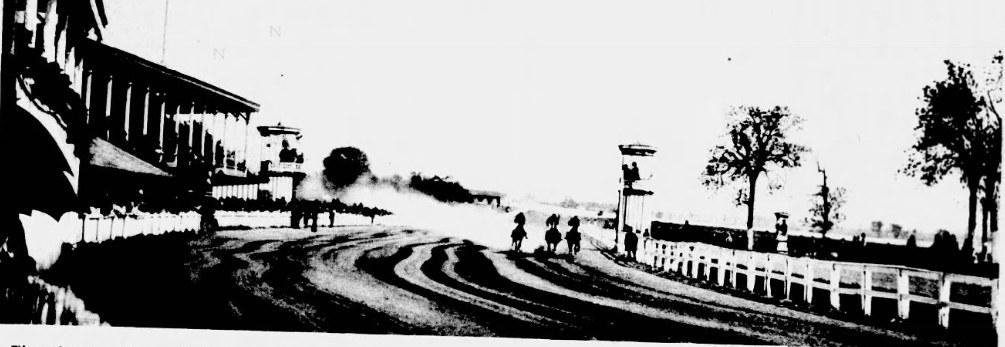
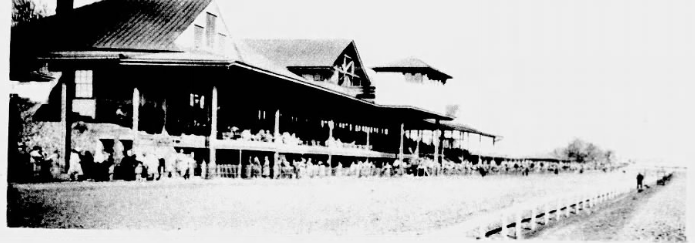
On July 23, 1826, that loose enthusiasm hardened into an institution. A group of horsemen — Clay among them, alongside Jesse Bledsoe, Dr. Warfield, and Thomas F. Marshall — organized the Kentucky Association to promote the breeding and racing of thoroughbreds. Over the next several years the Association bought 65 acres at the east end of Fifth Street and, in 1828, laid out a one-mile course with a grandstand and stables: the Lexington Race Course. Writing as it came down, the Leader would call it the place where “turf history was written for 107 years.”
Where the legends started
The list of firsts that happened on that oval is staggering.
In 1831 the track ran the first Phoenix Stakes — named for the Phoenix Hotel downtown, which traced its own lineage to Postlethwait’s Tavern, where Lexington’s first jockey club had been organized. That race is still contested at Keeneland today, which makes it the oldest stakes race in America.
In 1876, a Lexington-born teenager named Isaac Burns Murphy won here early in a career that would make him the greatest jockey of the nineteenth century — three Kentucky Derby wins, a lifetime record so good it strains belief, and a place among the most celebrated Black athletes in America before Jim Crow shoved men like him out of the saddle. In 1898, another Black Lexington jockey, Jimmy Winkfield — the last of his race to win the Kentucky Derby — got his start on the same track.
It is worth sitting with that, because the same 1936 photo feature that lovingly reproduced the track’s oldest pictures also noted, without comment, that “at the left where the clubhouse later stood was the Negroes’ section.” The ground that launched Isaac Murphy and Jimmy Winkfield seated their neighbors in a Jim Crow grandstand. Hold onto that; the story comes back around to it.
By the new century the Kentucky Association had settled into its role as a beating heart of the American breeding industry. The Breeders’ Futurity, inaugurated in 1910, drew 749 nominations in its first year; the Blue Grass Stakes followed in 1911. Both races, like the Phoenix, would eventually be inherited by Keeneland.
The place was old enough by then to carry its own folklore. The trees that once stood in the infield, one caption recalled, “were cut down to make gun stocks during the Spanish-American War.” This was a working track in a working neighborhood, and it wore its century hard.
A long, slow slide
Institutions this beloved rarely die of one clean blow. The Kentucky Association died of a dozen.
The first came in 1890, when financial trouble forced the original owners to sell. The Panic of 1893 hammered what was left, and on March 18, 1897, the track was put up at a foreclosure sale. In 1901 a St. Louis man named Charles Green bought the whole plant for one dollar “and other considerations” — the price a thing fetches when nobody’s sure it’s worth anything. A major fire in April 1906 tore through the surrounding block and destroyed eighteen homes. Reform movements periodically threatened to outlaw the betting that paid the bills.
The track hung on — through the 1910s, through a 1918–19 reorganization that folded it and three other Kentucky courses under the Kentucky Jockey Club — but by the early 1930s it was a century-old wooden plant in the middle of a Depression, and everyone could see it.
In February 1933 the Lexington Herald devoted a full page to the track under the headline “Century-Old Kentucky Association Track Holds Important Place in History of Turf.” It was the kind of retrospective a paper runs about the living — but the tone was already valedictory, walking readers back through Postlethwait’s Tavern and the 1787 Commons proclamation as if closing an account.
The spring meeting of 1933 opened on April 8. It would be the last. When the final card was run around April 22, the Herald-Leader noted that the meet’s largest crowd had turned out for closing day — a full house come to watch a track that none of them yet knew was finished. The Kentucky Association never held another meeting. Two years later, the grandstand where Isaac Murphy first won came down. A newspaper photographer caught the workmen “razing the old plant as it passed from existence.”
The housing project on the homestretch
What rose in its place says as much about Lexington as the track ever did.
The 65 acres at Fifth and Race became Bluegrass-Aspendale, the city’s first venture into public housing, built out in stages between 1936 and 1951. For a while it was a New Deal promise. Over the decades that followed it became something closer to the opposite — one of the most concentrated pockets of segregated poverty in the city, the kind of place the redlining maps this publication has written about drew their hardest lines around. The homestretch where Black jockeys had made history — and where their neighbors had been seated in a Jim Crow grandstand — became a Black housing project the city spent sixty years first building and then trying to undo.
Bluegrass-Aspendale was finally demolished in the 2000s and rebuilt as a mixed-income subdivision. Its developers named it, with either great tact or none at all, Equestrian View.
The gamble on the Versailles Pike
But a city does not become the Horse Capital of the World and then simply stop having a racetrack. In the two years the old plant sat dark, a group of horsemen decided Lexington would have a course again — and that this time it would be built to outlast them.
They organized as the Keeneland Association, and from the start it was a strange animal: a non-profit racetrack, chartered in 1935, run not to enrich owners but to hold racing “worthy of Kentucky.” The men behind it were the aristocracy of the Bluegrass turf — Hal Price Headley, its first president, and Major Louis “Louie” Beard, its guiding hand. They found their ground on the Versailles Pike, at the farm of John Oliver “Jack” Keene, an eccentric horseman who had spent years building his own private stone racetrack and clubhouse and never quite finishing it. That August, Keene sold the association roughly 148 acres for $130,000 — well under what the land was worth, his contribution to the cause.
On the morning of the 1935 Kentucky Derby, the new association threw a breakfast on the property for four to five hundred people, arranged by the Thoroughbred Club of America so the Bluegrass could come look at what was coming. The speaker was former Governor Edwin P. Morrow — the same governor who, fifteen years earlier, had sent the National Guard to a Lexington courthouse to stop a lynching. As the Herald-Leader reported it, Morrow told the crowd to
“Build a racetrack here worthy of Kentucky, one which will express the fine things in thoroughbred racing and sportsmen and which will keep Kentucky’s tradition alive.”
There were, he added, “one thousand reasons why a racing plant should be built here, and not one good reason why it should not” — a Depression joke about money that everyone under the tent understood.
“The cradle of the thoroughbred industry”
Keeneland opened on October 15, 1936. The inaugural race went to a colt named Royal Raiment, with Johnny Gilbert in the saddle; the featured Keen Handicap went to Myrtlewood, Brownell Combs’ brilliant filly, who ran six furlongs in 1:10 4/5. The Herald‘s front page the next morning ran the whole two-year ache of the thing across the top: “Scenes as Thoroughbred Racing Returned to Lexington.”
Its writer, Neville Dunn, reached for the grand register and mostly earned it:
“Keeneland, the monumental contribution of a horse-loving community to the King of Sports, threw open its gates yesterday afternoon and eight thousand persons, dressed in the height of fashion, happy in the return of racing to the city that has been the cradle of the thoroughbred industry of America for more than a hundred years, celebrated the event.”
He caught, too, the odd hush of a crowd getting exactly what it had wished for. As the first field jogged onto the track, “a hush swept over the crowd. Men and women who had been carrying on a noisy hum of conversation a moment before held their breath.”
The non-profit, as it turned out, was almost too non-profit: Keeneland famously closed its first year of operation with a net loss of $3.47. It has not had that problem since.
And the old track was not entirely abandoned to the wrecking crews. When Keeneland built its own entrance, it copied the design of the Kentucky Association’s gates — so that the crowds streaming in off the Versailles Pike each spring and fall pass, without knowing it, through a memory of a place on Race Street most of them have never heard of.
Two tracks
Lexington keeps two racetracks in its memory, though it only visits one.
There is Keeneland — green, immaculate, eternal-seeming, the one on the postcards. And there is the Kentucky Association course, where a Lexington kid named Isaac Murphy first crossed a finish line in front, where America’s oldest stakes race was born, and where, in the end, the grandstand came down and a housing project went up and then that came down too. One track we chose to remember. The other we paved, and renamed, and paved again.
The horses still run every October. It’s worth knowing, as you pass through the gates, whose gates they really are.
Sources
- Lexington Leader, “Famous Racing Course Passes / Pictorial History of Old Kentucky Association Track,” by Brownie Leach, Jan. 12, 1936 (public domain)
- The Lexington Herald, Keeneland opening-day coverage by Neville Dunn, Oct. 16, 1936 (public domain)
- Lexington Herald-Leader, “Crowd Drawn to Breakfast at Keeneland,” May 3, 1935 (public domain)
- The Lexington Herald, “Century-Old Kentucky Association Track Holds Important Place in History of Turf,” Feb. 23, 1933 (public domain)
- Kentucky Association (racetrack) — Wikipedia
- Keeneland — ExploreKYHistory (Kentucky Historical Society)
- Keeneland, Part 1 — Lexington History Museum
- “Goodbye Bluegrass Aspendale, Hello Equestrian View” — WUKY, June 11, 2010
- “Redlining, history, and the anatomy of inequality in Lexington, Ky” — The Lexington Times, 2022
This history was researched and drafted with AI assistance (Claude Opus 4.8), built from public-domain Lexington newspapers, and finalized for publication by The Lexington Times. Every direct newspaper quotation was verified against the original page images.
Republishing: This is original Lexington Times reporting, licensed under Creative Commons CC BY-ND 4.0. You may republish this article, in full and unaltered, for free — including commercially — with credit to The Lexington Times and a link to the original.