LEXINGTON, Ky. — A proposed resort-style hotel and entertainment complex at the Red Mile drew a postponement from Lexington’s Technical Review Committee after staff flagged concerns that the project’s commercial square footage exceeds what the zoning ordinance allows before mixed-use components are built.
The Red Mile mixed-use development, planned for 101 Windback Way, would add a six-story hotel, a four-story entertainment and concert building, and revised uses for several existing structures on the historic horse racing property. But the plan ran afoul of a provision in the zoning ordinance that caps commercial development at 40 percent of the total proposed until a mixed-use component is constructed. Staff recommended postponement, citing “questions regarding the proposed square footage of the hotel entertainment addition exceeding the allowable square footage.”
The applicant told the committee he would resubmit revised site statistics, acknowledging the need to adjust building specifications to comply with the timing restrictions. He also disclosed that Red Mile Road will eventually be widened to Burchelles Road, calling it “major improvements along Red Mile,” and noted the hotel would be tied to the property’s casino operations. Staff also raised environmental concerns, including identified springs, sinkhole areas, and the need for a geotechnical review before building permits could be issued. A 51-inch American elm proposed for removal prompted a request for a detailed mitigation plan.
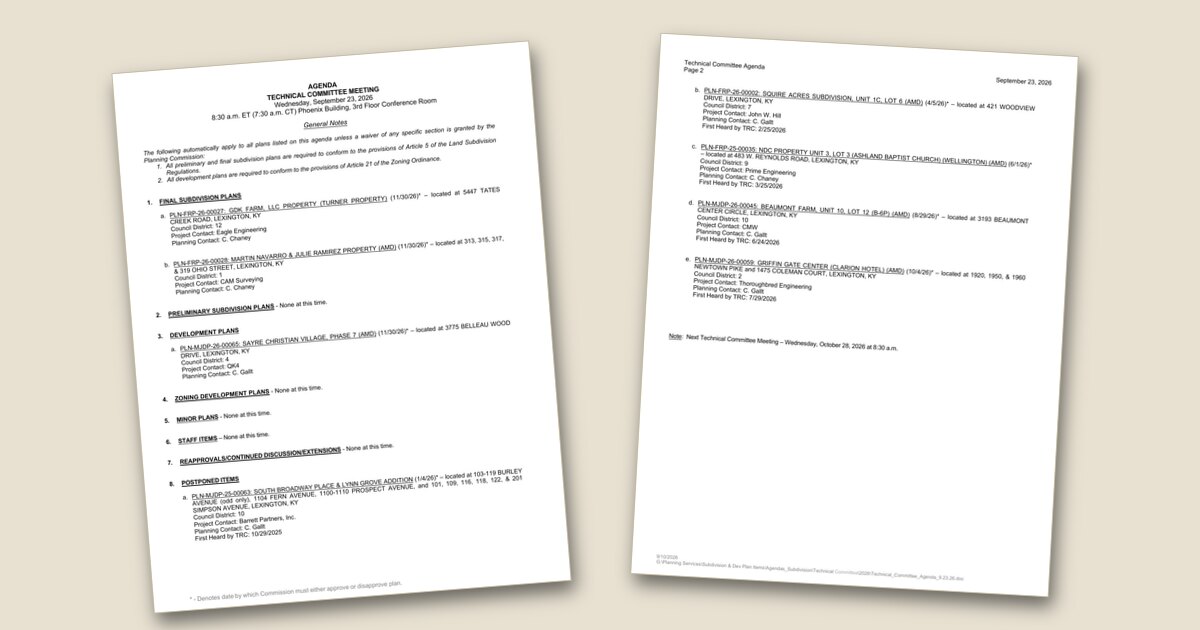
The committee moved through more than a dozen subdivision plats and development plans during the meeting, approving the majority with conditions while postponing several others for additional review.
A 12-unit multifamily building planned for 245 Stone Avenue in the Lindhurst Place neighborhood won approval with conditions. Greg Smorstad of Banks Engineering told the committee the Board of Adjustment had already granted a variance for the required landscape buffer between the residential and commercial zones. The project drew discussion about pedestrian access to Hagerman Court, where a retaining wall ranging from two to six feet in height complicates a direct sidewalk connection. Staff advised the applicant to redesign the building’s main entrance to be ADA-compliant, which could resolve multiple access requirements simultaneously. The building will house 12 single-occupancy units, and the question of whether waste management would require a dumpster enclosure instead of individual roll carts remained unresolved, with staff noting that “seven or more units, they’re gonna push for a dumpster.”
In the Chevy Chase neighborhood, the committee approved with conditions a plan to subdivide a lot at Ashland Terrace and Marquis Avenue into two parcels. Staff added a new requirement that a sidewalk be constructed along Marquis Avenue or that the applicant seek a waiver, a point the absent applicant will need to address. The property’s surveyor, John Hill, was unable to attend due to a medical emergency.
An apartment development proposed for Bryant Road near Man O’War Boulevard received split treatment. The committee approved the final record plat dedicating an existing access easement as a public street, with the applicant, Matt Carter of Vision Engineering, confirming it “was designed to public standards and built to public standards.” However, the accompanying development plan for more than 100 apartment units was postponed. Staff determined the plan must be reclassified from a final to a preliminary development plan because the previous preliminary approval expired more than two years ago. The ordinance was recently amended to require Planning Commission review of lapsed preliminary plans, staff noted, because “we have preliminary development plans out there from 20, 30 years ago” and “things have changed since then.”
A similar reclassification issue confronted a parking lot expansion at 2400–2401 Great Stone Point in the Beaumont area. The applicant, Fred Eastridge of Vision Engineering, told the committee he was “under a tight time crunch” to have the lot built by the end of June but learned the plan must go through Planning Commission review as a preliminary. Staff said the requirement had been in the ordinance for decades but was recently reinforced with new language.
The committee also postponed a proposed residential and commercial development at 150–151 Locust Point Way and 114 Mount Tabor Road after staff raised concerns about the applicant’s plan to build parking, gates, and other improvements within an undeveloped but dedicated public right-of-way for Locust Point Way. Staff told the applicant to “show how you can comply” without assuming the right-of-way will be abandoned, noting that “you’re showing improvements in a right-of-way” and “what you’re showing doesn’t meet the law.” Questions also arose about whether breezeways connecting multiple buildings would cause the project to exceed maximum allowable building square footage.
Among the plans approved with conditions, a new retail building proposed for the former Kroger site in the Beaumont shopping center at Harrodsburg Road and New Circle Road moved forward, as did a revised plan for a Wendy’s restaurant at the corner of Man O’War Boulevard and Harrodsburg Road, which had changed its design after reaching building inspection. An industrial development at 2020 Duncan Machinery Drive near Old Frankfort Pike also won approval, though it must add sidewalks along its road frontage — part of the city’s incremental approach to building pedestrian infrastructure on streets that currently lack it.
A workforce and affordable housing subdivision at Gulf View Estates also advanced. The property, zoned R1C, is being developed under a provision allowing higher-density R1T standards in exchange for a recorded covenant requiring affordability through November 2040.
The Calgill Partners development at 2550 Winchester Road near Interstate 75 was postponed, with a waiver needed for timing requirements on supportive commercial uses. The applicant said private street designations had been finalized and infrastructure plats were moving through engineering.
Plans approved with conditions must obtain a series of staff sign-offs from divisions including engineering, traffic, water quality, and the urban forester before they can be certified and recorded. Postponed plans will return to the committee after applicants address outstanding deficiencies. Several items are expected before the Planning Commission’s subdivision committee as soon as next week, with Planning Commission hearings anticipated in March.