The word is everywhere — hurled as an insult, invoked as a warning, debated by scholars who can’t agree on its meaning. But tracing fascism to its roots reveals patterns that are harder to dismiss than any definition.
You hear it everywhere now. On cable news, in congressional speeches, in arguments at Thanksgiving dinner. Fascism. The word has become so overused that it has almost lost its meaning — a political swear word, a rhetorical grenade lobbed at anyone whose politics you find threatening. But lately, the word is being used differently. Not as a lazy insult, but as a serious historical claim. Experts, historians, and scholars who have spent their careers studying the darkest chapters of the 20th century are issuing warnings: they believe the patterns are returning.
Are they right?
Answering that question requires more than opinion. It requires going back to the source — to the origins of fascism itself, to the specific conditions that created it, and to the frighteningly methodical steps by which it seized power. Only then can anyone honestly evaluate whether what we see today is the real thing, a cousin of it, or something else entirely.
The World After the War
To understand fascism, you have to understand the soil it grew from. Before the First World War, Europe was an age of extraordinary technological achievement — trains, automobiles, new industrial machines were rewriting the rules of daily life faster than societies could absorb. The era promised everything. Then it threatened to destroy everything.
The Great War, from 1914 to 1918, killed millions in a manner no one had previously imagined. Machine guns, aerial bombardment, and trench warfare introduced industrialized slaughter on a scale that left entire nations in psychological shock. When the guns finally fell silent, the survivors returned to ruined economies and broken political systems.
Italy had fought on the winning side, but its allies had promised territorial gains that never materialized. Italians spoke bitterly of a “mutilated victory.” Germany had it far worse. The nation lost over two million soldiers and half a million civilians, ceded 13 percent of its territory, and was buried under war reparations that, adjusted for inflation, amounted to roughly half a trillion dollars — a debt the country only finished paying off within the last few years. The German currency lost virtually all of its value. People carted wheelbarrows of cash to buy bread.
Both countries, along with much of Europe, found themselves at a fork in the road. Their fragile democracies — Italy had a parliament alongside its monarchy, Germany had voting rights including women’s suffrage — were in crisis. People began to wonder whether the entire system needed to be replaced.
One answer was communism. The Russian Revolution of 1917 had inspired workers and peasants across Europe to believe they could seize land and industry from the elites. Communist parties were growing. Strikes and factory occupations were spreading. But communism was not the only revolutionary idea on offer. In Italy, another vision was taking shape — one that would give the world a new and terrible word.
The Birth of Fascism
Benito Mussolini is the reason the word “fascism” exists at all. Before the war, he had been a rising star in Italian socialism, editing a major socialist newspaper and advocating for workers’ rights. But when World War I began, he broke with the socialist movement over a fundamental disagreement: he believed Italy should enter the war; the socialists were firmly anti-war. They expelled him. And from that rupture, everything followed.
Mussolini pivoted hard. He started a pro-war nationalist newspaper emphasizing pride, sacrifice, and the supremacy of the nation over class struggle. He enlisted and fought in the trenches. He came home wounded and radicalized.
In the spring of 1919, barely a year after the armistice, Mussolini gathered a small group of fellow ex-soldiers in Milan. Many of them felt humiliated, angry, and looking for someone to blame. He told them that Italy’s problems ran deeper than the war’s bad peace deal — that the country was being poisoned from within by communism, socialism, and the weakness of democracy itself. Liberal governance, he declared, had “gone drunk with compromise.” It couldn’t get anything done.
His solution was radical. Italy, he argued, must be ruled by men who had been forged in the trenches — a new elite created not by birthright but by combat. He called this vision a “trenchocracy,” the aristocracy of the trenches. And he adopted a symbol for it: the fascio, an ancient Roman emblem of a bundle of sticks bound together around an axe. A single stick breaks easily. A bundle becomes unbreakable. Add an axe, and you have a weapon of punishment. Italians, Mussolini declared, must become that bundle.
Fascismo. Fascism. The word itself is essentially an accident of branding. If someone else had started this movement first and chosen a different logo, we would probably call the whole phenomenon something different today.
At its root, then, fascism began as an ultranationalist movement founded by war veterans, set on restoring Italy’s greatness and glorifying violence as the sacred instrument for getting there. As one scholar of the period put it, fascism always involved the militarization of politics — violence presented as what makes men men.
The Blackshirts and the Playbook
What Mussolini did next established a template that would be repeated almost exactly in Germany a decade later.
He turned his club into a weapon. His followers began hunting down socialists and communists — smashing their printing presses, breaking up their meetings, beating their leaders. These violent squads, known as squadristi and eventually called the Blackshirts, swelled to a quarter million members. They raided and burned the headquarters of left-wing movements. They murdered socialist party members. They even destroyed the office of the socialist newspaper Mussolini himself had once edited.
Contemporary accounts from the period read like a catalog of terror: fascists arriving in trucks to attack workers’ clubs and set them on fire; fascists stabbing cafe employees; fascists beating doctors, lawyers, and even a ten-year-old child caught singing a socialist anthem.
How did they get away with it? Italy’s democratic government was divided and weak. But more importantly, the people who actually held power in the country — the wealthy landowners and industrialists — were quietly supportive. They feared communism far more than they feared Mussolini. Communist movements threatened to seize their wealth and redistribute it to workers. The Blackshirts, whatever their excesses, were useful. Business elites began funding them outright, even hiring them to break strikes and intimidate workers. As the scholar William I. Robinson of UC Santa Barbara has argued, one of fascism’s first missions was always to crush anti-capitalist resistance from below.
The police and the army, meanwhile, were riddled with fascist sympathizers. The violence continued largely unchecked.
Then came the critical turning point. Italy’s centrist prime minister, faced with growing socialist representation in parliament, decided to invite Mussolini’s fascists into his governing coalition. The reasoning was familiar: bring the radicals inside the system, and you can tame them. As historian Federico Finchelstein has observed, the establishment believed they could control the fascists because they saw them as vulgar, narcissistic, and ignorant. They were wrong.
Mussolini was now a legitimate politician. His movement had been accepted — first by the economic elites, then by the political mainstream. This acceptance, this legitimization, is one of the most important and repeatable steps in the fascist path to power.
From there, things accelerated. The governing coalition collapsed. Mussolini directed tens of thousands of Blackshirts to march on Rome. Italy’s king, suspecting much of his own army sympathized with the fascists, chose not to resist. He invited Mussolini to become prime minister.
Once in power, Mussolini initially promised to respect the constitution. Over the next four years, he demolished it. His Blackshirts intimidated voters and suppressed opposition. He censored the press, created a secret police, abolished all other political parties, and finally abolished elections themselves. By 1925, Italy was a one-party dictatorship under a single charismatic leader who demanded total submission to the state and its founding myth: that Italy was a superior civilization, heir to the Roman Empire, humiliated by enemies foreign and domestic, and now reborn under his iron hand.
Hitler’s Imitation — and Escalation
Adolf Hitler was watching all of this very closely.
Germany after World War I was in even worse shape than Italy. Once one of the most advanced economies on Earth, the country was now devastated — militarily, politically, and economically. Millions were looking for answers. Many were drawn to communism. But many others, particularly humiliated war veterans, were drawn to a different kind of story.
That story was built on a fantasy of racial superiority. For decades, a strain of pseudo-scientific thinking had been percolating through German intellectual life, twisting legitimate discoveries in linguistics — the finding that many world languages share a common ancestor, labeled “Aryan” after an Indo-Iranian cultural group — into a myth of racial purity. Some Germans began to imagine that “Aryan” was not a language family but a master race, one that had originated in Northern Europe and from which all great civilizations had descended. This idea had no basis in real science, but it was intoxicating for a wounded nation looking for an explanation of how their great civilization had ended up on its knees.
Enter Hitler: a 30-year-old war veteran who joined one of Germany’s many small, fringe nationalist groups after the war. He rose to lead it, rebranded it — calling it the National Socialist German Workers’ Party, a name deliberately designed to attract working-class voters even though the party’s ideology had nothing genuinely socialist about it — and built a paramilitary wing, the Brownshirts, modeled directly on Mussolini’s Blackshirts. He adopted the swastika, an ancient symbol repurposed as an emblem of the fictional Aryan past, and set his gangs loose on communists, socialists, and above all, Jewish people, who became the ultimate scapegoats for every problem Germany faced.
In 1923, inspired by Mussolini’s March on Rome, Hitler attempted a coup — the infamous Beer Hall Putsch in Munich. It failed spectacularly. He was arrested and imprisoned.
But prison proved to be a turning point. Hitler spent his time writing Mein Kampf, a book that was part autobiography, part racial manifesto, and part political strategy document. In it, he diagnosed his own mistake: he had tried to seize power through force alone, without first gaining the mainstream acceptance that Mussolini had cultivated from business elites and the political establishment. Violence by itself was not enough. Democracy would have to be used as a vehicle — infiltrated, exploited, and then destroyed from within.
When he got out of jail in late 1924, that is exactly what he set out to do.
He rebuilt the Nazi Party as a legitimate political machine. His first electoral attempt, in 1928, was a flop. Then the global financial crash of 1929 hit, and Germany — already struggling — was devastated worse than almost any other nation. Unemployment soared to one in three. Hitler’s message of national humiliation, racial betrayal, and promised rebirth found a massive new audience among desperate people. Nazi vote totals surged in the 1930 elections, then again in 1932, when the party received more votes than any other.
And just as in Italy, the establishment made its fatal miscalculation. Germany’s political and economic elites, terrified of rising communist influence and convinced they could manage Hitler, invited him to become chancellor in January 1933. They would impose restrictions, they assured themselves. He would govern within the framework of the constitution.
Less than a month later, someone set fire to the Reichstag, Germany’s parliament building. The suspect found at the scene was a communist. Hitler used the crisis to declare a state of emergency, suspending the constitution and all basic rights — freedom of expression, freedom of the press, protections from unreasonable search and seizure. Within months, he abolished all other political parties. By 1934, he held absolute power.
The racial fantasies that had once been the obsession of fringe groups became official state policy. Hitler launched a systematic purge of anyone deemed an enemy of the nation — communists, socialists, Roma, disabled people, queer people, and above all, Jewish people, who were stripped of citizenship in 1935 and subjected to organized mass violence by 1938. In November of that year, Nazi gangs destroyed hundreds of synagogues and thousands of Jewish businesses, arrested 30,000 Jewish men, and sent them to camps. World War II had not yet started.
When it did, the industrialized horror that followed — the murder of approximately six million Jews and millions of others in the Holocaust — represented the endpoint of the fascist logic: a nation convinced of its own racial purity, led by a single unchallenged leader, mobilized for war and genocide.
The Pattern
Step back from the specific histories of Mussolini and Hitler, and a strikingly consistent pattern emerges — a kind of operational playbook for how fascism works.
Both men started with small groups that glorified violence against political enemies. Both created narratives built on a mythologized past and blamed their enemies for the loss of that mythical golden age. Both promised national rebirth under the leadership of a single charismatic strongman. Both were eventually welcomed into mainstream democratic systems by establishment elites who thought they could be controlled — elites who feared left-wing movements more than they feared the fascists. Both used democracy as a vehicle to gain power, openly despising it even as they participated in it. And once in power, both dismantled democracy from the inside, eliminating free press, opposition parties, independent courts, and elections themselves — replacing them with a propaganda-saturated, leader-worship state that they then aimed outward in wars of conquest.
These patterns are not a definitive checklist. There is no single agreed-upon definition of fascism, and scholars have been arguing about where to draw the line for decades. Historian Ian Kershaw once wrote that defining fascism is like trying to nail jelly to a wall. But the patterns are real, and they are recognizable.
The Experts Disagree
The most important — and most uncomfortable — question is whether those patterns are active today. The honest answer is that the world’s leading experts on fascism don’t agree.
Federico Finchelstein, a historian of fascism, populism, and dictatorships at The New School for Social Research, argues that what we see today is not yet fascism — but it’s close. His key criterion is the destruction of democracy itself. Fascism, he insists, cannot exist without dictatorship. Today’s nationalist strongman leaders still operate within some form of democratic system, however distorted. Until they call for the abolition of voting and constitutions entirely, they remain what Finchelstein has called “wannabe fascists” — leaders who have followed some of the interwar playbook but haven’t gone all the way. Yet.
Roger Griffin, an emeritus professor at Oxford Brookes University and one of the world’s foremost scholars on fascism — who defined the ideology’s core as “palingenetic ultranationalism,” a revolutionary myth of national rebirth from perceived decay — goes further. He argues that the F-word is actually unhelpful for understanding today’s threats. What we are seeing, he believes, is not the return of fascism but the rise of something he calls “illiberal democracy” — systems that maintain the formal architecture of democracy (parliaments, elections, constitutions) while systematically stripping away the liberal features (individual rights, equal protection under law, independent courts, free press) that make democracy meaningful. Getting fixated on fascism, Griffin warns, takes our eyes off this newer, in some ways more insidious phenomenon.
On the other side, scholars like William I. Robinson of UC Santa Barbara argue that insisting on a perfect match with 1930s conditions is itself the problem. Robinson contends that the most important feature of fascism is not the final endpoint of dictatorship but rather a specific alliance: an ultranationalist movement accepted and enabled by economic elites, joined with a receptive, suffering mass population. When that triangulation forms, the fascist project is underway — regardless of whether it has completed the full journey to dictatorship yet.
Timothy Snyder, the historian and author of On Tyranny, focuses on the narrative dimension. For Snyder, fascism begins when politics stops being about the future and becomes about a mythic story of a glorious past — a humiliated nation, enemies blamed for its decline, and a leader who promises rebirth. The specifics of the 1930s matter less than the underlying storytelling structure: if we could just get the enemy out of our country, there would be harmony, love, prosperity. Conflict was always brought by the outsider.
And then there is the framework offered by the late Italian philosopher and novelist Umberto Eco, who grew up under Mussolini’s regime and wrote an influential 1995 essay identifying 14 features of what he called “Ur-Fascism” — eternal fascism. His list included the cult of tradition, rejection of modernism, action for action’s sake, disagreement as treason, fear of difference, appeal to a frustrated middle class, obsession with a conspiracy plot, and the impoverishment of language to limit critical reasoning. Eco argued that these features don’t need to form a coherent system; they often contradict each other. But, he warned, it is enough for just one of them to be present for fascism to begin coagulating around it.
Jason Stanley, a philosopher now at the University of Toronto and author of How Fascism Works, has been among the most direct voices in applying the label to contemporary politics. He has described fascist politics as a set of tactics — “us vs. them” division, propaganda, anti-intellectualism, victimhood narratives, hierarchy — that can operate within a democracy long before that democracy formally collapses.
The scholar Robert Paxton, author of The Anatomy of Fascism and one of the most cited authorities on the subject, initially resisted applying the fascist label to contemporary politics. He later changed his position, concluding that certain events — particularly the violent attempt to overturn an election — bore enough resemblance to Mussolini’s March on Rome and Hitler’s Beer Hall Putsch that the comparison was warranted. His widely referenced definition describes fascism as a form of political behavior marked by obsessive preoccupation with community decline, humiliation, or victimhood, and by compensatory cults of unity, energy, and purity — a mass-based party of committed nationalist militants, working in uneasy but effective collaboration with traditional elites, that abandons democratic liberties and pursues with redemptive violence goals of internal cleansing and external expansion.
The Numbers
Whatever one calls it, the global trend lines are troubling.
The V-Dem Institute’s 2025 Democracy Report found that the average level of liberal democracy worldwide continues to decline, falling back to 1985 levels by population-weighted measures. For the first time in more than 20 years, autocracies now outnumber democracies globally — 91 autocracies compared to 88 democracies. The proportion of the world’s population living in a liberal democracy has hit a 50-year low: less than 12 percent. Meanwhile, 72 percent of the global population — roughly 5.8 billion people — now live under some form of autocratic rule.
Freedom of expression is worsening in nearly a quarter of all countries, setting a new record. The erosion is not limited to distant authoritarian states. It is happening in Hungary, in India, in Israel, in the United States — countries that, until recently, most people considered stable democracies.
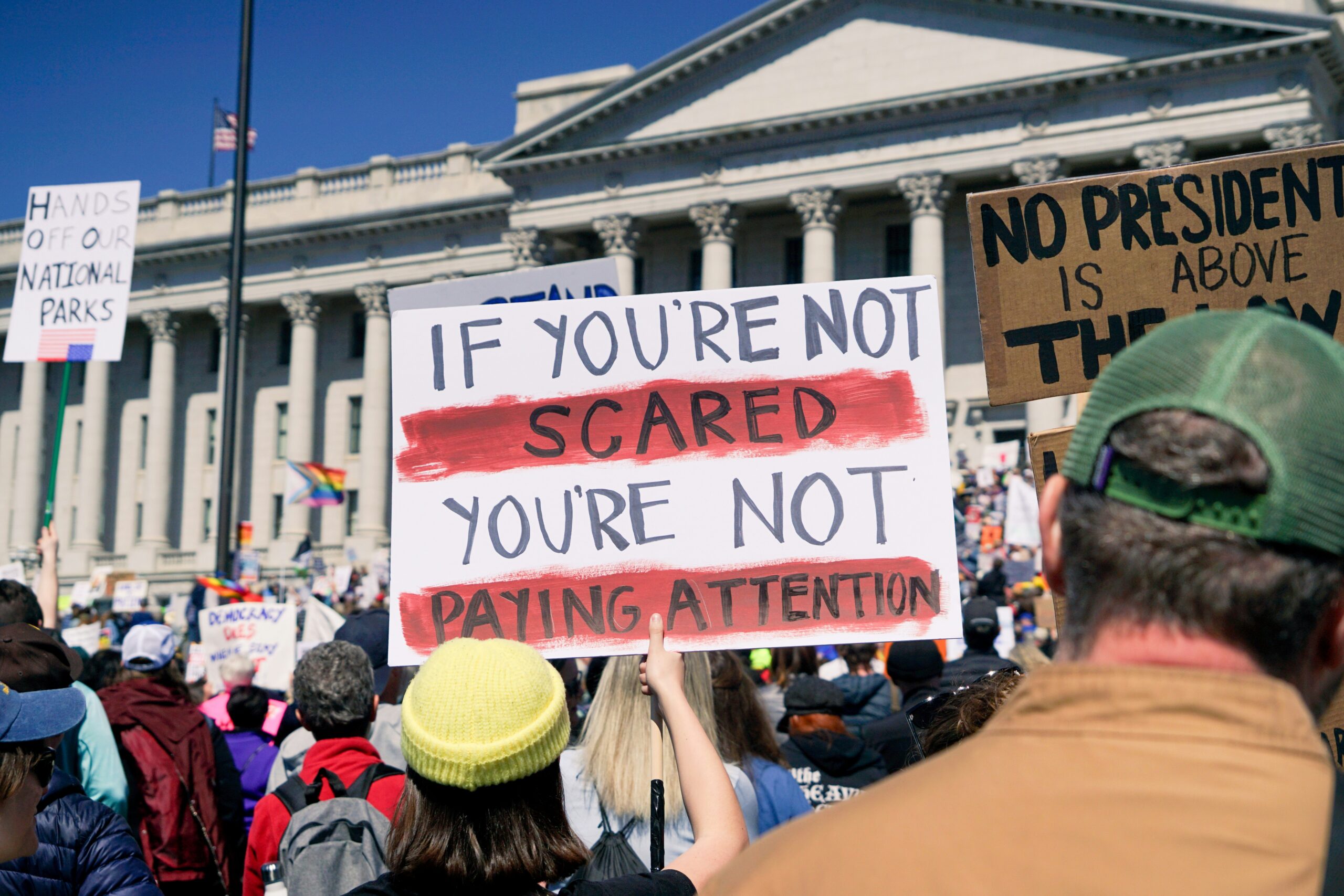
Alongside this institutional erosion, communities that openly embrace the symbolism and ideology of historical fascism have become more visible: mass fascist salutes in Rome, open praise of Hitler in public forums, marchers in American cities chanting “Blood and soil” — a direct translation of the Nazi slogan Blut und Boden. The first major expansionist ground war on European soil since World War II is underway. Strongman leaders around the world invoke idealized pasts and promise to make their nations great again.
What Fascism Isn’t — and Why That Matters
One of the clearest takeaways from this history is what fascism is not. It is not simply politics you dislike. It is not authoritarianism in general, though all fascism is authoritarian. It is not conservatism, though fascism often rides conservative anxieties into power. And it is not a fixed, rigid ideology in the way that Marxism or liberalism is. Paxton has argued that fascism is not really an ideology at all — it’s better understood as a loose collection of “mobilizing passions.”
What makes fascism distinctive is its method and its psychology: the glorification of violence, the myth of national rebirth, the demand for a singular leader, the contempt for democratic deliberation, the identification of scapegoated enemies, and — critically — the willingness to use democracy as a tool for destroying democracy. Fascism is willing to use democracy to destroy it, but it never cares about it.
This is why the debate over definitions, while sometimes frustrating, actually matters. Mabel Berezin, a sociologist at Cornell University, has argued that the word “fascism” carries a kind of “epistemic plasticity” — it bends to fit whatever the user wants it to mean, which weakens its analytical power. She suggests that, in the American context especially, focusing on fascism may obscure what is actually most dangerous: a distinctly American strain of nativism, unmoored from institutional structures, that threatens democratic norms in its own specific way.
In other words: the label may matter less than the underlying dynamics. And those dynamics — the erosion of rights, the consolidation of power around a single leader, the scapegoating of outsiders, the normalization of political violence, the alliance between nationalist movements and economic elites — are plainly visible in multiple countries around the world right now.
The Uncomfortable Lesson
Perhaps the most important lesson from the history of fascism is not about any particular leader or movement. It is about ordinary people.
Fascism did not succeed in Italy or Germany because a small band of extremists forced their will on an unwilling population. It succeeded because millions of ordinary citizens went along with it — some out of genuine enthusiasm, some out of economic desperation, some out of tribal loyalty, some simply because they didn’t think it was their problem. The business elites who funded the Blackshirts thought they were making a pragmatic calculation. The politicians who invited Mussolini and Hitler into government thought they were managing a threat. The citizens who voted for fascist parties thought they were choosing strength over dysfunction.
A Dutch political scientist named Rosan Smits, who has written extensively on the subject, has argued that fascism is less about one fixed ideology and more about a process that develops inside modern democracies — a process of gradually undermining democratic norms, dividing society into “the people” versus “the enemy,” and dehumanizing opponents. She stresses that this happens not only because of a small group of extremists, but because ordinary people go along with it.
That is the part of “never again” that tends to get overlooked. The phrase is usually aimed outward — at the specific horrors of the Holocaust, at the villains who perpetrated them. But its deeper meaning is a mirror: ordinary people, including ourselves, are capable of participation in collective moral failure. If we only see evil as something that belongs to others, we will fail to recognize the warning signs in our own societies — or within ourselves.
Domination, violence, and hierarchy are not exceptions in human history. They are the norm. For most of our existence, large-scale human organization has relied on force, fear, and inequality. The instincts of control, submission, and vengeance have not disappeared simply because we built parliaments and wrote constitutions. When we study fascism, what we are really confronting is the persistence of those instincts — and the conditions under which they reassert themselves.
No Final Word
This is not the final word on fascism. The experts themselves cannot agree, and they have spent their careers studying the subject. But there is one area where most of them converge: we do not have to wait for it to be 1933 again to notice that something is happening.
Because the point of understanding fascism was never to win arguments or to settle on an ultimate definition. It was to recognize the patterns — glorified violence, scapegoated enemies, mythologized pasts, complicit elites, dismantled institutions — and to call them out while it is still possible to do something about them.
History does not repeat itself, but it often rhymes. The question is whether we are paying close enough attention to hear it.
This article draws on reporting and expert interviews conducted by journalist Johnny Harris, as well as the scholarship of Mabel Berezin (Cornell University), Roger Griffin (Oxford Brookes University), Federico Finchelstein (The New School for Social Research), Timothy Snyder, William I. Robinson (UC Santa Barbara), Alexander Reid Ross (Portland State University), Umberto Eco, Robert Paxton, and Jason Stanley, among others. Data on global democratic trends from the V-Dem Institute’s Democracy Report 2025.