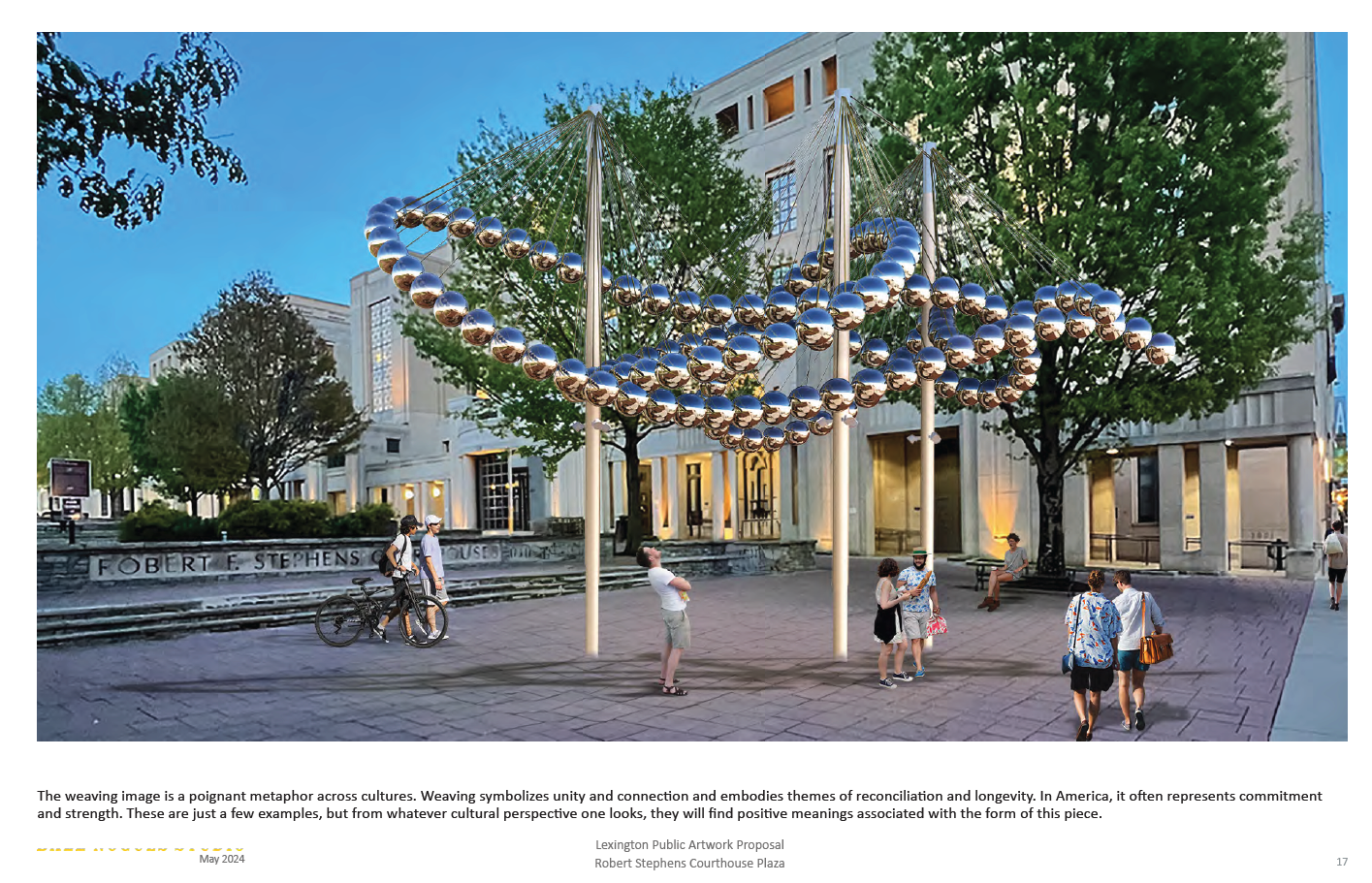
Lexingtonians have a beautiful way of processing our collective trauma. For the uninitiated: “anal beads” is what the internet has affectionately dubbed “A Common Thread” — the $900,000 mirror-polished sphere sculpture the city commissioned for Lexington’s 250th anniversary, now parked on the Robert F. Stephens Courthouse Plaza. The piece was funded out of 2023 bond money ($850K for the artwork, $50K set aside for future conservation). Reactions at the October dedication were, per local TV, “mixed.” Reactions on Reddit were somewhat less mixed.
A Reddit thread about a ZZ Top concert has become the clearest civic diagnosis Lexington has gotten in a while — and it deserves to be taken seriously.
On Sunday night, roughly 4,000 people squeezed into Gatton Park on the Town Branch to see Dwight Yoakam and ZZ Top kick off the new amphitheater’s summer concert series. On Monday morning, r/lexington did what r/lexington does: it produced the most accurate reporting on the show anyone is likely to file.
The headline complaint: fourteen porta-potties for a crowd of four thousand. The park’s permanent, flush-toilet bathrooms — the clean ones, with sinks — were reserved exclusively for VIP ticket holders. “I stood 40 mins in line to pee, and the line grew by 50% during that time,” K_money_twenty, the thread’s original poster, wrote. “This was mid-set. I imagine it was worse between sets. I don’t see how this passed any permitting.”
That question — how did this pass permitting? — is the one worth asking. But it’s not the only one.
The math was never going to work
The portable-toilet industry’s standard rule of thumb for events serving alcohol is roughly one unit per 50 to 75 attendees. For 4,000 people at a show running four-plus hours with beer and bourbon sales, that’s somewhere between 55 and 80 units. Gatton Park put out 14 — and then gated the real bathrooms behind a VIP wristband.
That isn’t a logistical hiccup. That’s a number so far outside the range of reasonable planning that someone, somewhere, made a conscious decision that this was fine. Either they ran the math and accepted what it meant, or they didn’t run it at all. Neither is flattering.
A commenter named Tubbyseth1 added the small, damning details: no toilet paper in the stalls, empty hand sanitizer dispensers, no hand-washing stations. An elderly cancer survivor with a destroyed bladder, according to the OP, showed up near the front of the line with a look of panic and had to be let ahead. “Whatever happened to ADA accommodations?” K_money_twenty asked. “Just because there is one ADA porta potty does not mean true accessibility.”
This, at a park whose own promotional materials lean heavily on the language of accessibility and community.
The pattern was predictable — and predicted
This wasn’t Gatton Park’s first show. It was, depending on how you count, maybe the second big stumble in a string of stumbles.
The park’s October 9 booking of Kansas, Jefferson Starship, and Molly Hatchet — a bill we described at the time as reading like the playlist at a 1983 Camaro meetup — was cancelled outright for lack of ticket sales. Two nights before the ZZ Top show, Gatton Park’s “Bloom” art launch pulled 500-plus people and provisioned a single food truck, which predictably ran out. “Seems like whoever is in charge is just bad at logistics in general,” one redditor wrote. “Here’s hoping they can get it together!”
LhendRusc, also in the thread, put a finer point on it: “And yet all of this was entirely predictable, based on past performance, before they even broke ground.”
The concert series is run by Oak View Group — the same company that already manages Rupp Arena, the Central Bank Center convention halls, and the Lexington Opera House under a multi-year contract with Lexington Center Corporation. This is not a first-time promoter feeling its way through a new market. OVG books arenas across the Southeast. Whatever happened on Sunday night happened on their watch and with their name on the marquee.
“Anal beads all the way down”
Somewhere around the 30th comment, a poster named billypilgrimspecker produced the line that is about to outlive the concert it described:
“Really it’s all just anal beads all the way down when you think about it. The wheel goes on and on, perpetually up and out our butts. The best thing we can hope for is just a spherical point of perspective both to and from our own buttholes. This town is all the way up its own ass.”
The reference, for out-of-towners, is to “A Common Thread,” the $900,000 mirror-polished sphere sculpture the city commissioned for its 250th anniversary and installed on the Robert F. Stephens Courthouse Plaza last fall. The piece was paid for out of 2023 bond money — $850,000 for the artwork, $50,000 reserved for future conservation. Reaction to its unveiling was, to use the phrase local TV stations kept reaching for, “mixed.”
The thread’s joke is that the beads are the city’s mascot now. Not because everyone actually hates the sculpture — plenty of people in the thread defended it, and the Gatton family’s philanthropy got a careful, fair hearing — but because the object itself has come to stand in for something larger. “Lexington is all about aesthetics with functionality taking a backseat,” wrote Lightning2671, in a comment that earned 11 upvotes and no meaningful rebuttal.
That’s the diagnosis. And once you see it, you can’t stop seeing it.
The amphitheater at Gatton Park doesn’t slope. This is the most basic design feature of any outdoor music venue — you elevate the back, or you elevate the stage, so people further away can see. Gatton Park did neither. Attendees reported that unless you were in the first two rows of your section, your view was blocked, and that people with paid seats ended up standing in the lawn areas or crowding the front. Observers on Manchester Street had a better sightline than ticket-holders. One person noted they watched the concert for free from outside the fence.
The amphitheater is beautiful. It photographs well. It just doesn’t work as an amphitheater.
The civic pattern
The thread kept drifting, organically, from the concert to everything else. To the city council’s December vote approving an $86 million, 35-year lease-to-own deal with the Lexington Opportunity Fund — a partnership of the Webb and Greer companies — for a new city hall on West Vine. To the winter road-salt debacle. To potholes and torn-up streets. To the homelessness the city appears more interested in fencing off than addressing. To the sculpture. Back to the bathrooms.
None of this is literally one story. Gatton Park is privately funded; 98 percent of the $55 million raised for it came from private sources, including the Bill Gatton Foundation’s $14.5 million gift. The sculpture was public money. The city hall deal is public money structured as a lease. These are different pots, different actors, different accountability structures.
But the civic texture is the same. It is the sense — and “sense” is the right word, because this is how citizens actually experience government — that the people making decisions about what Lexington looks like are not the same people who have to use what gets built. That things are designed for the photograph, for the ribbon-cutting, for the donor plaque, and then handed over to a public that has to figure out how to actually live inside them.
You can see it in the amphitheater with no slope. You can see it in one food truck for 500 people. You can see it in fourteen porta-potties and locked bathrooms. You can see it in a park whose stated values include accessibility and whose operational reality excludes an 80-year-old man with a medical condition from taking a dignified pee.
What permitting actually requires
Back to the OP’s question. Gatton Park is private property, but special events in Lexington still require a city-issued permit, coordinated through the Mayor’s Office of Arts and Culture. The application, which must be submitted at least 12 weeks out, explicitly asks for a “plan of action regarding waste disposal, toilet facilities, crowd control.” LFUCG reviews it. LFUCG issues it.
Either OVG submitted a sanitation plan that specified 14 units for 4,000 people — and the city approved it anyway — or OVG submitted a plan with more units and didn’t deliver. Both possibilities deserve a straight answer from the city. The public deserves to know what was promised on the permit and what actually showed up.
And if there’s a standing agreement that private venues get a lighter touch on special-event review because the land itself isn’t public, someone should say so on the record, because that’s a policy choice worth arguing about in public. Thousands of Lexingtonians paid real money on Sunday to attend a show where the city’s permitting apparatus apparently signed off on a sanitation plan that would embarrass a medium-sized county fair.
A modest suggestion
Rickbertelson’s comment in the thread is the most constructive thing anyone has written about Gatton Park in months, and it deserves quoting at length in spirit if not in letter: two to three times as many portable toilets, or open the permanent bathrooms to everyone and put the nicer festival-style trailers in the VIP tent. Don’t book an opener for ZZ Top — they’re ZZ Top. Don’t schedule a 50-minute stage change on a 50-degree Sunday night when you’ve advertised a 10 p.m. end time and there are elementary schools four blocks away.
These are not hard fixes. They require that the people running the park treat the audience as the point of the exercise rather than the revenue stream that funds the exercise.
The bones of Gatton Park are good. The Gatton Foundation’s gift was generous. The park, on a normal Tuesday, is genuinely nice to walk through. The 12 acres it occupies were, until recently, a parking lot, and a park is better than a parking lot almost every time.
But a downtown amphitheater that can’t seat its audience, serve its audience, or let its audience use the bathroom is not a community amenity. It’s a prop. And Lexington has quite enough props already.
As billypilgrimspecker observed: anal beads all the way down.
The Lexington Times requested comment from Gatton Park CEO Allison Lankford, but did not receive a response.