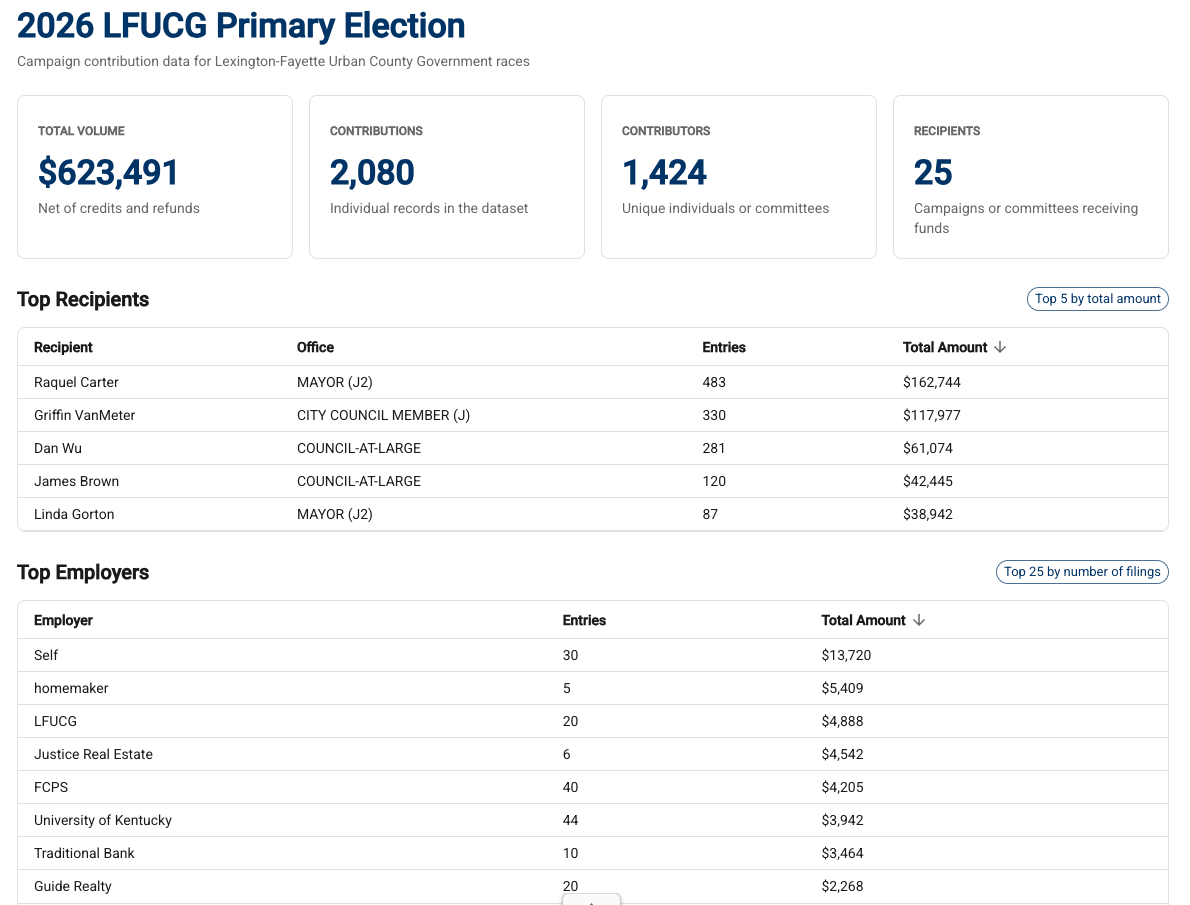
Published for the 2026 primary news cycle. Based on KREF 30-day pre-primary filings, data through April 19, 2026.
Every couple years, Lexington holds a municipal election. Most years, the council you wake up with on November 4 looks a lot like the one you had on November 3. Not this time. Seven sitting councilmembers aren’t running for re-election. The mayor’s office is being contested by a realtor who has already outraised the three-term incumbent by four to one. And three distinct coalitions are spending real money to capture a single open council seat on the city’s south side.
The state’s Registry of Election Finance released its 30-day pre-primary filings this week, and after a week of parsing the numbers, here’s what they tell us about who is trying to shape the next version of our city — and who might.
Most of what’s on your May 19 ballot is already decided
Here’s the part that confuses a lot of Lexington voters: despite all the signs in yards and the flurry of filings, only two LFUCG races are actually being decided in the May primary. The seven-candidate mayor’s race — where the field gets narrowed to two finalists for November — and the three-way contest for the open District 5 council seat. Everything else is either uncontested (five district seats have only one candidate) or will go straight to the November general election (all three at-large seats, plus six of the other district races).
So when you look at the money, you’re really looking at two different stories. Who is spending to win May, and who is quietly loading up for November.
The mayor’s race is an affordability-and-growth referendum in disguise
Raquel Carter, the challenger, is sitting on $162,744 raised. She owns Guide Realty, she’s 51, and she’s made expansion of Lexington’s urban service boundary — the line that separates the city from the surrounding Fayette County farmland — the central pitch of her campaign. Her donor file shows 448 individual contributions averaging around $235, plus roughly $52,000 of her own money. That’s the profile of someone running an insurgent campaign with real reach into working- and middle-class Lexington.
Linda Gorton, the two-term incumbent, has raised $38,942 — nearly all of it in the last month. For most of the cycle, she hadn’t actively fundraised at all, which itself was a story. Now that she has, her donor list reads like a directory of the people who build and own real estate in Lexington: Landscapers Corner, Red Draw Development, Anchor Properties, Rouse Properties, Kirkpatrick & Co. She also collected a $2,200 max-out from retired Kentucky Supreme Court Justice Laurance VanMeter — a detail worth circling, because the VanMeter name shows up in several other races too.
Five other candidates — Greg O’Neal, C.E. Huffman, Rama Asmani, Skip Horine, and Darnell Tagaloa — are also on the May ballot, but none have reported meaningful fundraising. Unless the primary shakes loose a surprise, we’re heading toward a Carter-Gorton November.
What’s actually at stake is this: the urban service boundary process was just overhauled in February, and an EHI Consultants study pegs Lexington as 22,000 housing units short. Carter wants to build out. Gorton’s donor base largely represents the people who would profit most from either outcome. The 2026 mayoral race is, in practice, a referendum on how Lexington grows — and whose friends get to grow along with it.
The only open-primary council race: District 5
Liz Sheehan announced in December she would not seek re-election, pointing at council pay as a barrier that shapes who can even run. Three candidates now want her seat, and they represent three completely different slices of Lexington.
Stephenie Hoelscher leads the pack at $26,430. She’s a former journalist and runs her own policy consulting firm. Her donors include Adam Edelen of Edelen Renewables, Holly Harris Vonluehrte of Arnold Ventures, and Billy Justice of Justice Real Estate. Plus Griffin VanMeter — more on him in a minute. Call this the progressive-policy coalition.
Michael McLaughlin comes in at $19,918. He’s a tech services executive. His donor list is old-line corporate Lexington: three members of the W.T. Young LLC family combined for $4,200, physicians from Retina Associates, executives from Alliance Resource Partners. Call this the legacy-Lexington coalition.
Nicholas Wolter has $16,189. He’s a home builder running for office for the first time. His donors are local builders and developers — Biller Homes, Sunshine Properties, Back Construction, Rouse Properties, Atchison Construction. Call this the construction-trades coalition.
Three candidates, three distinct donor networks, all above $16,000 on the same ballot line. It’s arguably the most interesting single contest of the cycle — whoever doesn’t make the top two on May 19 tells us a lot about which Lexington coalition has lost a seat at the table.
The November races where the money already tells you who’s winning
District 3 — Griffin VanMeter’s $118,000 single filing. This is the largest district-level haul of the cycle, by a lot. VanMeter is the co-founder of Kentucky for Kentucky and a co-leader of 2024’s successful Yes for Parks ballot initiative. His donors are a bluegrass-legal-equestrian roll call: Helen Alexander of Airdrie Stud, multiple law firms, multiple members of his own family, farm operators. His November opponent is former County Judge Executive Jon Larson — who has reported zero fundraising. That gap will narrow or it won’t; right now it looks like a rout in progress.
District 11 — Richard Moloney is back. Jennifer Reynolds is retiring after seven years. Moloney served seven terms in the 11th and two at-large, totaling more than 20 years on the council. He’s at $22,225 in this report, backed by engineers at Precision RMJE, developers at BrettCon, a bank CEO, a Commerce Lexington executive. His opponent Cassandra Vogl reported $1,350. This is an experienced-hand-returns story, running against a fundraising mismatch of about 16 to 1.
District 6 — the sleeper surge. Both candidates are newcomers — the incumbent isn’t running. Tina Bryson went from $537 in December to $15,371 now, a jump of almost $15,000 in a single reporting period. It’s a mix of family giving, local business owners, and labor money. Her November opponent Tyler Pyles also just filed, at $3,888. Worth watching as the money develops.
District 4 — a rematch, in miniature. Incumbent Emma Curtis has raised a very small $2,907 — but across 48 individual contributions averaging about $60 each. It’s the textbook small-dollar profile, with donors connected to LIUNA Local 189, Habitat for Humanity, software companies, and social service work. Her opponent Brenda Monarrez — who held this seat before Curtis — has reported a single $1,000 gift. The money is small. The underlying donor patterns are very different, and will tell a clearer story as November nears.
What to watch: four threads worth pulling
The VanMeter constellation. Griffin VanMeter is running in District 3 with $118K. He also gave $1,000 to Hoelscher in District 5. His family member Jane VanMeter maxed out to Hoelscher as well. And retired Justice Laurance VanMeter maxed out to Gorton for mayor. One family shows up on at least three campaigns — it’s the clearest cross-race pattern in the data.
Development money is consolidating. Gorton (mayor), VanMeter (D3), McLaughlin and Wolter (D5), Moloney (D11) — five campaigns across five races are pulling from overlapping real estate and construction networks. If the 2026 campaign becomes about how and where Lexington grows, this coalition will move together.
Grassroots is alive, but it’s split three ways. Herbert Lynn (running at-large) reported 169 individual contributions averaging about $50 — the highest donor count in the whole dataset. Emma Curtis in District 4 runs a similar operation. Dan Wu, the incumbent Vice Mayor defending his at-large seat, has 281 individual donations — many of them max-outs from small business owners across immigrant- and new-American Lexington. Three different theories of how grassroots wins in 2026.
The missing candidates. Jon Larson (D3), Matt Miniard (D9), Tray Hughes (D8), and incumbent Amy Beasley (D8 herself) have all reported exactly zero fundraising.
Why this matters for you
The 15-member Urban County Council sets your property tax rate, approves your police and fire budgets, decides whether the city expands outward or builds upward, and rules on every zoning dispute in your neighborhood. Because seven members are leaving at once, the council you get after November will look fundamentally different from the one you have now — and the money being raised right now is the clearest tell we have about whose vision of Lexington each candidate will bring into the room.
Primary day is Tuesday, May 19, 2026.
This post is based on Kentucky Registry of Election Finance filings pulled on April 19, 2026. A few candidates may file late and shift the numbers. We’ll update as the 15-day pre-primary and pre-general reports come in. You can explore the underlying data yourself at our campaign finance dashboard.