This is Off-Beat: a slow read of a public record. Today’s record is a committee transcript — the General Government and Planning Committee of June 2, 2026 — and the distance between what one council member said about data centers and what her own city had already put on paper.
The first presentation on the June 2 agenda was Lexington’s new artificial-intelligence policy. The council member who sponsored it opened by arguing against it.
“I have profound concerns about A.I.,” Council Member Emma Curtis told the committee, listing “the devastating environmental impacts, the threat to data security, and the means by which it has been forced into everyday life by a handful of billionaires and corporations.” She quoted Pope Leo on the need for “robust legal frameworks, independent oversight, informed users.” Then she got to the part that does not usually make it into a policy rollout from the policy’s own sponsor.
“At my core, I believe that A.I. has far greater potential for collective harm than collective good.”
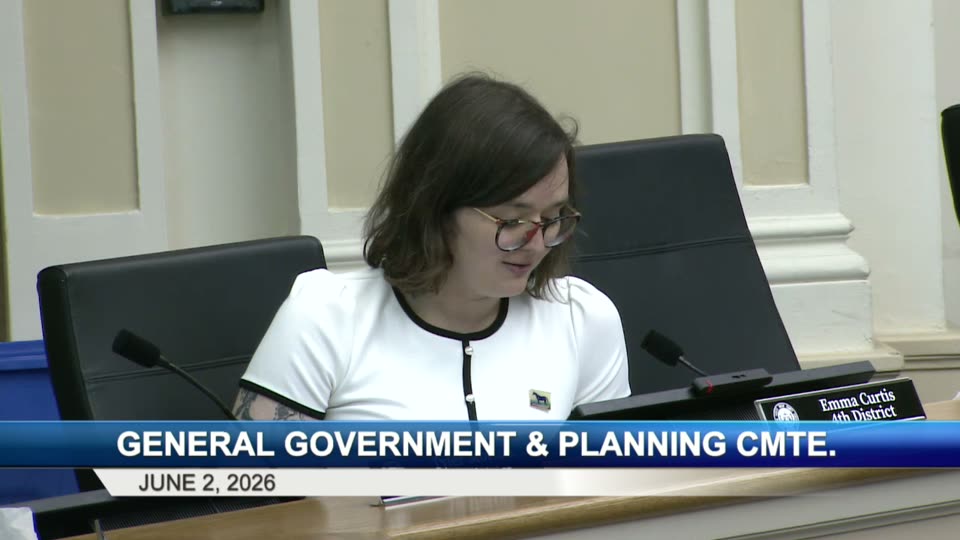
She was candid about the tension. “I sponsored this item and I’m proud to champion this policy, not because it wholly aligns with my personal belief — if you can’t tell, it doesn’t align with my beliefs,” Curtis said. “But I know these technologies exist and it’s no longer possible for us to avoid their existence.” The framing was harm-first and abstract: billionaires, the environment, the inevitable. The Pope made an appearance. The actual Lexington zoning code did not.
What the policy actually does
The policy under review was not new. The city’s Department of Information Technology adopted it in October 2025, and June 2 was a review, not a vote — “an overdue start,” as Curtis put it in her closing, “to a necessary conversation.” No legislative action was on the table.
Chief Information Officer Rogers walked the committee through the mechanics, and the mechanics were unglamorous. The governing rule, she said, is “human accountability always forever — that’s human in the loop.” Sensitive data is fenced off: “No sensitive data is to be used [or] employed without approval. You cannot feed anything sensitive or anything specific into these tools.” The city manages by exception — every use case submitted in writing, approved or denied in writing. It plans to block consumer tools like the public version of ChatGPT now that it has an enterprise standard. It assumes “all activity is monitored and logged.”
The rollout was equally earthbound. A “Copilot flight school” offered an hour of basic training to every employee outside public safety; 324 people enrolled, about 10 percent of the workforce. The city joined the GovAI Coalition, a government group started in San Jose, and a 10-city cohort run through Knight and Harvard. When Council Member Sevigny asked the obvious vendor question — what about Flock, the cameras, the cloud contracts — Rogers had a concrete answer: vendors are contractually barred from switching on new AI features “without our consent.”
This is what taking AI seriously looks like when it is someone’s actual job. It is procurement, ticketing, and a training intranet. It does not quote the Pope.
The data center nobody named
Curtis closed with a wider warning. “Our constituents have legitimate concerns about the rapid proliferation of data centers across the commonwealth in our country,” she said. “I share those concerns, and that is a part of the conversation that we are anticipating having in the near-term future.”
Anticipating. Near-term future.
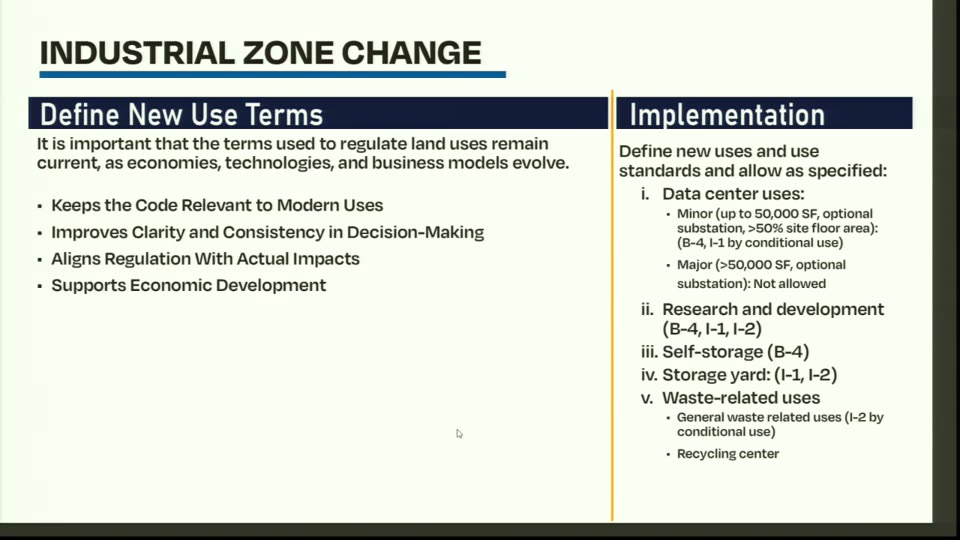
Here is what was already in front of the city on June 2. Since April 30, the Planning Commission had been workshopping a draft zoning code — part of the Blue Sky Small Area Plan, the long-range plan for the 303-acre industrial area near I-75 and Athens-Boonesboro Road — that would, for the first time, define “data center” in Lexington’s ordinance and then sharply restrict it. The Lexington Times had covered the draft twice, on May 3 and May 28. It is, by the consultants’ own description, one of the most aggressive municipal data-center policies in Kentucky.
The draft, presented by Caleb Rosico of consultant TSW, splits the use in two. A “minor” data center — under 50,000 square feet — would be allowed in the B-4 and I-1 districts by conditional use permit only. A “major” data center would not be allowed anywhere. Commissioner Frank Penn pressed the point at the May 21 work session: “Anything greater than 50,000 square feet would be prohibited, period.” Rosico’s answer was one word. “Countywide.”
By the same meeting, the draft had grown teeth specific to Fayette County. The consultants added a 1,000-foot buffer barring data centers near Agricultural Rural land outside the Urban Service Boundary — a setback Rosico credited to “a wonderful comment by [Commissioner] Worth at the last meeting because of the impacts that noise can have on the equestrians.” Heavy-industrial I-2 zoning was considered as a home for the use and rejected, because “there is very little I-2 in Fayette County that would meet the distance requirements from residential.”
And it was on a calendar. The same May 21 session pushed the Blue Sky public hearing from May 28 to June 11 — the close of the Planning Commission’s Subdivision Items meeting — so commissioners could read the full redline. June 11 is nine days after Curtis described the data-center conversation as something Lexington was anticipating having in the near-term future.
The person at the June 2 table who said any of this out loud was not the policy’s sponsor. It was the committee chair, Liz Sheehan, who delivered the update at the end of the agenda: “The Blue Sky small area plan is on our agenda for our next meeting in July… The consultant working with LFUCG on the Blue Sky plan is recommending some updates to our industrial code… updating zones B-4, I-1 and I-2. And some of those revisions do pertain to data centers.”
Zones. A consultant. A draft. A date.
What’s actually new
The recycled-versus-new split is the whole story here. The AI policy was eight months old. The Pope’s letter and the worry about billionaires are imported from a national argument that, by June 2026, you could hear on any podcast. The genuinely new local instrument — the thing with a hearing date, a square-footage cap, an equestrian buffer, and a countywide prohibition — was the one that went unmentioned by the member who raised the subject, and named plainly by the one running the meeting.
Sheehan had set the through-line earlier, when the conversation was still about Copilot. “I’m never afraid of technology or the tool,” she said. “What is important to us is creating the guidelines, the safeguards, the accountability — who has access to it.” She reached the same place Curtis did — guardrails, oversight, public trust — without the apocalypse. She also reached for license-plate readers and an actual zoning draft instead of the commonwealth and the Pope.
None of this makes the national alarm baseless. The week of the meeting, residents in Boyd County were packing a convention hall over a $14 billion data center; the Kentucky Center for Economic Policy was questioning a 50-year sales-tax exemption with no approved projects to show for it; the fight had reached the U.S. Senate. Fayette County is one of seven named in the state’s 2025 data-center incentive statute. The concern is real, and Curtis is the member who put the AI policy on the agenda in the first place — that is worth keeping in view.
But the record is the record. When a council member told her colleagues that data centers were a problem for the near-term future, the local handle on that problem already had a square footage, a setback measured in feet, a list of zones, and a Thursday. The chair was the one holding it.
This is Off-Beat, a Lexington Times column that reads the public record slowly.
This column was drafted with AI assistance (claude-opus-4-8) and finalized for publication by The Lexington Times. Reporting is grounded in the LFUCG Granicus video and machine-generated transcripts of the General Government & Planning Committee (June 2, 2026, clip 6787) and the Planning Commission Work Session (May 21, 2026, clip 6776), cited inline; quotations were verified against those transcripts with light copy-edits for readability. Screenshots are frames from the LFUCG Granicus recordings captured June 3, 2026.
Republishing: This is original Lexington Times reporting, licensed under Creative Commons CC BY-ND 4.0. You may republish this article, in full and unaltered, for free — including commercially — with credit to The Lexington Times and a link to the original.